





 Portuguese
  English
  Spanish
 5 min of reading
  4 comments


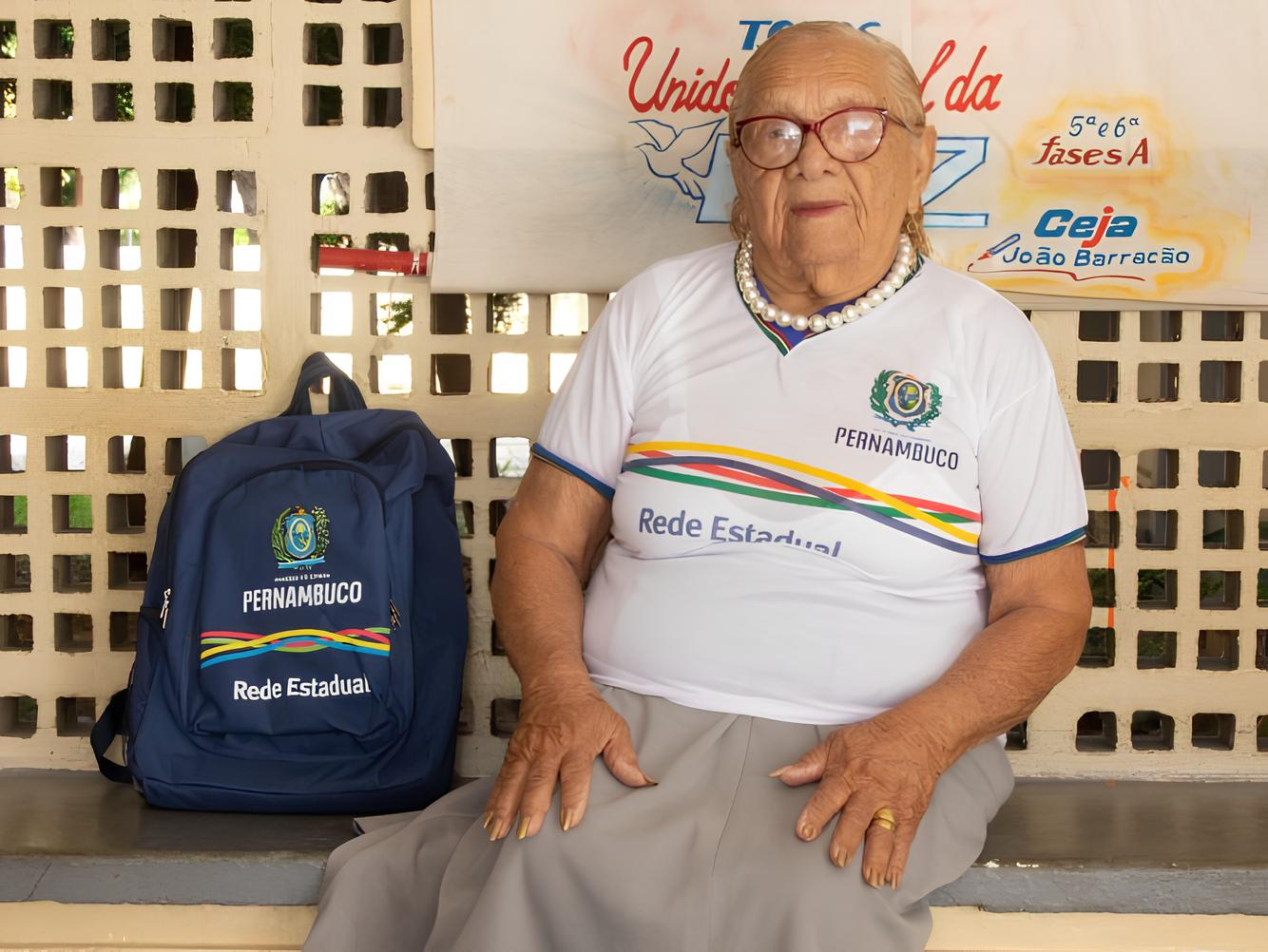


At 94, Dona Edelzuíta Returned to Studying After Being Prohibited in Childhood. A True Story Exposes Historical Exclusion and Rekindles Debate About Education in Brazil.
Published first on September 6, 2023, by the Terra portal, the case of Dona Edelzuíta breaks a logic that has crossed generations in Brazil: the idea that studying has a certain age and that, for some people, this right simply never existed. At 94, she returned to the classroom, officially becoming one of the oldest active students in the country and reigniting a deep debate about education, gender, historical exclusion, and lost time.
The story gains even more weight when one knows the starting point. In her childhood, Dona Edelzuíta was prohibited from studying by her own father, who believed that school would make her learn “to write for boyfriends.” The decision interrupted her literacy and delayed for almost a century a simple wish: to learn.
Childhood Marked by the Prohibition of Studying
Dona Edelzuíta was born in a rural and deeply conservative Brazil, where female education was viewed with suspicion. For many families, school was not a place for girls. It was considered a threat to customs, paternal authority, and the traditional role of women.
-
Man never set foot on the Moon? 5 scientific proofs confirm that humanity has been there and definitively dismantle conspiracy theories.

-
The Brazilian Army will adopt humanoid robots to test the concept of future combat, says a website, surprising everyone, but later revealing that it was all just an allusion to April Fool’s Day.

-
There is a city in China right next to Hong Kong where people speak Portuguese, the streets have names in Portuguese, and the architecture looks like it came straight out of a historic city in Brazil.

-
Rare frog thought to be extinct after only appearing in fossils reappears, becoming a ‘living relic’ of evolution and gaining a real path to spread after combating introduced predators.



In her case, the prohibition came early and was definitive. Her father decided that studying was unnecessary — and could even be dangerous. The phrase quoted by the Terra portal, “learning to write for boyfriends,” summarizes a mentality that condemned thousands of women to functional illiteracy throughout the 20th century.
Without school, Edelzuíta grew up, worked, raised a family, and aged carrying a silent absence: that of never having had access to formal knowledge.
Decades Away from the Classroom, But Not from the Desire to Learn
Even away from school, the desire to learn never disappeared. Throughout her adult life, Dona Edelzuíta lived with practical limitations imposed by the lack of full literacy: difficulty with documents, restricted reading, and constant dependence on others for simple tasks.
Still, according to reports, she always repeated that she “wanted to study.” A desire that, for a long time, seemed impossible — whether due to age or the socially diffused idea that “it’s too late already.”
This is a central point of the story: educational abandonment was not a choice, it was an imposition. And the return, almost a hundred years later, is an act of personal reparation.
The Return to Studies at 94
Already in her 90s, Dona Edelzuíta made a decision that surprised family members, educators, and classmates: she officially returned to studying through youth and adult education. Not as a symbol, not as a visitor, but as a regular student, with a notebook, assignments, and evaluations.
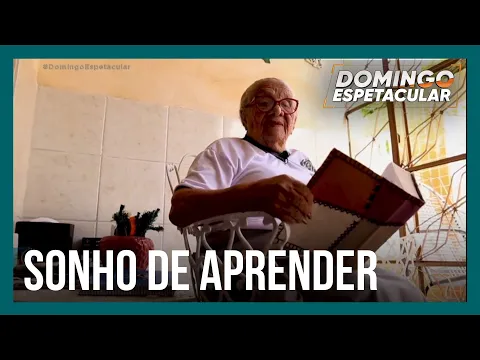
Inside the classroom, she began to coexist with students of different ages, many under a third of her age. Still, reports indicate that she quickly stood out for her discipline, attention, and respect for the school environment.
The presence of a 94-year-old student altered the dynamics of the class. Teachers began to use her journey as a living reference of the value of education. Younger students began to take their studies more seriously.
When Studying Becomes an Act of Historical Resistance
The case of Dona Edelzuíta is not just an inspiring story. It exposes a structural problem in Brazil: millions of elderly people have been deprived of education for cultural, economic, and gender reasons.
For decades, especially in rural areas, girls were taken out of school to work, take care of the house, or simply because “they didn’t need to study.” The late return of these individuals to education reveals a historical debt that the country is still trying to correct.
By sitting back at a school desk, Edelzuíta is not just learning. She is breaking a cycle of exclusion that has crossed generations.
The Plan to Go Beyond: The Dream of College
One of the aspects that stands out most in the case is that the return was not seen as a final point. Dona Edelzuíta expressed the desire to continue studying and, if possible, enter higher education.
Even if the plan seems unlikely under a purely statistical logic, it carries enormous symbolic weight. It represents the idea that learning does not end with age, but only when the individual no longer wishes to learn.
Educators involved report that her enthusiasm contrasts with the early dropout of many young people, showing how the value of education changes when it is denied for a lifetime.
The Social Impact of a True Story
Stories like that of Dona Edelzuíta gain repercussion because they touch on something collective. They speak not only of individual overcoming but of structural injustices, of denied opportunities, and of choices that were never made.
At the same time, the case raises an uncomfortable reflection: how many people never had the chance to return? How many died without learning to read because they heard, too early, that studying “wasn’t for them”?
Dona Edelzuíta became news because she returned. But millions were left behind.
A Direct Message to Brazil
At 94, upon returning to school, Dona Edelzuíta sends a powerful message to a country that still grapples with school dropout, functional illiteracy, and devaluation of education.
She shows that learning has no age — but also highlights that no one should need to wait nearly a century to exercise this right.
More than an inspiring story, her case is a mirror of everything Brazil needs to correct when it comes to education, equality, and access to knowledge.







Valeu Edelzuita, mostra para todos e todas que dizem: sou muito velho ou velha para fazer qualquer coisa porque passou da idade, inclusive estudar. Parabéns
Essa história é inspiradora? Sim. Exemplo para muitas pessoas? Sim. E é lógico que a dona Edelzuita está animada para, se possível, (conforme a reportagem apontou) encarar uma faculdade. No entanto, sabemos que a régua sobe um pouco, e as cobranças de trabalhos e TCC exigem não apenas intelecto, exige bastante agilidade. Impossível não é, mas tem que ter um grande propósito.
Ela já é vitoriosa, mesmo sem faculdade ou TCC. Parabéns D. Edelzuita.
Planeja faculdade?