





 Portuguese
  English
  Spanish
  5 min of reading
  10 comments


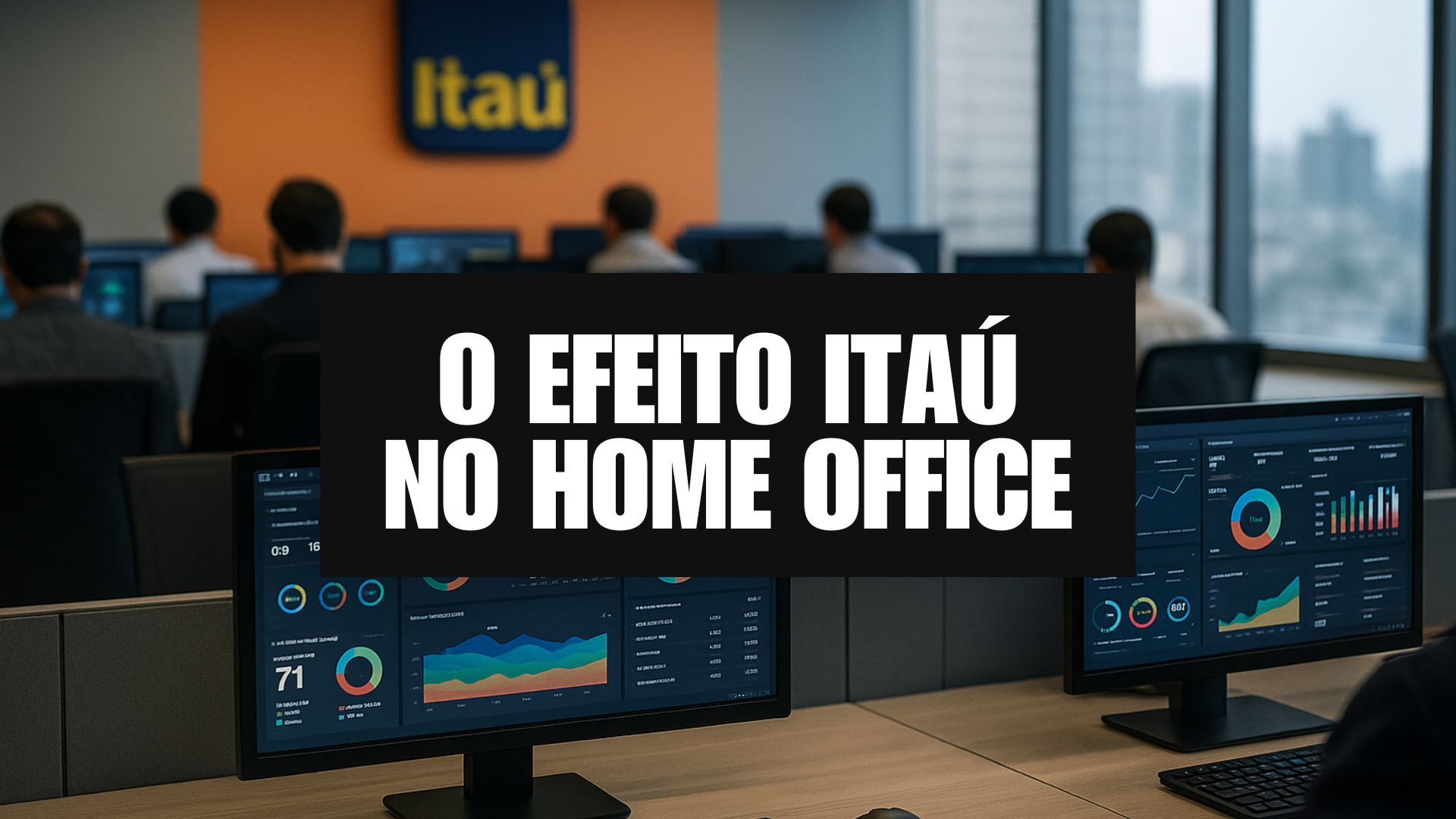


Monitoring Software Advanced During Remote Work And Now Dominates In-Person Offices. The Practice Promises Productivity Gains But Raises Legal, Ethical, And Economic Questions Being Debated Among Experts And Companies.
The dismissal of hundreds of Itaú employees for alleged low productivity in remote work, reported in September, brought to the forefront a phenomenon that had been consolidating since the pandemic: the use of monitoring software to measure activity and performance, both in remote and in-person settings.
Market research cited by consulting firms indicates that most large corporations already adopt some degree of digital tracking, and more sophisticated tools can record everything from app openings to keystrokes and periods of inactivity.
Although the promise is efficiency, experts interviewed by industry sources warn of financial costs, organizational impacts, and legal risks that grow at the same speed as technology does.
-
Inflation in March reaches 0.88% according to IBGE and pressures the Brazilian economy, impacting family budgets and requiring more strategic decisions to maintain financial control.

-
In Paraná, distributor Pacto connects 100% of the load in Coronel Vivida to batteries: a BES of 10 MW and 20 MWh costs just over R$ 30 million and lowers the local tariff now.

-
With a dependence of up to 80% on gas imported from the United States, Mexico is responding with a robust energy strategy, betting on shale gas, creating a scientific committee, and preparing to expand natural gas production to reduce vulnerability and strengthen its energy security in the coming years.

-
The United States proposes to Brazil a critical minerals agreement with a minimum price to combat Chinese dumping and priority for investment, but the Planalto is blocking the signing out of fear of upsetting China and due to electoral calculations in a year of competition.

The incident involving the bank raised alarms in HR, legal, and compliance departments regarding limits, proportionality, and transparency in data collection.
How Digital Monitoring Works In Companies
The suite of available tools has evolved rapidly.
There are software capable of logging clicks, keystrokes, active screen time, use of corporate programs, email accesses, and browsing.
Dashboards and dashboards gather real-time indicators and feed KPIs used in evaluations and management decisions.
According to Paulo Castello from Fhinck, the main change is that “companies have started using data to make more informed decisions,” which includes promotions and, in extreme cases, layoffs.
This layer of measurement is not limited to remote work.
“The employee’s location does not change the company’s technical ability to monitor the use of corporate email, internet browsing, or the use of work programs,” says Stephanie Almeida from Poliszezuk Lawyers.
In her assessment, the return to the office should not stop monitoring; it should just shift its focus.
Costs And Economic Impact Of Digital Surveillance
In addition to investment in culture and processes, there is the monthly technology bill.
Licenses for digital surveillance vary, on average, from R$ 50 to R$ 160 per employee per month, a burden that weighs more heavily on the budget of SMEs than on large groups.
At the same time, the global market for productivity software has been expanding revenue and maintains the office segment as the growth engine, with billion-dollar figures estimated by market data platforms.
The discussion, however, does not end with price.
Organizations report gains in control and standardization of processes; on the other hand, recent academic studies link intensive surveillance to stress, decreased satisfaction, and less autonomy, factors that can impact performance.
In practical terms, the dilemma is clear: more is spent to monitor, but the return does not always come in the form of net efficiency.
What Labor Legislation And The LGPD Say
Under Brazilian labor law, there is no expectation of absolute privacy in the workplace.
Lawyer Fábio Monteiro from Pellegrina e Monteiro notes that monitoring the location, searches, and control of telematic means such as emails and work phones are possible.
<p“Other countries, such as Portugal, have integrated their data protection laws into labor codes, which has not yet occurred in Brazil,” he states.
The LGPD imposes limits.
Fábio Chong de Lima from L.O. Baptista advises that companies provide the equipment so that monitoring is restricted to corporate devices and follows three pillars: legitimate purpose, transparency, and necessity.
Data collection cannot access private messages or personal data without legal basis, and monitoring audio or video in the employee’s home is considered highly intrusive.
In courts, there is still a lack of consolidated jurisprudence on the extent of monitoring.
Exaggerations can result in damages for moral damages, labor lawsuits, and challenges based on the LGPD.
Meanwhile, abroad, there are movements for more explicit regulation: New York requires formal notification to employees about monitoring practices, and European authorities reinforce requirements for transparency, minimization, and impact assessment.
Telework As An Extension Of The Work Environment
From a legal perspective, telework is an extension of the work environment.
It is the employer’s responsibility to provide tools and establish clear rules via contract or internal policy.
Monteiro points out that productivity metrics are subject to monitoring, as long as they are limited to the work context.
In cases of abuse, employees can request access to data, contest methodologies, contact unions, and seek Labor Justice.
For lawyer Stephanie Almeida, three principles should guide any policy:
- Clearly Defined Purpose.
- Proportionality in the technique used.
- Transparency with acknowledgment terms or contract addendum.
Without prior communication, the data may be rendered unusable as evidence and generate liability.
How Workers Should Protect Themselves
Basic rule: corporate equipment for corporate purposes.
The first step is to understand the internal policy and act with the awareness that activities on company devices can be monitored.
If there is a perception of privacy violations or excessive collection, the guidance is to store evidence, seek legal assistance, and if applicable, communicate through a union representative.
Governance And Ethics In Technology Use
Management specialists advocate taking the issue out of the strictly technical realm.
According to Sérvulo Mendonça of holding SM, monitoring needs to align compliance, LGPD, and ethics.
The critical point, he says, is whether the employee was informed and how the data is used.
Psychologist Daniele Marques from Protagonist sees greater maturity in the use of dashboards and indicators, but believes that success depends on combining data with a human interface, transforming metrics into objective feedback and development practices.
Technical Risks And Internal Threats
The attack surface is not theoretical.
Internal incidents remain relevant, and experts estimate that a significant portion of breaches results from employees, contractors, or executives, whether intentional, accidental, or through negligence.
In Brazil, the average cost of a breach reached R$ 7.19 million in recent studies, pushing organizations to reinforce controls, including during termination processes.
“Without transition plans and adequate monitoring, those leaving can become a latent threat,” warns Thiago Guedes from DeServ.
High-profile cases involving frauds with Pix and alleged insider participation illustrate the gray area between human error and malfeasance.
The message to companies is twofold: calibrate monitoring to mitigate risk without crossing the line of privacy invasion.
The Impact Of The Itaú Case On Corporate Culture
The Itaú incident has become a symbol of a new corporate struggle: how to measure performance without reducing work to telemetry of clicks and keystrokes.
For headhunter Diego Rondon, the message is that the “era of naivety” regarding presence and visibility is over, but productivity requires environment, clarity, and autonomy.
Without this, he says, trust erodes, and organizations lose good people just when they need to retain talent.
The question, therefore, shifts from whether technology can monitor to how and why to monitor.
With public rules, metrics aligned with function, and effective governance, companies tend to reduce litigation and maximize benefits.
There remains a question that the case has exposed: Is it possible to scale the use of data for management without undermining the trust that sustains long-term productivity?









Complicado, aqui claramente existe uma gestao ineficiente e falha, onde nao importa o que o funcionário entrega e sim a quantidade de cliques que ele da no teclado e no mouse.
Onde está o planejamento de metas, o alinhamento de entregas e sobretudo a transparência ?
Se cada um cumprisse a sua obrigação no seu trabalho de forma honesta não precisaria disso mas as pessas adoram serem espertas…
Sai do fake Itaú! Parabéns mano continue se esforçando pra garantir a viagem pra Disney de seu patrão final de ano e ainda condições insalubres no trabalho. So gente dominada pelo sistema defende empresa multimilionária!
Demitiram junto um profissional que estava há mais de 15 anos na empresa, não tiveram tempo de conhecer a índole desse profissional?
No caso do Itaú, a alegação de que monitoraram por alguns meses, verificando no período uma produtividade aquém do esperado, pergunto: por que não fizeram intervenção? não havia nenhum líder para corrigir tal desempenho? teria tido o Banco prejuízos então? Acho tudo muito estranho: uma chefia esperar meses para alertar o funcionário quanto ao seu rendimento. Se o Banco tolerou baixo rendimento ao longo de meses, pode-se deduzir, no mínimo, que o posto de trabalho era desnecessário (?)
Acho que o Itaú errou tanto com os seus funcionários quanto com o seu público. Propaganda em horário nobre com toda uma atmosfera de gentileza não recupera uma imagem institucional arranhada. Finalizando, que falta fazem um bom RH bem como uma área de endomarketing, que cuidem dos seus clientes internos, seus funcionários!
Eles devem ter percebido quem usava software e hardware para burlar detecção e mandaram os malandros embora.
Você só pode ser empresário pra pensar uma coisa tão **** assim