





 Portuguese
  English
  Spanish
  3 min of reading
  0 comments


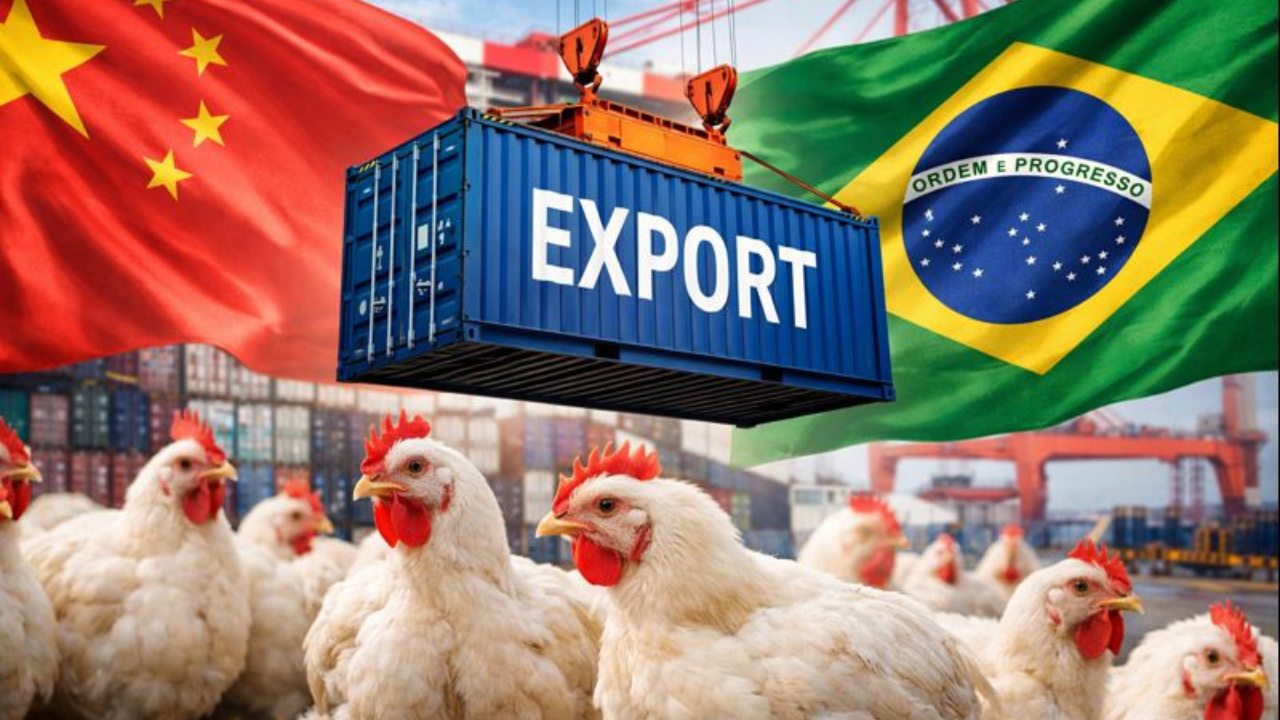
Chicken Exports from RS Are Allowed After China Lifts Embargo Due to Newcastle Disease in Commercial Farm.
The export of chicken from Rio Grande do Sul to China will be resumed after Chinese authorities end the safety embargo imposed in 2024.
Thus, the decision came after the completion of a risk analysis that confirmed the control of Newcastle Disease in the state.
The announcement was formalized in January 2026 and ends a period of one year and six months of trade restrictions, which directly impacted the southern Brazilian slaughterhouses and the flow of Brazilian exports to the Asian market.
-
Middle East War Hits Fertilizers and Transportation and May Strain Brazilian Wallets
-
Russia Considers Suspending Gas to Europe After Surge in Energy Prices
-
How A War Thousands of Miles From Brazil Started Disrupting Global Shipping Routes, Raising Container Costs, and Putting Up to 40% of Brazilian Beef Exports at Risk
-
Iran-U.S. War Drives Up Oil Prices and Pressures Global Financial Markets

China imposed the restriction in July 2024 when officials identified an outbreak of Newcastle Disease in a commercial farm located in the municipality of Anta Gorda in the interior of Rio Grande do Sul.
In light of the case, the Chinese government immediately suspended chicken meat purchases originating from the state, following its health protocols to protect the poultry population.
China’s Decision Ends Safety Embargo
The General Administration of Customs of China (GACC) officially communicated the end of the safety embargo.
Then, in a document published on January 16, the Chinese customs authority confirmed the resumption of purchases after concluding the technical evaluation.
“Based on the results of the risk analysis, China lifts the restrictions related to Newcastle Disease in Rio Grande do Sul as of the date of this communication,” states the GACC text.
According to Brazil’s agricultural attaché in Beijing, Leandro Diamantino Feijó, the process now enters the operational phase.
“In the coming days, GACC will reactivate the licenses of the slaughterhouses that were embargoed,” he explained.
Direct Impact on Southern Brazilian Slaughterhouses
Despite the official announcement, the practical release of sales still depends on technical adjustments in the Chinese system.
Thus, by early afternoon on the day of the announcement, the GACC platform still had eight southern Brazilian slaughterhouses under commercial restrictions.
Among the impacted units are plants from BRF and JBS, as well as slaughterhouses from the companies Minuano, Agrosul, Aurora, and Languiru.
The sector projects a gradual normalization as China reinstates industrial licenses.
Ministry of Agriculture Confirms End of Restrictions
The Ministry of Agriculture assessed the decision as strategic for Brazilian foreign trade.
For the Secretary of Commerce and International Relations of the Ministry of Agriculture and Livestock (Mapa), Luis Rua.
“With this announcement, there are no more restrictions on chicken meat shipments to China, whether from Brazil or from Rio Grande do Sul,” he stated.
Mapa informed that it would issue an official statement later that same day, reinforcing the relevance of the Chinese market for national poultry farming.
Recent History of Embargoes and Partial Release
Thus, the resumption of chicken exports from Rio Grande do Sul occurs after a recent sequence of health restrictions.
In November 2025, China lifted a broader embargo on imports of poultry products from Brazil.
At that time, however, China did not include southern Brazilian slaughterhouses in the release, leaving the state out of the Chinese market.
Now, Rio Grande do Sul regains full access to the main destination for Brazilian chicken meat exports.
Resumption Strengthens Brazilian Chicken Exports
Thus, the normalization of sales brings relief to the production chain and reinforces Brazil’s sanitation credibility in international trade.
Furthermore, the decision strengthens the country’s position among the world’s largest exporters of animal protein.
So with the end of the safety embargo, the sector anticipates a gradual resumption of shipments, the recomposition of contracts, and the recovery of the export rhythm over the coming months.
See more at: After Embargo, China Will Resume Chicken Imports from Rio Grande do Sul






Seja o primeiro a reagir!