





 Portuguese
  English
  Spanish
  2 min of reading
  0 comments


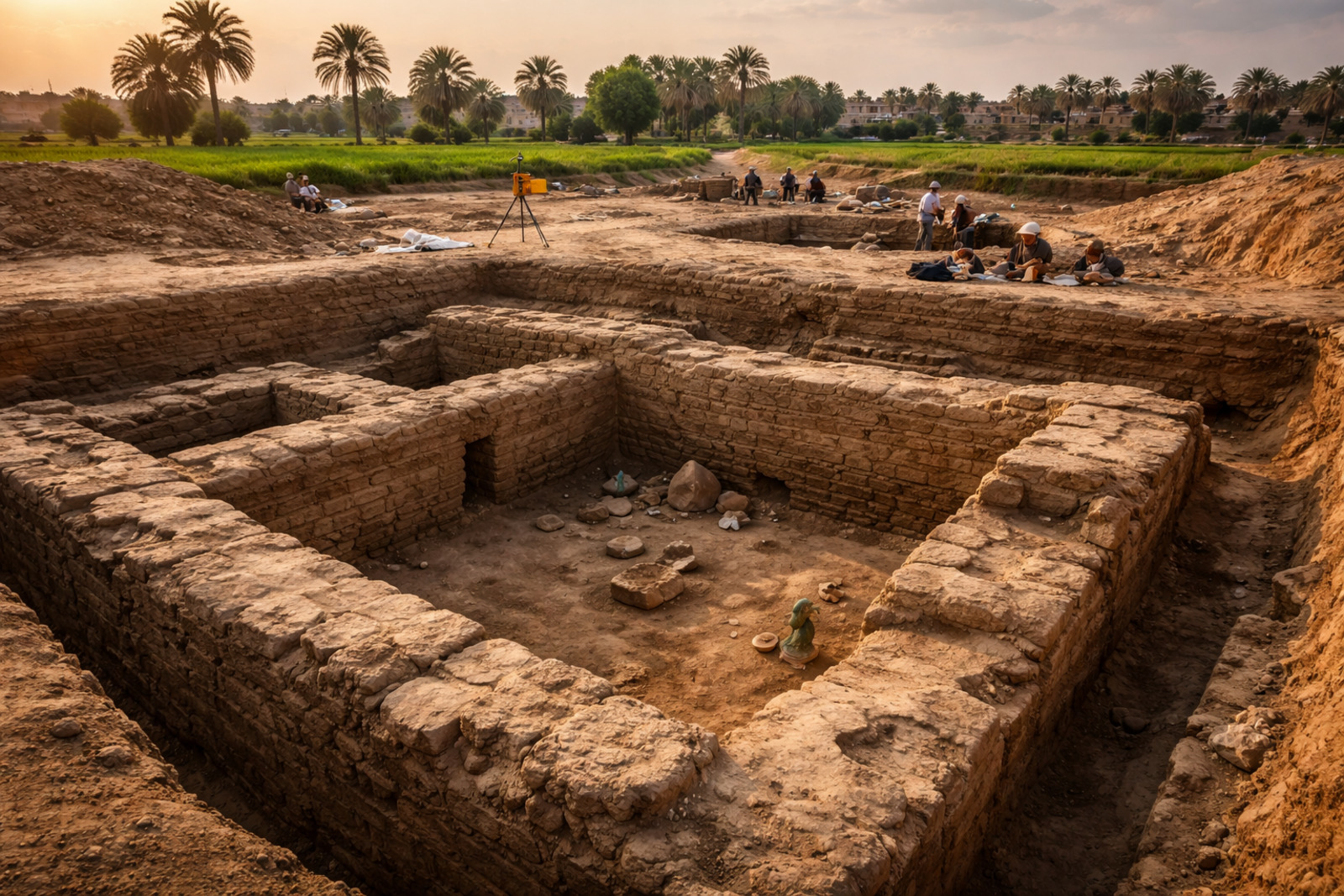
Scans of the soil revealed a 500 square meter structure buried in Buto, Egypt, with ritual indications and possible ancient religious function.
Scientists identified a buried structure in the ruins of Buto, in northwestern Egypt, after advanced soil scans. The find, located between 3 and 6 meters deep, further reinforces the potential of archaeology in areas difficult to excavate.
Scan in Buto
The discovery occurred at Tell el-Fara’in, known as the Hill of the Pharaohs. The area features accumulated mud and high water tables, factors that hinder deep excavations and limit conventional archaeological methods in ancient Egypt.
To overcome these obstacles, the team led by Mohamed Abouarab analyzed radar images from the Sentinel-1 satellite. The anomalies observed on the surface indicated possible hidden constructions beneath the ground.
-
Supercomputer calculates when humanity may disappear from Earth, predicts a scorching supercontinent, temperatures of up to 70 degrees, and a planet moving towards becoming uninhabitable.

-
INMET danger alert: heavy rains between the 3rd and 4th may drop up to 100 mm/day and winds of 60 to 100 km/h in several regions of Brazil require extra caution.

-
The parts crisis may bring back the drop notch and microSD in 2026; while Windows 11 promises to become lighter, leaks mention batteries of up to 10,000 mAh and 200 MP cameras.

-
In Kenya, engineer Nzambi Matee created “bricks 2.0” using packaging plastic: a mixture with sand, heated and pressed; they are 5 times more resistant, already have official licensing, and are being used in streets and construction projects.


Soil Tomography
After the satellite stage, researchers applied Electrical Resistivity Tomography, or ERT.
The technique sends electric currents into the ground through electrodes and measures the resistance found in different layers.
With this procedure, a structure of mud bricks measuring about 500 square meters, with dimensions of 25 by 20 meters, was detected.
The space was covered by debris and ceramics accumulated over centuries.
Ritual Traces of the Structure
Subsequent excavations confirmed that the construction dates back to the Saite period, about 2,600 years ago. This was the last dynasty of native Egyptian rulers before the Persian conquest.
At the site, amulets and statuettes linked to Isis, Horus, and Wadjet emerged. A rare object with elements of falcon, baboon, and Patikos was also found, along with altars suggesting a religious function.
Next Steps
The results indicate that the combination of remote sensing and geophysical measurements can enhance archaeology in ancient Egypt, especially in complex regions of the Delta.
Now, the team intends to extend the scans to greater depths. The suspicion is that another, even larger temple may be hidden beneath a thick layer of clay in the same region.
With information from Olhar Digital.








Seja o primeiro a reagir!