





 Portuguese
  English
  Spanish
  4 min of reading
  0 comments


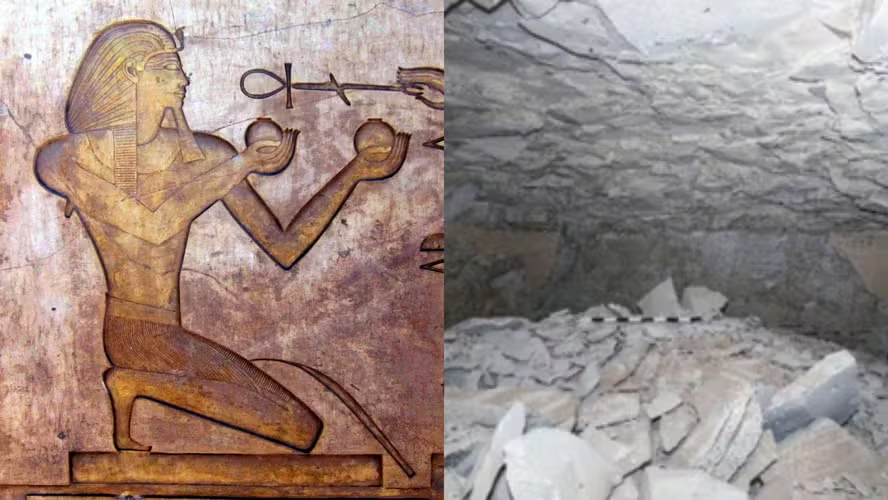
Discovery Reveals New Details About Thutmose II, Showing an Egyptian Ruler with Powers and Influence Beyond What Was Known
The Theban Mountains, silent for thousands of years, have just revealed a secret kept for 3,500 years. Among the shadows of the monumental temples of Luxor, archaeologists found a tomb sealed for millennia. Its occupant? Thutmose II, a pharaoh whose discreet reign seemed destined for oblivion.
No grand building celebrating his achievements, no glorious record. Until now, everything indicated that he had been erased from history. But a recent discovery may change that perception.
The King Who History Tried to Erase
Thutmose II ruled Egypt between 1493 and 1479 BC. He was the son of Thutmose I with the secondary queen Mutnofret and ascended to the throne by marrying his half-sister Hatshepsut. His reign has always been seen as weak and insignificant.
-
Scientists create a “molecular sponge” that transforms dirty water and even water from the Dead Sea into potable water using only sunlight and without consuming any electrical energy.

-
Chinese company creates solar cell that breaks the physical limit of silicon with 34.85% efficiency and promises to revolutionize electricity bills with panels that generate 20% more energy starting in 2026.
-
For the first time in over half a century, humans have seen the Moon up close and returned to tell the tale, and the technology that brought them back makes Apollo look like a toy.
-
From 1969 to 1972, only 12 human beings set foot on the Moon, and then the world simply stopped going, until this week when NASA showed that the journey back has finally begun.
Few monuments bear his name. At Karnak, Elephantine, and in Nubia, he oversaw modest constructions. However, most of his achievements were overshadowed by his wife and his son, Thutmose III.
In the military field, he is credited with suppressing revolts in Nubia and the Levant. However, evidence suggests that his generals led those campaigns.
His debilitated state of health, confirmed by the analysis of his mummy — extreme thinness and skin marked by lesions — reinforces the hypotheses of a ruler influenced by his wife. Hatshepsut may have wielded true power during her husband’s reign.
Nevertheless, the newly discovered tomb sheds new light on this narrative. Alabaster fragments bear the royal cartouche “Aakheperenre,” confirming that Thutmose II was pharaoh by his own merit.
On the walls, passages from the Book of Amduat indicate that he received funeral rites reserved for the kings of the New Kingdom. The painted starry blue ceiling, similar to the tombs of important figures like Thutmose III and Ramses VI, reinforces his significance.
Despite this, after his death, his legacy was almost completely erased. Hatshepsut, who declared herself pharaoh, replaced Thutmose II’s name with her own on several occasions.
Thutmose III, in turn, continued the work of erasure in his quest for legitimacy. This deliberate effort may explain why the tomb remained hidden for so long.
Mystery in the Empty Tomb
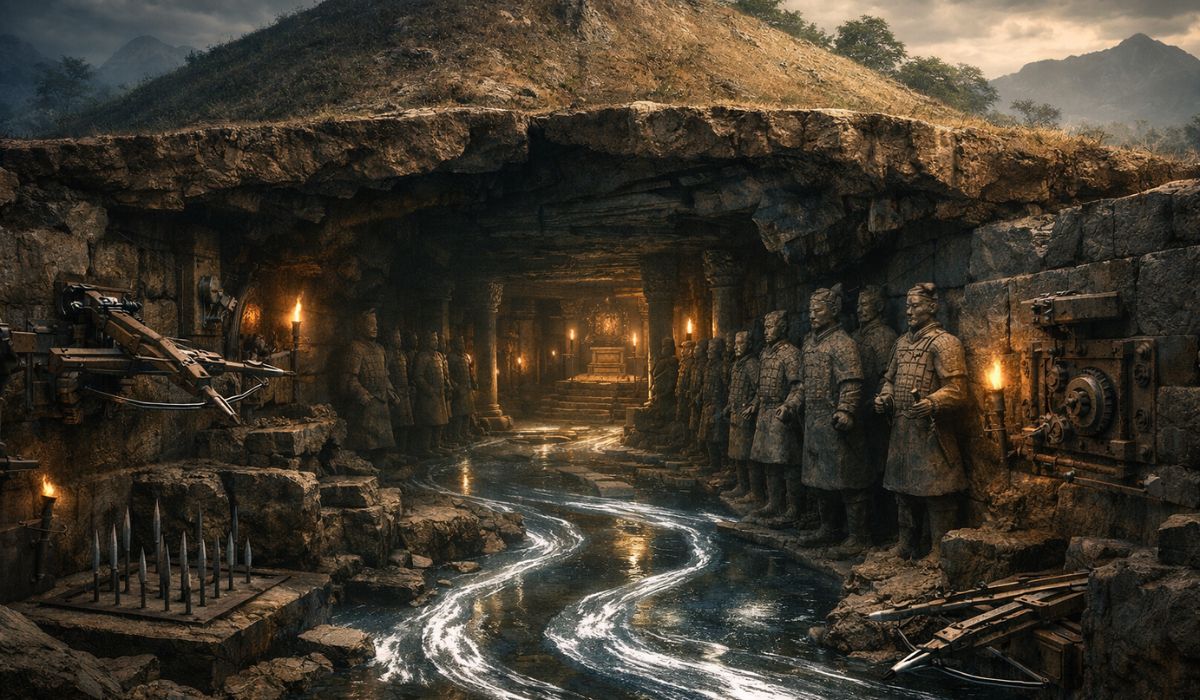
Upon entering the tomb, archaeologists came across a riddle. The burial chamber was completely empty. No sarcophagus, treasure, or furniture. But the site was not looted — it was intentionally emptied.
Preliminary analyses suggest that a catastrophic flood occurred shortly after the burial. The tomb, located beneath an ancient waterfall, became filled with mud and debris.
This forced the priests to move the body and funeral objects to another location. Fragments of funerary vessels bearing Thutmose II’s name, broken during the process, reinforce this theory.
British archaeologist Piers Litherland commented: “It was only gradually, as we sifted through all the material — tons and tons of broken limestone — that we discovered these small alabaster fragments, which provided the name of Thutmose II“.
But, after all, where is the pharaoh really? His mummy, found in 1881 in the Deir el-Bahari hiding place, may not be his. There are claims that the body was moved a second time.
If a second intact tomb exists, it may contain important and revolutionary objects for understanding the funeral rites of the New Empire.
Mohsen Kamel, the deputy director of the excavations, highlighted: “The possible existence of a second, still untouched burial site is a fascinating prospect. We could discover invaluable objects and gain insights into how Thutmose II was perceived after his death“.
A Key Piece in the History of the Thutmosids
The Thutmosid dynasty was one of the most powerful in Ancient Egypt. Thutmose II, once seen as a secondary figure, now takes on a central role at a moment of transition.
His son, Thutmose III, would become one of the greatest conquerors in Egyptian history. However, his ascent was marked by international disputes.
The relationships between Thutmose II, Hatshepsut, and Thutmose III were complex. Thutmose III, although the legitimate heir, was a child when his father died.
Hatshepsut then took power as sovereign, sidelining the young prince and ruling for over twenty years. She built grand temples and conducted trade expeditions.
The rediscovery of Thutmose II’s tomb raises new questions. Was he too weak to rule alone? Did Hatshepsut plan to seize power while her husband was still alive? The artifacts found may help clarify these doubts.
With information from Science & Vie.






-

-

-

-

16 pessoas reagiram a isso.