





 Portuguese
  English
  Spanish
  2 min of reading
  0 comments


The Asteroid 2024 ON, the Size of a 60-Story Building, Is on a Collision Course with Earth, Raising Concerns About a Possible Impact
An asteroid the size of a 60-story building, named 2024 ON, is approaching Earth at an alarming speed of 40,235 kilometers per hour, according to NASA alerts. Discovered on September 5, 2024, by astronomer G. Borisov, the asteroid has generated significant interest both in the scientific community and among space enthusiasts due to its massive size and the proximity with which it will pass our planet.
With a diameter of approximately 720 feet, equivalent to two football fields, 2024 ON is expected to make its closest approach to Earth on September 15, 2024.
NASA reported that the asteroid will pass about 620,000 miles away, which is more than two and a half times the distance between Earth and the Moon. Although this proximity raises concerns, the U.S. space agency emphasizes that the chance of collision with our planet is low.
-
The oceans are darkening all over the planet – what is happening?

-
An engineer designs a solar plane to fly on Mars at an altitude of 1,000 meters and a speed of 300 km/h, covering 16,000 kilometers in a Martian year, 900 times the distance traveled by the Ingenuity helicopter in three years on the planet before experiencing a rotor failure, and NASA is already funding the feasibility study.

-
A new phenomenon of contactless magnetic friction intrigues scientists and questions a theory that has been valid since the 17th century.

-
An impressive phenomenon in Northern Brazil causes rivers of different colors to flow side by side, revealing secrets about sediments, currents, and biodiversity.


The NASA Jet Propulsion Laboratory in Pasadena, California, is leading efforts to monitor the asteroid’s trajectory and ensure it poses no threat. Other institutions around the world, such as the European Space Agency (ESA) and several universities, are also involved in analyzing the composition of 2024 ON. The goal is not only to ensure Earth’s safety but also to study the asteroid’s formation to better understand the composition of celestial bodies and gain new data about the early solar system.
NASA Detected Another Large Asteroid Recently
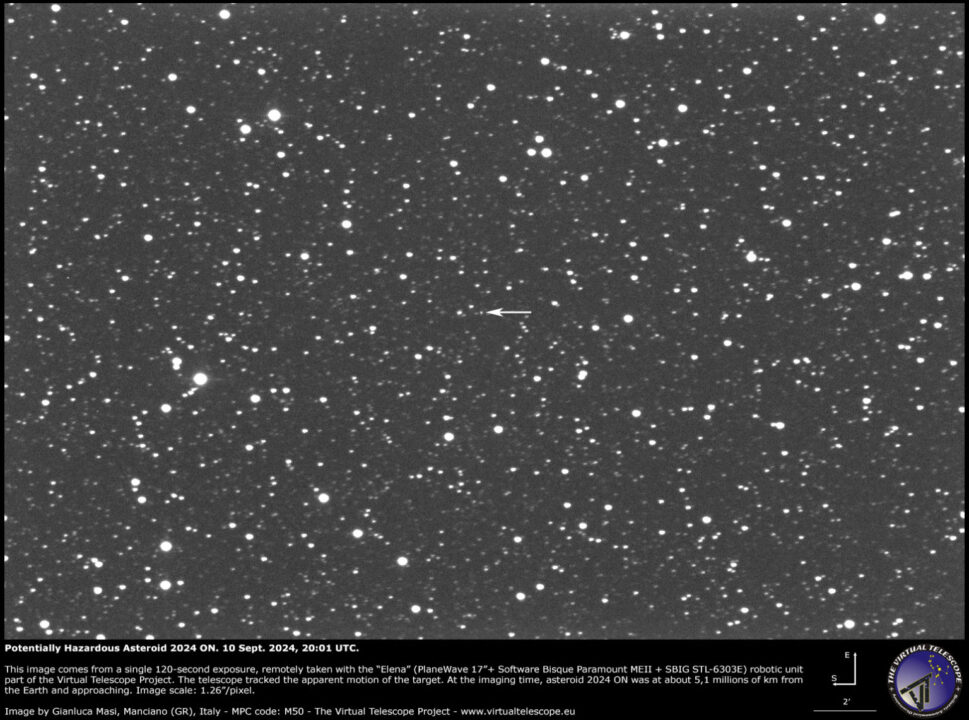
This is not the first time a near-Earth object has caused a stir. In June 2024, asteroid 2024 RR3 passed just 360,000 km from the planet, or about 93% of the distance between Earth and the Moon. Despite the proximity, the Virtual Telescope Project, which monitors asteroids, reassured the public, stating that both asteroids will pass safely.
The approach of objects like 2024 ON serves as a reminder of the importance of monitoring and studying asteroid programs. These international efforts continue to provide crucial information to ensure Earth’s safety and expand knowledge about our solar system.








Seja o primeiro a reagir!