





 Portuguese
  English
  Spanish
  5 min of reading
  0 comments


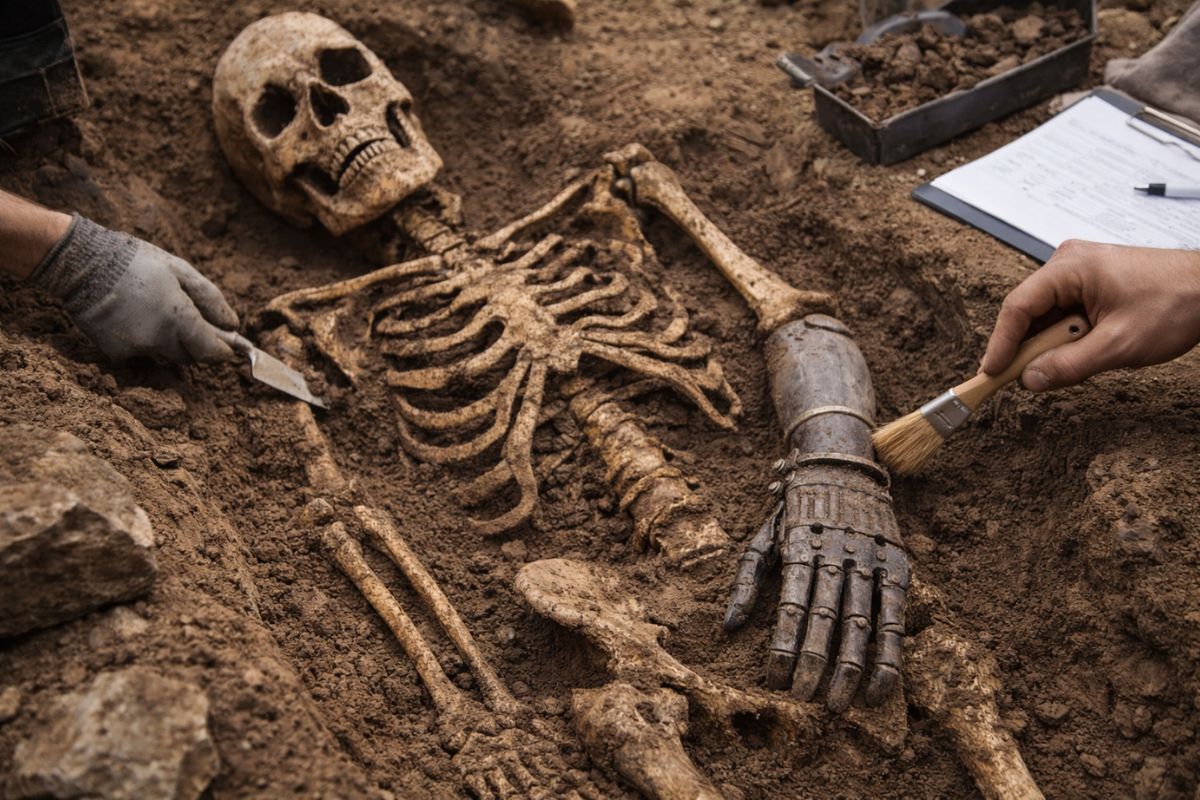
The man was between 30 and 50 years old when he died, lived between 1450 and 1620, and his prosthesis is one of only 50 known in all of Central Europe from that period
Imagine digging a trench to install a water pipe and coming across the remains of a man who lived over five centuries ago. This is exactly what happened in Freising, a historic city in Bavaria, southern Germany. Workers who were doing plumbing work near the St. Georg parish church found a medieval skeleton with something unusual in its left hand: a prosthesis made entirely of iron and non-ferrous metal in place of the fingers.
The discovery was announced by the Bavarian State Office for the Preservation of Monuments (BLfD) and caught the attention of the international scientific community. According to Dr. Walter Irlinger, head of the conservation department at BLfD, “even for experienced archaeologists, this was a particularly special discovery.”
And when the researchers began to analyze the piece, what they found was even more surprising.
-
You will be able to enter for free a 1,680-ton military ship of the Brazilian Navy that conducts rescues and patrols at sea, but only on three special days during the 368th anniversary of São Francisco do Sul in Santa Catarina.

-
Milei opens the Andes glaciers for copper and lithium mining in the name of the energy transition, but environmentalists accuse the government of sacrificing 8,484 km² of freshwater reserves that protect nearly 17,000 ice masses to attract foreign investors.

-
Police, specialists, and Army teams have cordoned off a beach in England after the discovery of more than 150 World War II phosphorus grenades, which were set on fire and led to a security operation.
-
With air mattress technology, this giant vessel floated over the water and crossed the English Channel in half the time of ferries; meet the SR.N, the largest hovercraft in the world that transported cars and passengers at over 120 km/h.

What was the iron hand found in the skeleton like?

The prosthesis is a hollow piece that replaced four fingers of the left hand: index, middle, ring, and pinky. According to Dr. Walter Irlinger, in a statement published by the Medievalists.net portal, each finger was individually molded from metal sheet, positioned slightly curved, mimicking the natural resting position of the human hand.
The fingers of the prosthesis were immobile, with no mechanical components. The piece was likely attached to what remained of the hand with leather straps. And here comes a detail that impressed the researchers: inside the iron hand, restorers found a fabric similar to gauze, which served as padding to protect the stump of the skin from direct contact with the metal.
Another important point: the man’s thumb was still preserved. A bone from the thumb was found corroded on the inside of the prosthesis, indicating that the amputation removed only the four fingers, keeping the most important finger for the hand’s gripping function.
But who was this man?
What is known about the owner of the iron hand?

Radiocarbon dating of the medieval skeleton revealed that the man died sometime between 1450 and 1620, according to the analysis conducted by the BLfD. The estimate is that he was between 30 and 50 years old at the time of death.
It is not known exactly how he lost his fingers. But the historical context of Freising offers strong clues. The city was the seat of an influential bishopric during the Middle Ages and was at the center of various military conflicts over the centuries, including the Thirty Years’ War (1618 to 1648), one of the longest and most destructive conflicts in European history.
According to the BLfD, these confrontations likely led to an increase in the number of amputations in the region and, consequently, a greater demand for prostheses. Doctors of that time were already thinking about how they could make life easier for people who had lost limbs, the preservation office stated in an official communication.
And this was not the only iron hand in the region.
Was the Freising prosthesis common in the Middle Ages?
No. In fact, it is extremely rare. According to the BLfD, there are currently about 50 comparable prostheses known throughout Central Europe from the period between the late Middle Ages and the early modern era. These pieces range from simple and immobile models, like that of Freising, to prostheses with mechanical components that allowed articulated movements.
The most famous example is that of the knight Götz von Berlichingen, known as “Götz of the Iron Hand.” He lost his right hand in 1504 during the siege of Landshut, a city in Bavaria just 40 kilometers from Freising, when a cannonball hit his sword and severed the limb. His first prosthesis was made by a local blacksmith, but later he commissioned a much more advanced version, with fingers that mechanically bent, allowing him to hold reins, weapons, and even a quill to write. Both of Götz’s iron hands are still on display today at the Götzenburg castle museum in Jagsthausen, Germany, as recorded by The History Blog portal.
The prosthesis found in Freising is much simpler than Götz’s. But the fact that it exists, that it was carefully constructed, and that it has internal padding shows that even common people, not just wealthy knights, had access to some type of prosthetic technology at that time.
This leads to an important reflection.
What does this discovery reveal about medicine in the Middle Ages?
Archaeology often shows a side of the Middle Ages that history books sometimes forget. While the period is often associated with wars, plagues, and ignorance, discoveries like that of Freising prove that there was a real and sophisticated effort to care for people with physical disabilities.
The prosthesis was not just functional. It was designed to look like a hand. The curved fingers, the hollow shape, the leather covering, and the internal padding show a level of care that goes beyond simple mechanical replacement. It was an attempt to give the patient something resembling the appearance and dignity of having a complete hand.
According to Smithsonian magazine, researcher Jacky Finch from the KNH Center for Biomedical Egyptology at the University of Manchester highlighted that ancient prostheses had a striking characteristic: they tried to visually resemble what they were replacing. The modern logic is different, with implants connected to the nervous and sensory system. But 500 years ago, the ingenuity lay in the ability to create, with iron, leather, and fabric, something that allowed a person to continue living with functionality and self-esteem.
The iron hand of Freising is not just an archaeological curiosity. It is proof that the human instinct to care, adapt, and overcome physical limitations did not begin with modern technology. It was already there, shaped in metal, held with leather straps, padded with gauze, in the wrist of a man who lived and died in a city in Bavaria over five centuries ago.
With information from the Bavarian State Office for the Preservation of Monuments (BLfD), Medievalists.net, Ancient Origins, Smithsonian Magazine, and The History Blog.









Seja o primeiro a reagir!