






 Portuguese
  Spanish


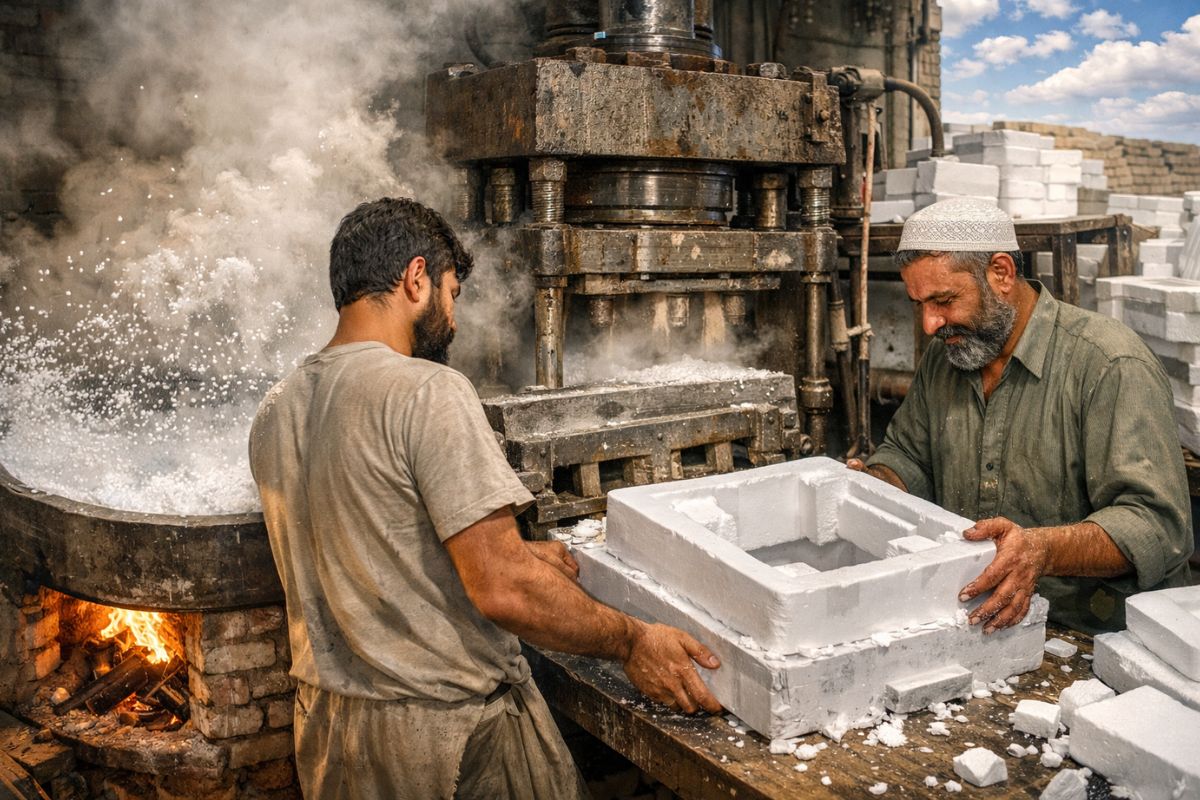

Packaging Styrofoam is born from an artisanal process that uses a wood-fired boiler to generate steam, expands polystyrene beads, and relies on manual finishing to ensure fit and quality
The Styrofoam that protects TVs, stoves, and refrigerators often seems “too industrial” to be a topic of discussion, but in Pakistan, it is produced in a way that draws attention. Instead of automated lines, the process works with a wood-fired oven, high-pressure steam, and old hydraulic presses, maintaining a heavy and constant work routine.
The video from the Red Bull BR channel follows the step-by-step process and shows that, even with machines, the final quality still depends on the human eye, especially in the finishing stage, when any imperfection can compromise the protective function.
From polystyrene to Styrofoam: the expansion begins with the beads

It all starts with polystyrene beads, which are placed in a cylinder and receive a bath of high-pressure steam. The heat causes the material to expand and gain the light and “fluffy” appearance that characterizes the Styrofoam used in packaging.
-
Workers renovating a playground in northern England uncover 176 World War II bombs buried underground; training artifacts still contained explosives.

-
Brazilian Architect Transforms Waste into Sustainable Homes with Solar Power and Rainwater Systems for 40 Years

-
Security Guard Becomes Doctor at Louisiana Hospital Where He Once Worked, Studied Chemistry Between Shifts

-
Woman Rescued from Luxury Complex in Brazil Worked Without Pay for 55 Years, May Be Entitled to Over $300,000




After expansion, the enlarged beads go through cooling, are bagged, and move on to the next phase. Production does not stop, because the pace depends on the pressure and temperature remaining stable at all times.
The wood-fired boiler is the engine of the process

To generate steam, no electric machines are involved in controlling the operation. The wood-fired boiler keeps the fire burning all day long, ensuring the necessary heat to expand the particles and sustain continuous operation.
The video makes it clear that the furnace is the most sensitive point: one mistake or a moment of inattention can drop the pressure, jam the line, and cause losses, because everything is connected to the steam.
Old hydraulic presses shape the Styrofoam piece by piece
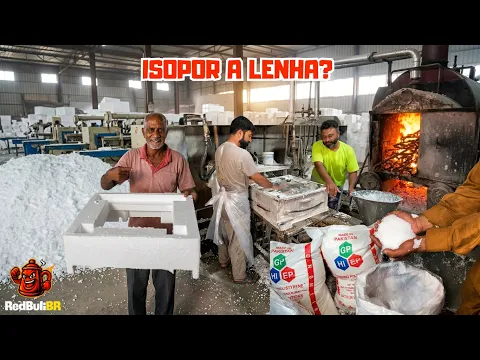

With the beads already expanded, the path leads to the presses. There, workers manually fill the molds, ensuring that each space is occupied. Under intense pressure and steam heat, the beads fuse and form the protective piece.
It is at this stage that the Styrofoam stops looking fragile and gains structure. Each open mold reveals a finished piece, still hot, releasing steam, and the result depends on precision and experience.
The manual finishing defines the final quality

Even with presses, the human touch remains central. Heat, time, and pressure need to be in balance, and any small mistake can compromise uniformity. Therefore, workers correct flaws, adjust details, and ensure standards.
When the piece seems ready, final touches are still needed. The final cuts are made manually to remove excesses, adjust edges, and ensure a perfect fit.
Each unit is carefully reviewed, because an imperfection can hinder the protection of the product during transport and storage.
Why a rustic process still delivers results
What impresses is seeing a simple and rustic technology producing essential items for logistics. The Styrofoam that comes from this line is not just “a white block”.
It needs to fit, absorb impact, and protect the product until it reaches the consumer’s home, and this requires consistency.
In the end, the video reinforces an idea that applies to many small factories: even with machines, the final quality is born from the combination of process and people, especially when the operation depends on constant attention.
Would you have the courage to work in a place like this, with heat, steam, and pressure all day to produce packaging Styrofoam?


