





 Portuguese
  English
  Spanish
  4 min of reading
  0 comments


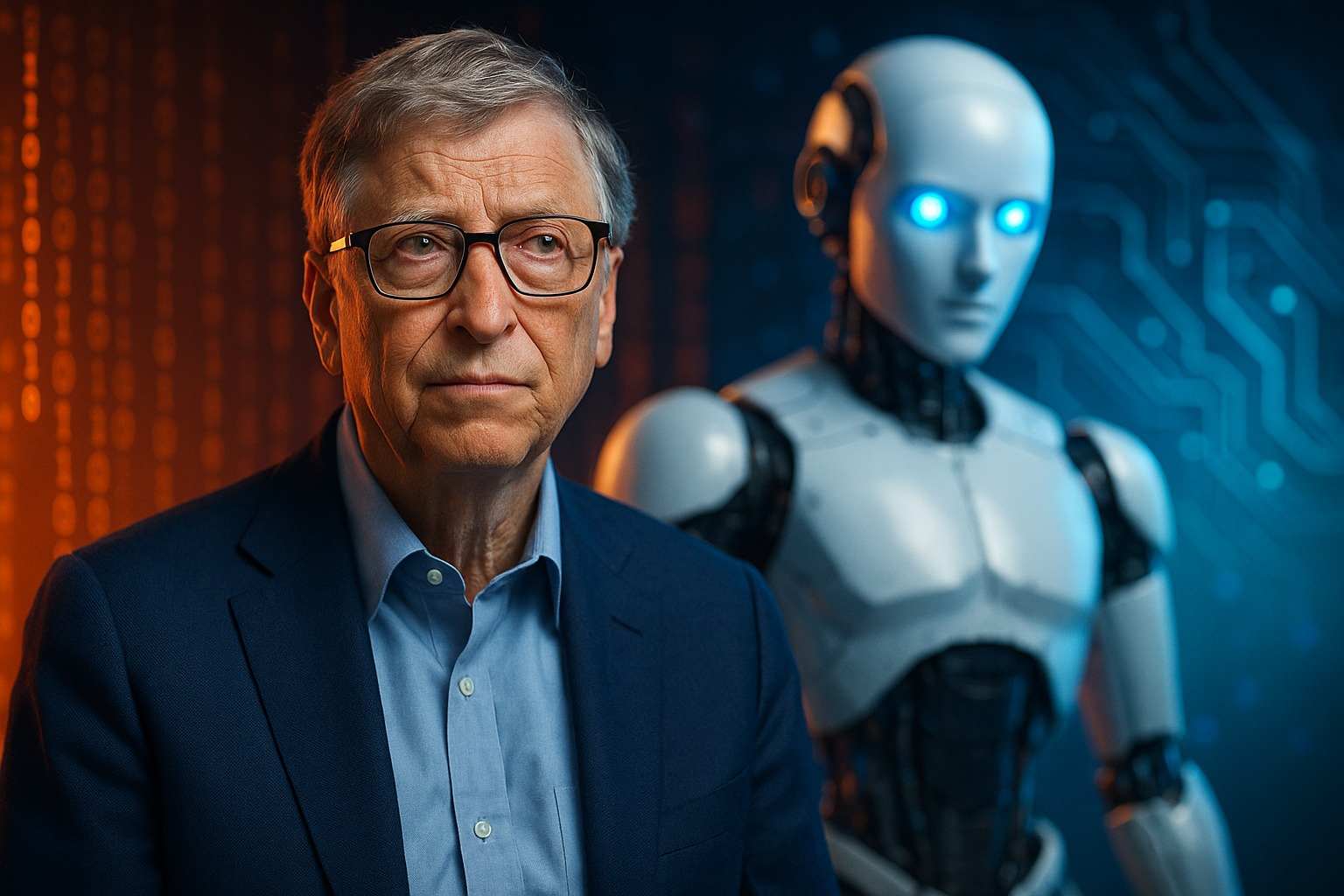
Artificial Intelligence Is Transforming The Job Market At An Unprecedented Pace And Could Eliminate Up To 300 Million Jobs. Bill Gates Points Out Which Three Professions Are Most Likely To Survive In This New Digital Era
The artificial intelligence (AI) revolution is reshaping the global job market at a rapid pace, and even the biggest technology enthusiasts admit that no one knows for sure how deep this impact will be. Bill Gates, co-founder of Microsoft and one of the leading figures of the digital age, acknowledged in a recent interview with CNN that the advancement of AI is surpassing expectations — and that many professions could disappear before people even have time to adapt.
“It’s improving at a pace that surprises me,” Gates said, revealing that he uses technology several times a day for complex inquiries and often comes across extremely comprehensive answers. This observation is not isolated.
Dario Amodei, CEO of Anthropic, believes that up to half of entry-level white-collar jobs could cease to exist in the next five years.
-
Tourists on Everest were poisoned by guides who mixed substances in food to provoke false symptoms of altitude sickness while helicopter operators and hospitals charged inflated rescue fees to insurance companies.

-
Few people know this, but Neil Armstrong, one of the most famous NASA astronauts in history, survived the Korean War after jumping from the plane during his seventh combat mission aboard the USS Essex aircraft carrier of the United States.

-
Diving with a camera in Lake Furnas reveals a submerged city with an entire street, almost intact houses, a preserved bridge, a wood stove, a Kombi, and even a bus at the bottom of the largest lake in the Southeast.

-
Iceland accidentally drilled into a magma pocket at 2,100 meters and revealed that the extreme heat beneath the crust could pave the way for a new source of continuous energy.


Giant companies are already adjusting: Meta is developing an AI engineer, while IBM has eliminated 8,000 human resources jobs this year, citing automation as the cause.
Even in the face of this scenario, Gates identifies three areas that remain more resistant to replacement — at least for now.
The Technological Race And The Frightening Pace Of Transformation
Gates’s comments come amid a profound transformation in the job market. What once seemed like science fiction is now reality: AI is already writing emails, generating programming codes, and providing customer service on an industrial scale.
At Amazon, CEO Andy Jassy warned that some corporate teams, including software development, will face cuts due to automation.
The biggest concern, according to Gates, is not what AI already does, but what it will still do. “The question is: has it arrived so fast that we don’t have time to adapt?” he asks. The answer, it seems, is yes.
Goldman Sachs studies estimate that artificial intelligence could replace the equivalent of 300 million full-time jobs worldwide. Routine and repetitive tasks — such as telemarketing, data entry, and administrative support — are among the first to be eliminated.
Experts disagree on when AI will reach or exceed human capacity: some bet on two years, while others mention a decade. Generative tools like Claude, GPT-4, and Gemini show rapid advances in reasoning and execution, approaching a tipping point.
The Three AI-Proof Professions According To Bill Gates
Even with alarming predictions, Gates believes that some professions will remain relevant in the near future. He points to three areas that remain less vulnerable to total replacement by artificial intelligence: software development, the energy sector, and biology.
Software Developers
Although AI can already generate and debug code, it still lacks accountability. Gates asserts that human engineers are essential in the design of critical systems, oversight of algorithms, and adjustments of models.
In other words, AI needs people to create it and fix its flaws. Human oversight ensures safety and accuracy in high-risk environments, keeping developers in a strategic position.
Energy Sector Professionals
From operating nuclear reactors to managing renewable networks, the energy sector involves high complexity and stringent safety requirements. Gates questions: “Would you trust an AI to operate an entire national power grid without human supervision?”.
For now, the majority answer is no. The need for human control and responsibility makes complete automation in this field unlikely.
Biologists
While AI can read genomes and identify patterns of diseases with impressive speed, major scientific breakthroughs still depend on creativity, intuition, and hypothesis formulation.
Gates emphasizes that limitations in funding for biological research reinforce the importance of the human element.
Curiosity and the ability to formulate new questions are still attributes that machines cannot fully replicate.
Less Work, More Leisure? The Promise And Risk Of A New Era
Among Bill Gates’s boldest predictions is the possibility of the traditional 40-hour workweek collapsing. He believes that AI could enable three-day workweeks, freeing up time for leisure, family, or even a second career. “By increasing productivity, you can release people for smaller classes, longer vacations, or doing more,” he stated.
However, the optimistic outlook conceals a concerning challenge: the fate of those whose jobs disappear in the process. Young professionals, in particular, face an uncertain future. Many entry-level positions — crucial for developing leaders — are among the first to disappear, creating a bottleneck that hinders professional advancement.
A survey conducted in 2025 by McKinsey & Company revealed that 42% of Generation Z graduates believe that AI has already reduced their job prospects. At the same time, companies are expanding their specialized AI teams and reducing traditional hiring, radically altering the entry points into the job market.
The Great Unknown: Where Are We Going?
Even with all the available data and predictions, no one knows for sure what the future of artificial intelligence will be. Some experts believe that so-called “general AI” — capable of thinking like a human — could emerge within this decade. Others consider this prediction premature and unlikely.
Gates himself admits that he could be wrong in his projections. His main concern is not with the replacement itself, but with the speed at which it could occur.
In a world where the most valuable skills in 2023 could be obsolete by 2026, even qualified professionals risk being caught off guard.
The billionaire’s conclusion is straightforward: for now, those working in fields such as programming, energy, or biology have a better chance of remaining relevant. For everyone else, it may be time to rethink plans and prepare for a scenario where adaptation will not be an option — but a necessity.









-

-

-

-

-

17 pessoas reagiram a isso.