





 Portuguese
  English
  Spanish
  3 min of reading
  0 comments


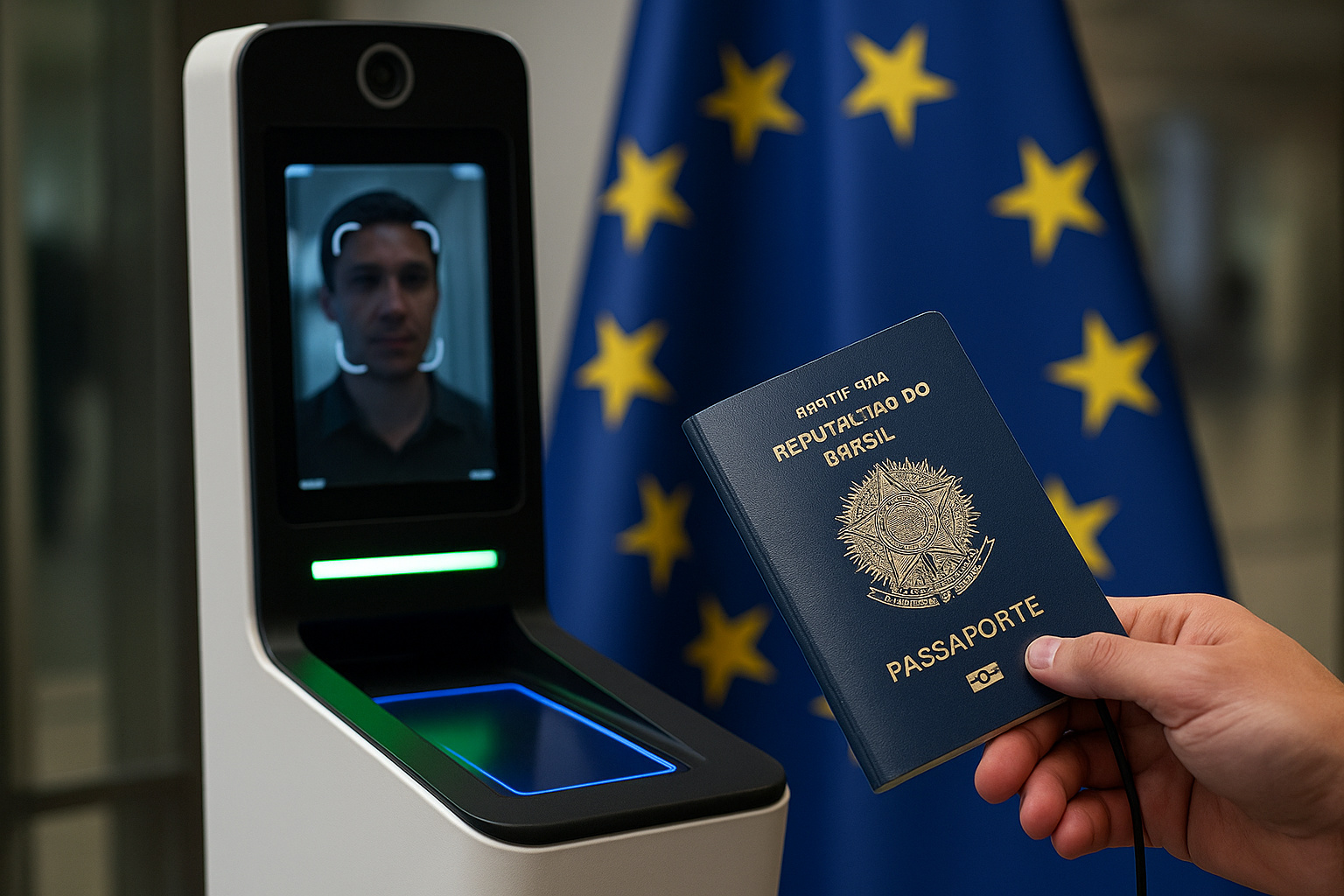
Starting This Sunday, the Digital System Will Replace the Stamp on the Passport
Starting on October 12, 2025, Brazilian and other travelers from outside the European Union will need to follow new procedures to enter the Schengen Area. This change is part of the Entry/Exit System (EES), created by the European Commission to replace the stamp on the passport with digital records, such as facial recognition and fingerprints.
What Changes for Brazilians Entering Europe
Now, border control will be completely electronic. Thus, the EES will record the entries and exits of each traveler, allowing for precise monitoring of the duration of stay. In addition, the system is expected to reduce queues, speed up inspections, and increase security at airports.
According to the European Commission, the system will start operating in October 2025 and will be implemented gradually at airports, seaports, and land borders. Subsequently, it will reach full operation in April 2026.
-
U.S. Armed Forces send warships to the Strait of Hormuz for mine removal from the channel as supertankers resume transit and global tensions pressure oil.

-
While $5.5 billion aircraft carriers dominate the seas with advanced technology, an $80 million submarine can simulate a devastating attack and expose strategic vulnerabilities that still challenge naval powers.

-
A country where no mother pays income tax if she has three children and still receives incentives, easy credit, and state support to increase births and try to reverse the population decline.

-
Is Brazil really safe? The global war scenario shows real risks for energy, food, the economy, and internal stability.

With this, the system will automatically identify whether the visitor respected the 90-day limit of stay within a 180-day period. Thus, authorities will be able to apply sanctions more accurately.


How the New System Will Work
On the first entry, the traveler will present the passport, register fingerprints, and have their facial scan taken. Then, upon departure, the system will cross-check data to confirm compliance with the authorized timeframe.
On subsequent trips, identification will occur automatically through facial recognition. Children up to 12 years old, on the other hand, will only need a photograph.
Additionally, records can be made by border agents or at self-service kiosks installed at main entry points. Although some countries offer digital pre-registration, in-person verification will remain mandatory.
All information collected will be stored in a secure system and will be cross-checked automatically. This way, authorities will be able to confirm the legality of the stay and prevent fraud.
The System Will Be Mandatory for All Travelers
The EES will be mandatory for all visitors without European citizenship, including people from Brazil, Iceland, Norway, Switzerland, and Liechtenstein. Furthermore, usage will be free, as reported by the European Border Agency Frontex.
On the other hand, the new process represents a milestone in modernizing Europe’s external borders. Thus, the continent will strengthen its fight against irregular immigration and identity fraud.
ETIAS: New Authorization Will Be Required in 2026
In addition to the EES, the European Travel Information and Authorization System (ETIAS) will come into effect at the end of 2026. It will require an online registration for tourists visiting the Schengen Area.
To obtain the authorization, the traveler will fill out a digital form, provide personal data, and pay a fee of 20 euros (about R$ 125). The document will be valid for three years or until the passport expires, whichever comes first.
According to the European Commission, the ETIAS will serve to enhance security and streamline tourist flow. Furthermore, it will enable authorities to identify risks in advance and prevent irregular stays.
Countries That Will Adopt the Biometric System
The Entry/Exit System (EES) will cover 25 countries in the Schengen Area. Among them are Germany, France, Spain, Italy, Portugal, Greece, Austria, Switzerland, Sweden, Denmark, Belgium, Netherlands, Poland, Finland, Norway, Iceland, Hungary, Malta, Romania, Slovakia, Slovenia, Croatia, Estonia, Latvia, and Lithuania.
According to European authorities, the first major operational test will take place during Easter 2026, a period of high tourist flow. This way, the continent will be able to assess the performance of the system on a large scale.










Seja o primeiro a reagir!