





 Portuguese
  English
  Spanish
  5 min of reading
  0 comments


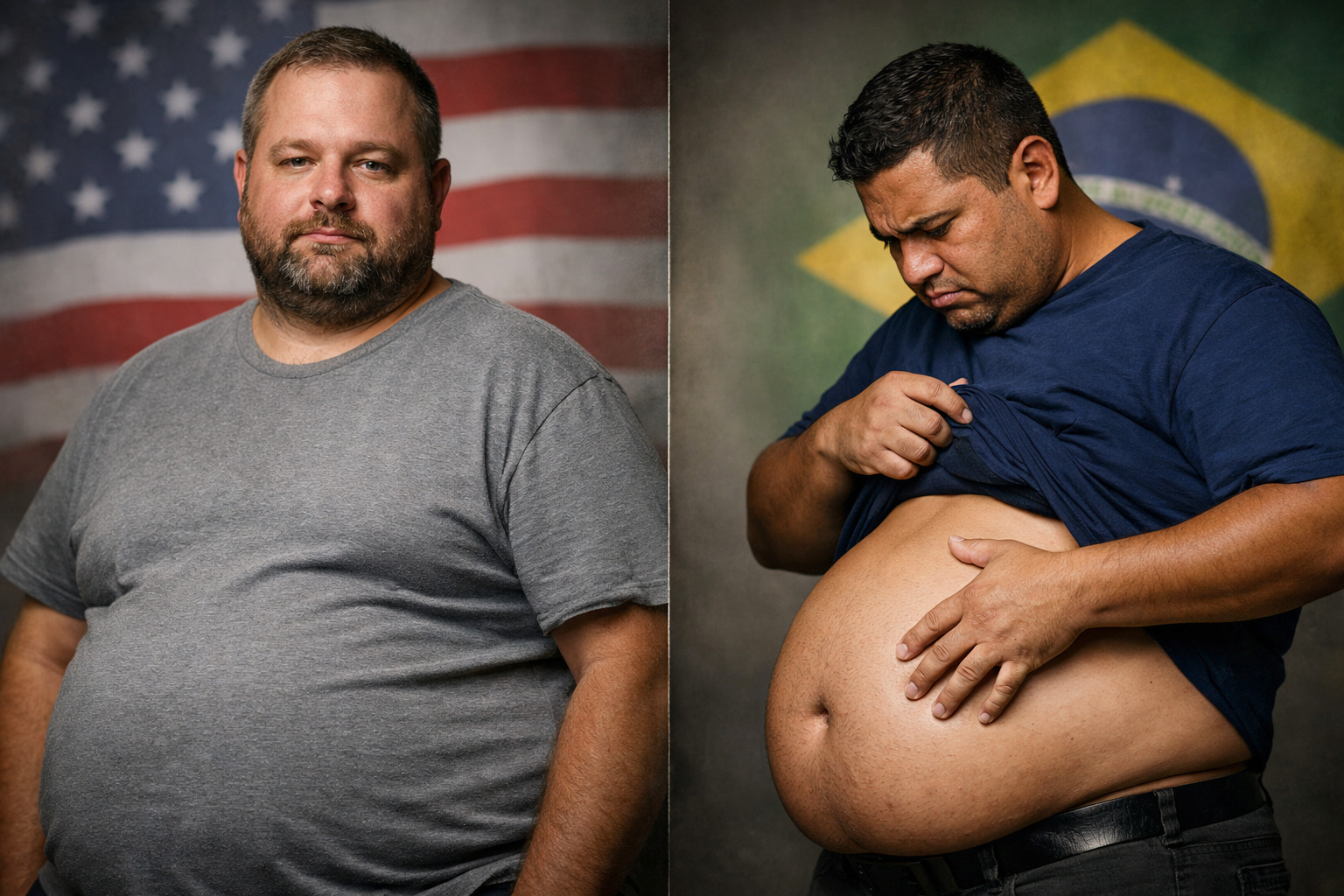
Accelerated Growth Of Obesity Worries Experts And Indicates That Brazil May Repeat The Trajectory Observed In The United States, With Serious Impacts On Public Health And The Economy
The Brazil faces a growing obesity epidemic, and recent numbers reveal a worrying change in the health profile of the population. Currently, almost 70% of Brazilians are overweight, while about 30% already show some degree of obesity, according to recent surveys. This scenario indicates that 1 in every 3 people in the country already lives with obesity, a trend that is rapidly advancing and placing Brazil on a similar trajectory to that observed in the United States.
This advancement has caught the attention of public health experts, mainly because the rate of growth of obesity in Brazil is occurring more rapidly than in developed countries. Moreover, the phenomenon does not only affect those who are currently overweight. Even people who currently maintain a weight considered healthy may suffer indirect consequences from this crisis, as the healthcare system, the economy, and overall quality of life are directly impacted.
The information was disclosed in analyses from G1 and research on nutrition and public health, with data compiled by research institutions and discussed by nutrition and epidemiology experts, including studies related to the work of epidemiologist Carlos Augusto Monteiro, an international reference in studying the relationship between food and chronic diseases.
-
Attracting around 250,000 people a year, a lighthouse 200 meters from the sea, on a 60-meter high cliff, on the North Sea coast in Denmark, becomes one of the most impressive examples of how nature can threaten historical buildings.

-
The narrowest house in the world is only 63 centimeters wide, but inside it can accommodate a bathroom, kitchen, bedroom, office, and even two staircases.

-
In the middle of the sea, these enormous concrete and steel structures, built by the British Navy to protect strategic maritime routes, look like they came straight out of a Star Wars movie.

-
For years, no one could cross a neighborhood in Tokyo because of the tracks, but an impressive solution changed mobility and completely transformed the local routine.


Obesity Grows Faster In Brazil Than In The United States
The numbers reveal the speed of the problem. In 2015, about 19% of the Brazilian population was considered obese. By 2023 this index rose to approximately 31%, representing an increase of about 63% in less than ten years.
If this trend continues, the projection is even more worrying: by 2045, almost 48% of the Brazilian adult population could be in a state of obesity.
To understand the magnitude of this growth, just observe the trajectory of the United States. Currently, 74% of the American population is overweight and about 44% is considered obese. However, this advancement occurred more gradually. In the U.S., the obesity rate increased from 20% in 1990 to 35% in 2010, a significant growth that took about two decades to occur.
In Brazil, on the other hand, this process is occurring in a much shorter timeframe, indicating that the country may reach levels similar to those of Americans in a relatively short period.
The consequences are already beginning to appear. According to the portal Poder 360, between 2010 and 2024, approximately 45,310 people died in Brazil due to causes associated with obesity. In the United States, the situation is even more dramatic: it is estimated that about 300,000 deaths per year are related to overweight and associated diseases.
The Role of Ultraprocessed Foods in Changing Brazilian Diets
To understand why Brazilians are gaining weight, researchers began to investigate changes in dietary patterns over recent decades.
In the 1990s, Brazilian scientists already expressed concern about the increasing number of people with obesity, even in a country that was still facing malnutrition issues. To analyze the phenomenon, researchers used data collected by IBGE through Family Budget Surveys (POF), which have recorded eating habits since the 1970s.
Initially, the data indicated something seemingly contradictory: the direct consumption of sugar, salt, and oils was decreasing. However, upon deeper analysis, researchers realized that these ingredients had not disappeared from the diet but had only changed in their form of consumption.
Instead of being used in home cooking, they became present within ultraprocessed foods, industrial products that combine ingredients extracted from food—such as isolated proteins, extracts, sugars, and refined oils—with a range of chemical additives.
These products are designed to be extremely tasty, convenient, and inexpensive, which facilitates their presence in virtually every environment of daily life. Today, it is common to find cookies, sodas, snack foods, ice creams, and ready-made meals in subways, pharmacies, gas stations, and supermarkets.
This dietary transformation coincided with the expansion of large multinational food companies in Brazil. Companies like Nestlé, Coca-Cola, Danone, Mondeléz, and Unilever broadened their presence in the country starting in the 1990s, a period marked by intense globalization of the food industry.
As a result, the traditional diet based on rice, beans, and home-cooked meals began to lose ground to industrialized products, similar to those consumed on a large scale in countries like the United States and the United Kingdom.

Marketing, Food Environment And Impact On Public Health
Another relevant factor to explain the rise in obesity is the so-called “obesogenic environment”, a concept used by scientists to describe a scenario where high-calorie foods are abundant, cheap, and heavily promoted.
During the 1990s and 2000s, advertising campaigns for industrialized foods were directed especially at children and working mothers, highlighting the convenience of these products. Giveaways, collectible toys, characters, and promotions helped to solidify the consumption of these foods from childhood.
Even with some current regulations, marketing continues to evolve. Today, digital advertising utilizes online behavior data to target personalized ads, often aimed at children and teenagers.
Studies from UNICEF (United Nations Children’s Fund) indicate that ultraprocessed foods are often more accessible, cheaper, and more promoted in lower-income communities, which further increases the consumption of these products.
This context contributes to the rise of diseases associated with excess weight, such as type 2 diabetes, cardiovascular diseases, and metabolic problems.
In addition to the impacts on individual health, costs for the public healthcare system are also rising. Currently, the Unified Health System (SUS) spends about R$ 1.5 billion a year on treatments related to obesity.
In the United States, projected spending is even more impressive: estimates indicate that in the next decade, the country may spend between 8 and 9 trillion dollars on obesity-related treatments, considering both public and private expenses.
Nutritional Education And Individual Choices Also Make A Difference
Although structural factors have a strong influence, experts emphasize that individual food choices also play an important role in obesity prevention.
Studies show that diets based on less processed and more natural foods tend to generate greater satiety and lower caloric intake throughout the day.
In an experiment conducted with adults, researchers compared diets with and without ultraprocessed foods. Even with similar caloric and macronutrient availability, participants consumed an average of 500 extra calories a day when following a diet rich in ultraprocessed foods.
As a result, they gained about 1 kg in just two weeks, primarily in the form of body fat. When they returned to a diet based on natural foods, the weight was reduced again.
These results reinforce the importance of strategies that prioritize reducing the consumption of ultraprocessed foods, increasing the intake of natural foods, and promoting greater nutritional awareness.
Moreover, nutritionists point out that maintaining the consumption of industrialized foods around 10% of total daily caloric intake can allow for a balanced diet without the need for extreme restrictions.
In light of this scenario, experts warn that tackling obesity requires a combination of public policies, nutritional education, and cultural changes, preventing Brazil from entirely following the same path observed in countries with high obesity rates.
With information from the channel: Elementar






-

Uma pessoa reagiu a isso.