





 English
  Francês
  Alemão
  Italiano
  Japonês
  Norueguês
  Portuguese
  Spanish
  4 min of reading



In Factories, The Villains of Energy Bills Are Electric Motors, Which Account for 70% of All Electricity Consumed, According to Eletrobras/Procel
Electric motors are in homes – in blenders, mixers, hair dryers, refrigerators – as well as in businesses and industries, in elevators, escalators, and in applications like milling machines, lathes, and conveyor belts, for example. Their use is so extensive that a recent research report from Market Research Future, “Electric Motors Market for Household Appliances,” confirms that there will be a growth of 5.87% between 2022 and 2030, just for household use, not accounting for industrial parks.
Also Read
- Construction of Statkraft’s wind farm starts in June in Bahia; the complex will feature 163-meter Nordex turbines, will create many jobs, and supply 190,000 homes in the Northeast
- Daimler Automobile Manufacturer Withdraws and Sells Part of Denza, Its ‘Chinese Mercedes-Benz Electric Cars’ to Giant BYD, Giving Chinese More Power Than Germans
- With an investment of 12 million reais, Librelato innovates its production line by investing in automation processes and purchasing the largest Robotic Welding Cell in Latin America
- Roc Stratolaunch, The Largest Airplane in The World, With the Largest Wing Measuring 117 Meters, 6 Engines, and One of the Strangest Designs in The World, Completed Its First Test Flight Yesterday (01/16) Reaching 330 KM/h
According to the research, the increase is due to the demand for energy-efficient motors: “It is expected that emerging regions around the world will present unexplored opportunities. Industry players are trying to expand their production capabilities with better cost efficiency supported by new possibilities,” states the report, also pointing out that while the outlook is positive on one side, the market still witnesses significant gaps. One of these obstacles is the low adoption of variable frequency drives, hindering the already delayed progress of Industry 4.0 through industrial process automation.
Enormous Volume of Production, Distribution, and Sales, Transport Strategies, Imports, and Exports Put Brazil in Second to Last Place in The International Ranking
In Brazil, electricity is the most important input; its rational use is essential when it comes to reducing expenses and competitiveness. In factories, the villains of energy bills and their high costs are electric motors, which account for 70% of all electricity consumed, according to Eletrobras/Procel.
-
Abandoned house for 15 years disappears in the woods, shocks owner with unrecognizable scenery and is reborn in an intense transformation after almost 90 hours of work in just 10 days.

-
In just three hours, a natural stone floor transforms the entrance of the house with an organic effect, immediate drainage, and a sophisticated non-slip finish that doesn’t puddle water, dries quickly, and impresses with the final result.
-
‘Interlocking brick’ made of earth arrives in the construction industry with cost reductions of up to 40% on the project.

-
Espírito Santo will receive the largest engineering project in its history with the duplication of BR 262, which will have 50 viaducts, 28 bridges, and 2-kilometer tunnels cutting through the most challenging mountainous region of the entire state.


Exactly 20 years ago, Law No. 10,295 was enacted, aimed at combating energy waste. In its Article 2, the legislation highlights that checking establishments regarding the maximum energy consumption levels or minimum energy efficiency of equipment and machines will be based on viable values.
“It happens that to meet this condition, an immense amount of information is necessary, such as production volume, distribution and sales, transport strategies, imports and exports, among other factors that are naturally difficult to acquire,” analyzes Joelintom Geffer, technical promoter at Siemens of Reymaster Electrical Materials and an expert in industrial automation.
This means that in terms of energy efficiency, Brazil is in second to last place in the international ranking among the 16 largest economies in the world. “To reverse this situation, adopting variable frequency drives is urgent,” comments Geffer.
Variable Frequency Drives Applied to Single-Phase and Three-Phase Electric Motors Could Be The Solution to Electricity Waste in Brazil and Worldwide
Variable frequency drives are applied to single-phase and three-phase electric motors, enabling their operation with precise control of starting current (reducing costs related to oversized cables, contactors, circuit breakers, panels, and transformers). It is possible to control the speed and torque of the motor, resulting in lower electricity consumption and greater durability of mechanical components in a machine or process.
Their operation is relatively simple; it involves converting the sinusoidal electrical voltage signal into a square wave signal, using a modulation called PWM – Pulse Width Modulation, and this input signal is processed by several blocks that make up this equipment.
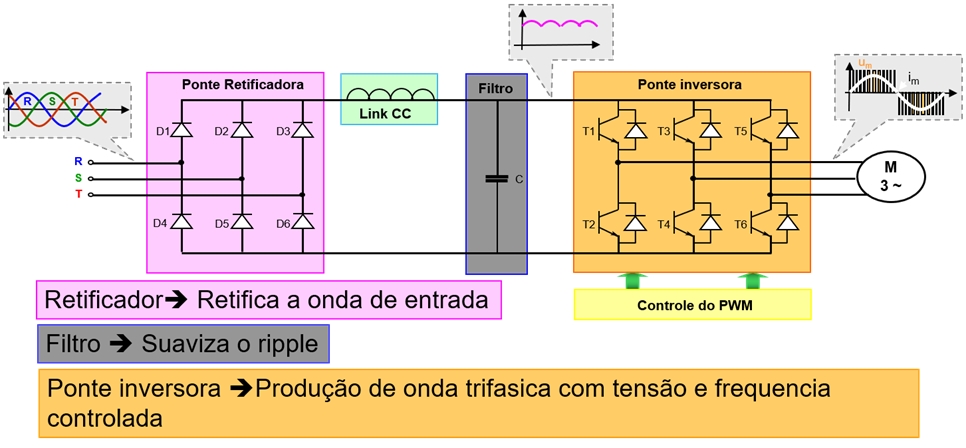
In Addition to Helping Save Energy, Variable Frequency Drives Are Responsible for Better Performance of Machines and Equipment
Those who think their only utility is to save energy are mistaken. On the contrary: variable frequency drives are responsible for better performance of machines and equipment; they require less maintenance; they protect the motor more effectively; they save space in installation and mainly facilitate the digital transformation for Industry 4.0!
Reymaster, based in Curitiba (PR) and Joinville (SC) – serving all of Brazil – has a complete portfolio of these devices through a partnership with Siemens and Schneider brands, along with a specialized technical team to meet each need of the national industry!








Seja o primeiro a reagir!