Portuguese
 Spanish


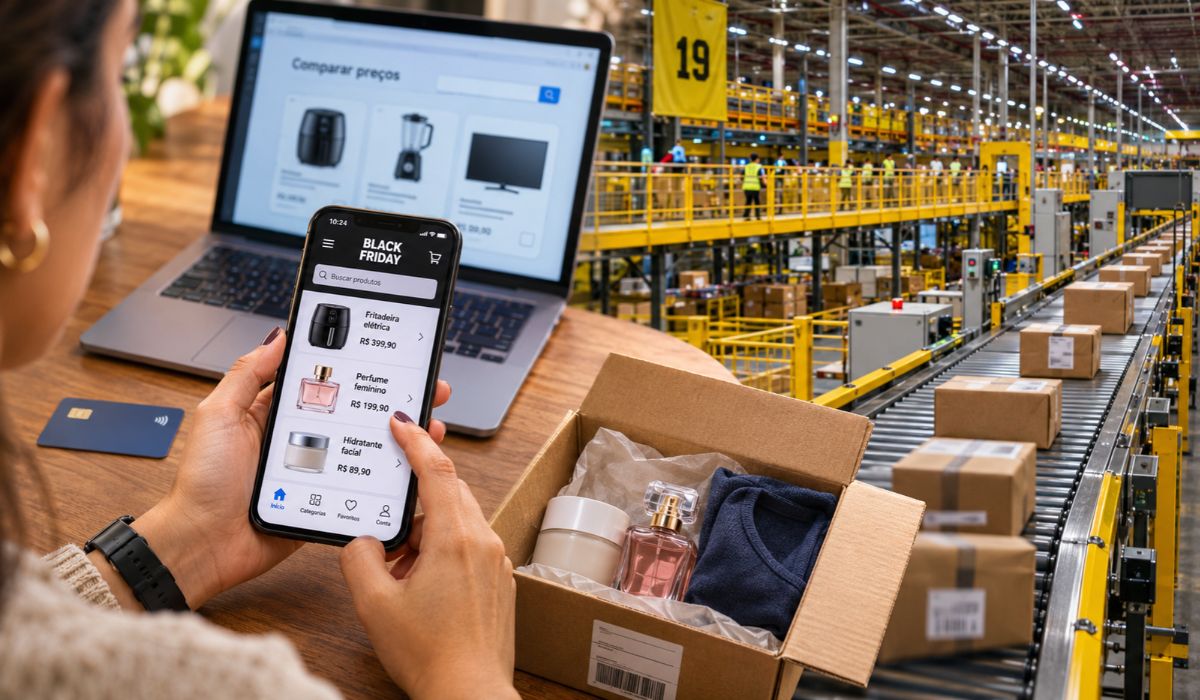

Brazilian e-commerce generates strong activity during Black Friday 2026, as consumers place lower-value orders, beauty product sales grow and some purchases shift to other days in November.
The 2026 Black Friday generated R$5.45 billion in Brazilian e-commerce sales over the 24-hour period on Friday, Nov. 27. A total of 10.49 million orders were recorded, but average order value fell from the previous year.
The figures were released Saturday (Nov. 28) by Confi through its market intelligence platform Neotrust, which tracks the performance of Brazil’s digital retail sector.
Average order value, a measure of the average value of each order, fell from R$549.83 to R$519.79, a 5.5% decline, according to the comparison in the report.
-

-

-
-




Despite the drop, Black Friday sales revenue was about 4.5 times the average daily revenue of Brazilian e-commerce in 2026, estimated at R$1.2 billion.
Consumers place more orders but lower the value of each purchase
Pedro Chiamulera, Confi’s CEO, said the difference between revenue trends and order volume suggests consumers are paying closer attention to prices and the deals offered by retailers.
Rather than focusing exclusively on higher-priced products, Brazilians also took advantage of promotions to buy items in other categories.
This pattern had already been observed before Black Friday.
Data collected by Confi from January through September 2026 showed that e-commerce orders rose 34.9% from the same period a year earlier, while average order value fell 13.4%.
However, a lower value per order does not necessarily mean that each consumer generated less in purchases during the campaign. One person may place several orders with different retailers.
It is also important to note that Neotrust’s financial indicators are reported in nominal values, without adjusting for inflation.


Appliances lead sales revenue as electronics lose ground
Despite changes in shopping behavior, appliances remained the top category by sales revenue on Black Friday.
The category generated R$794.1 million on Friday, up 6.1% from the previous event.
Mobile phones followed with R$451.8 million, while fashion and accessories generated R$414.8 million in sales.
One of the strongest results, however, came from a department that traditionally competes with technology products for consumers’ attention.
Beauty and fragrance recorded 21.2% growth, reaching R$293.2 million in sales revenue. The category contributed the most to the market’s expansion that day, according to the survey.
Sports and leisure also advanced, growing 11.5%, as did health, which rose 10.4%.
By contrast, the electronics department saw sales revenue fall 18.4%. Computers and IT declined 13.9%, while gaming dropped 1.2%.
For Mauricio Cwajgenbaum, business director at Neotrust and Aftersale, the differences among categories show that consumers did not respond uniformly to promotions.
E-commerce generates R$357.7 million in just one hour
The evening accounted for Black Friday 2026’s highest financial activity.
Between 7 p.m. and 7:59 p.m., online stores generated R$357.7 million, equivalent to approximately R$99,000 per second based on the average for that interval.
The time of peak sales revenue shifted from the previous edition, when sales peaked between 11 a.m. and 11:59 a.m.
Over the entire evening, e-commerce generated R$1.94 billion in sales revenue, accounting for 35.6% of Friday’s financial activity.
The surge also poses a challenge for companies responsible for payment processing, picking products, warehousing and shipping orders.
With millions of orders placed in a short period, retailers’ logistics capacity becomes especially important for meeting the delivery deadlines promised to consumers.

Black Friday sales are no longer concentrated on a single Friday
Some purchases took place before Black Friday officially began.
On Thursday, November 26, e-commerce generated R$2.94 billion. Combined, Thursday and Friday saw R$8.39 billion in sales and approximately 19 million orders.
Léo Bicalho, market intelligence director at Neotrust, said that advance purchases require retailers to spread their promotional strategies across several days rather than concentrate all their efforts on Friday.
The trend is also linked to the approaching holiday season.
A survey conducted ahead of Black Friday by Instituto Locomotiva and QuestionPro found that 70% of respondents planned to take advantage of the promotions to buy gifts early.
The discount campaign is not over yet. In October, Confi’s forecast projected R$13.3 billion in online sales from Nov. 26 to 29, ahead of Cyber Monday on Nov. 30.
For consumers who have already made purchases online, Brazil’s National Consumer Secretariat (Senacon) notes that they may exercise their right to cancel within seven days of receiving the product or, as applicable, signing the contract, without giving a reason or paying additional costs.