





 Portuguese
  English
  Spanish
  6 min of reading
  0 comments


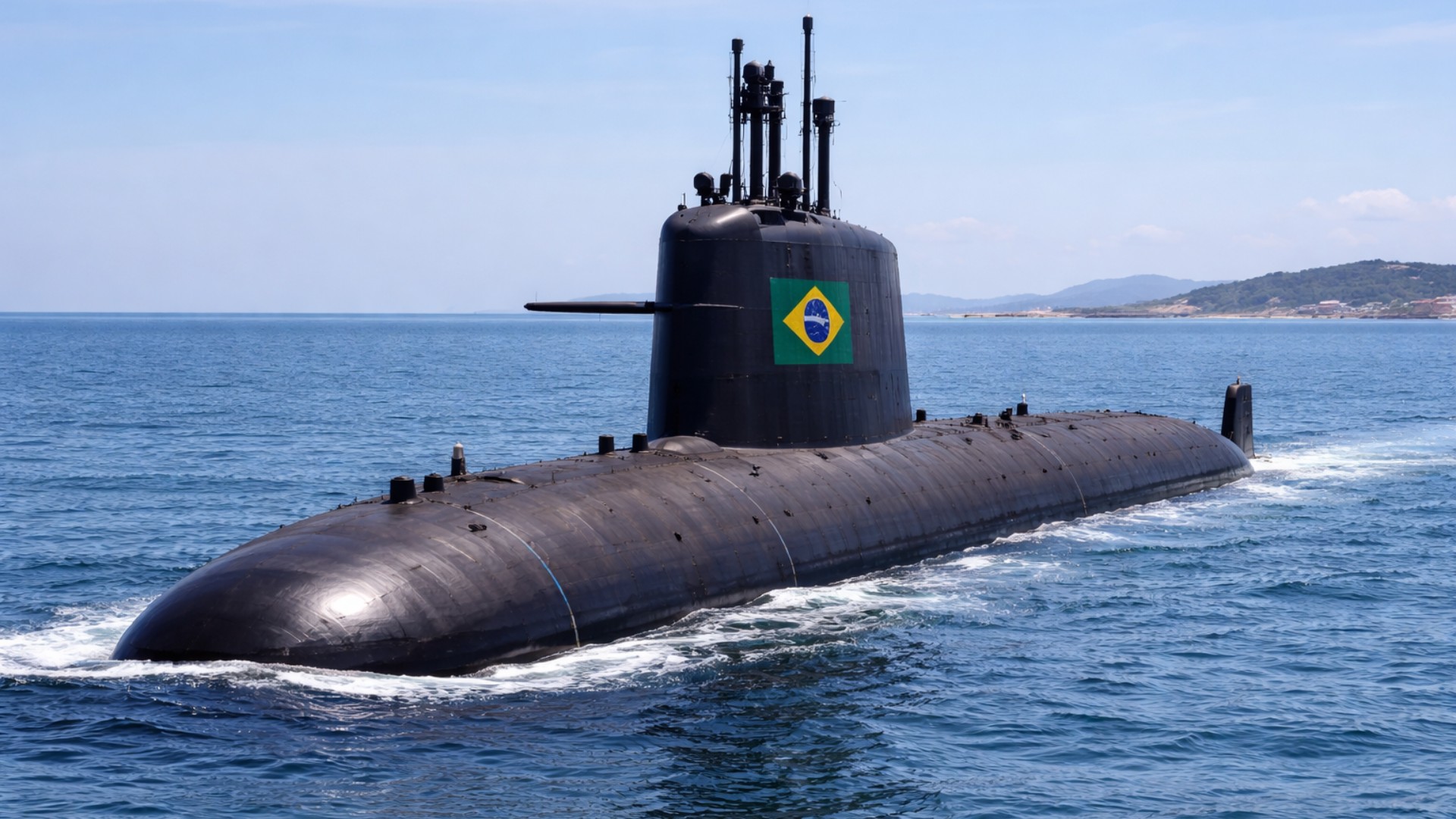
International pressure, budget disputes, and sensitive technology place the Brazilian nuclear submarine project at the center of a strategy involving defense, autonomy, and geopolitics, while the country tries to advance without revealing information considered critical by the Navy.
The advancement of the first Brazilian submarine with nuclear propulsion is surrounded by two fronts of pressure, according to an interview given to the BBC Brazil newspaper: the dispute for resources to maintain the schedule and negotiations with international organizations to safeguard data considered strategic by the Navy.
Leading this process is Admiral Alexandre Rabello de Faria, in command of the General Directorate of Nuclear and Technological Development of the Navy since April 2024, at a time when the country is trying to move forward with the Álvaro Alberto project, a central piece of PROSUB, a program initiated in 2008 with France and connected to a Brazilian ambition dating back to the late 1970s.
In Rabello’s assessment, Brazil should not give up either the technology or the military objective associated with the submarine, according to a report published by BBC Brazil.
-
A Brazilian island charges R$ 0.50 to receive visitors and prohibits any new residents.
-
Why was the Great Wall of China built? The truth that many are unaware of!

-
At 73.8 meters tall, the world’s tallest teapot-shaped building has 15 floors, ensures stability, and impresses with an internal space of 28,000 cubic meters.

-
Ambev has planted over 3 million trees and restored an area equivalent to the coastline from São Paulo to Natal, and the result after 15 years of silent investment has finally appeared for all of Brazil to see.


In an interview, the admiral maintained that the vessel is treated by the force as a deterrent instrument for the so-called Blue Amazon and for the extensive Brazilian coastline.
The central argument is operational: a nuclear-powered submarine can remain on patrol longer, move at greater speed, and enhance the Navy’s response capability to threats in the South Atlantic.
Tests of the nuclear reactor and stage in Iperó


Today, however, the project still depends on a stage prior to the sea.
The technical focus is on the Nuclear Electric Generation Laboratory (Lagene), in Iperó, in the interior of São Paulo, where the Navy intends to validate on land the prototype of the nuclear plant that will equip the submarine.
The logic is to exhaustively test the reactor and the propulsion system before any integration into the hull.
Only after this phase does the plan foresee the assembly of the onboard plant and the sequence of tests in Itaguaí, Rio de Janeiro, where the shipyard and the program’s infrastructure are already located.
Budget and delays in the Brazilian nuclear submarine
The main bottleneck remains the budget.
Rabello states that the program has suffered successive delays due to fluctuations in public funding, and the Navy itself admits that the speed of execution directly depends on the regularity of financing, according to findings from the BBC Brazil newspaper.
The timeline mentioned by the admiral for the submarine’s launch in 2037 has come to symbolize precisely this impasse: without a stable flow of resources, the goal may slip again.
The assessment also aligns with the government’s official monitoring of strategic defense projects, which has already recorded delivery difficulties linked to budgetary constraints.
While the nuclear submarine remains under development, PROSUB has advanced on parallel fronts.
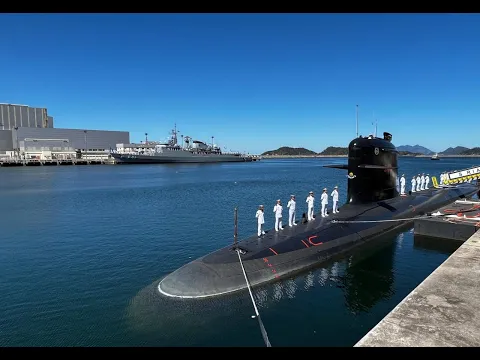
The Navy reports that Riachuelo and Humaitá have already been incorporated into the operational sector, that Tonelero has been launched and undergone immersion tests, and that Angostura remains as the fourth conventional submarine planned in the program.
This sequence is relevant because the experience accumulated with the construction, integration of systems, and operation of conventional submarines is presented by the force as an industrial and technological base for the leap of Álvaro Alberto.
Negotiation with the IAEA and protection of sensitive data
In the external field, the knot lies in defining the safeguards that will be applied to the nuclear material intended for naval propulsion.
Brazil is maintaining a specific discussion with the International Atomic Energy Agency regarding procedures outlined in Article 13 of the quadripartite safeguards agreement, a mechanism that addresses nuclear material used in activities such as submarine propulsion.
In May 2022, the country submitted a proposal for special procedures to the agency, and the negotiation continued to be analyzed in subsequent reports from the body.
It is at this point that Rabello establishes a line of resistance.
The admiral states that the country needs to fully comply with its non-proliferation commitments, but asserts that it is not acceptable to disclose information that could compromise Brazilian defense.
The concern is to separate what the IAEA should verify to ensure that there will be no diversion of nuclear material from what the Navy treats as sensitive technical data regarding the reactor, propulsion, and military performance of the vessel.
In practice, the negotiation revolves around this limit.
The Brazilian position also appears in broader international forums.
In 2025, during the IAEA General Conference, Brazil reiterated that any safeguards arrangement for naval nuclear propulsion should preserve the non-discriminatory nature of the international regime and be treated with institutional transparency.
At the same time, the agency recognizes that the topic is sensitive and without many precedents, which helps explain why there is no quick resolution for the Brazilian case.
International scenario pressures Brazil’s defense strategy
Rabello relates the importance of the project to the deterioration of the strategic environment, as also pointed out by BBC Brazil.
In the interview, he cited the war in Ukraine and the conflict involving Iran as examples of a more unstable international system focused more on national protection logic.
The admiral’s reading is that, in this scenario, the sea remains Brazil’s most vulnerable frontier, especially since the country still does not have a fully consolidated maritime surveillance system.
Therefore, he argues, the deterrent capability in the South Atlantic has gained additional weight in naval planning.
This concern also appears in the way the Navy observes the movements of the United States in the Western Hemisphere.
The National Security Strategy published by the White House in December 2025 states that the hemisphere hosts strategic resources and that Washington should deepen regional partnerships to shape this area of interest.
Commenting on this geopolitical redesign, Rabello said he sees the U.S. as a historical partner but acknowledged discomfort with the pressure for countries to align with blocs in a new division of power.
The regional backdrop became even more sensitive after the American military operation that resulted in the capture of Nicolás Maduro in January 2026, an episode reported by international agencies and mentioned in the interview as a sign of the asymmetry between the naval power of the United States and that of South American navies.
Rabello stated that Brazil is not preparing to confront powers of that scale but defended the need to maintain at least a minimum capacity for protection and deterrence.
In this reasoning, the nuclear submarine appears less as a direct confrontation instrument and more as an asset of strategic presence, technological autonomy, and long-range protection.
The admiral’s statement summarizes the logic that sustains the program even amid delays, high costs, and diplomatic pressures.
“What compromises Brazil’s defense cannot be negotiated or accepted by the country,” he stated when discussing international safeguards.
In another passage, he reinforced the same line by saying that Brazil “cannot give up this technology and this military asset.”
The Navy’s bet, therefore, continues to be to preserve the project, consolidate the industrial base created around it, and prevent the combination of fiscal tightening and external pressure from reducing an initiative treated internally as strategic.






Seja o primeiro a reagir!