





 Portuguese
  English
  Spanish
  4 min of reading
  1 comment


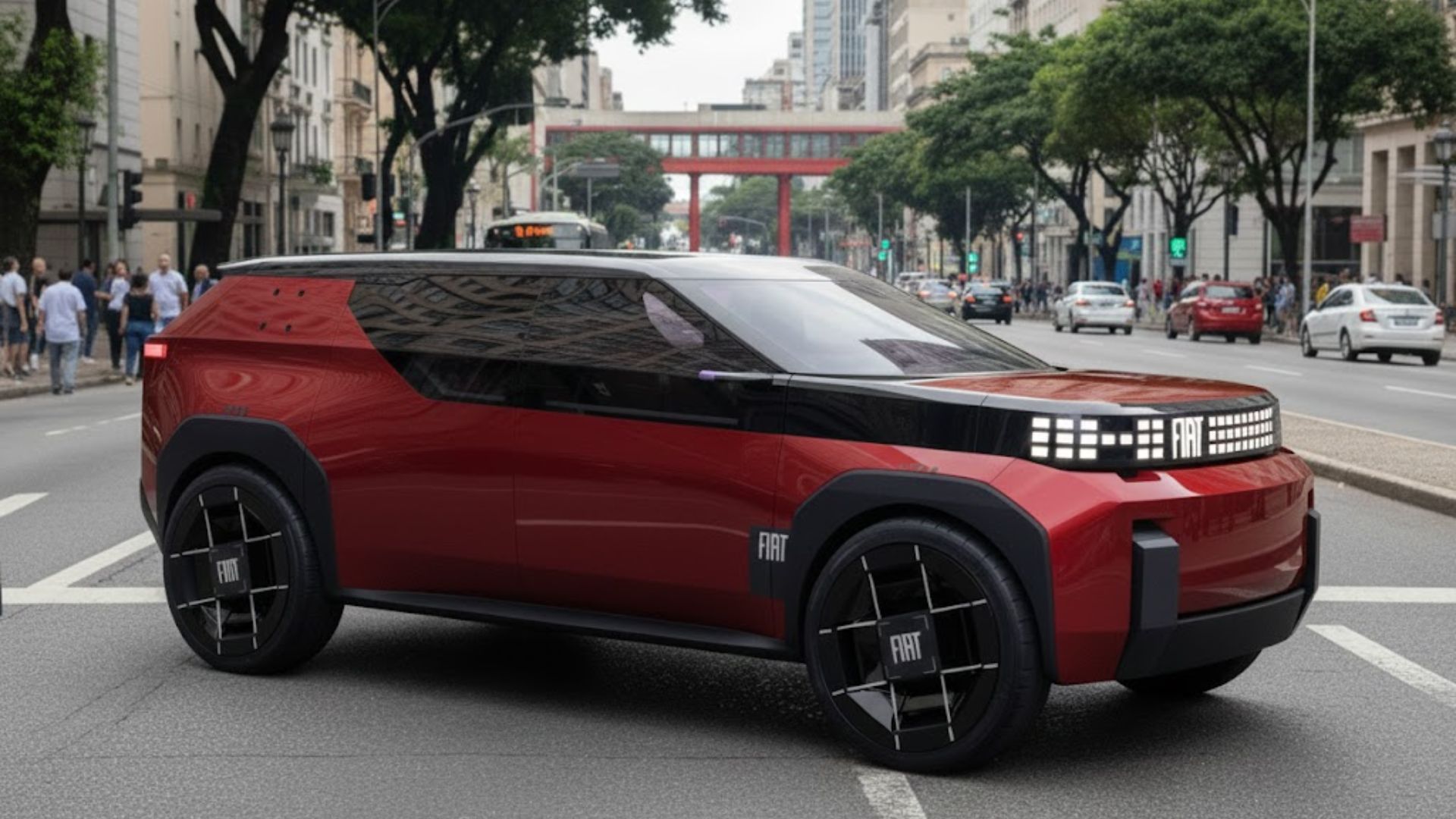


Fiat’s Seven-Seat SUV Advances in Global Planning, With Launch Expected in Europe Before Arriving in Brazil, Focused on Interior Space, Mild Electrification, Local Production, and Positioning Above Current Models of the Brand in the Brazilian Market.
Fiat is preparing a new seven-seat SUV for production in Brazil, with an expected arrival in dealerships around 2027, according to information already disclosed by automotive publications.
The new model, internally referred to by the codename F2U, is expected to use a 1.0 turbo flex engine with a 12-Volt mild-hybrid system, delivering up to 130 hp and working with a CVT transmission with simulated ratios.
The model also targets dimensions around 4.40 m in length, with a family-oriented proposal and an estimated price in the range of R$ 150 thousand.
-
The Toyota Hilux is R$ 75.5 thousand cheaper and bets on the 2.8 turbodiesel engine with up to 204 hp and 50.9 kgfm to catch up with the VW Saveiro, which leads with 4,472 sales.
-
The new Renault Koleos has a screen exclusively for the passenger that is invisible to the driver, heated rear seats, and 29 assistance systems, but its Chinese competitors cost R$ 40,000 less and deliver more power.
-
The car stored for 38 years: when opening the barn door, what appears is breathtaking and looks like a scene from a movie!

-
Fiat works miracles in the Brazilian market, lowers the price of its 0 km hatch to R$ 69,990, reestablishes the model as the cheapest car in the country, and reignites the battle against Kwid and C3.

Although the car is designed for the Brazilian market, the debut is expected to occur in Europe first, with a launch planned for 2026.
The strategy, according to findings published by the site Motor.es, is to position the utility vehicle as a top offering in the brand’s portfolio in the region, where Fiat is seeking to reinforce competitiveness in a segment pressured by the presence of Chinese manufacturers.
Name Pandissima and Connection with the Giant Panda
In Europe, Motor.es indicates that the model may adopt the name Pandissima, directly referencing the Giant Panda.
The connection would not only be through nomenclature.

The expectation is that the two cars will share the Smart Car platform, a base that the Stellantis group has been using as architecture for different projects, including options with electrification.
In addition to the technical kinship, the European plan indicated by the report is to replicate a known recipe in the entry and mid-range SUV segment.
The proposal combines good interior space and competitive pricing, a strategy that helped consolidate the Duster sold in Europe by Dacia.
In this context, the new utility vehicle appears as an alternative to models of Chinese origin.
The publication cites competitors such as MG ZS, Jaecoo 5, and BYD Yuan Pro, within the market analysis conducted for the European continent.
Project F2U in Brazil and Positioning Above in the Range
In Brazil, the F2U is expected to occupy a tier above other projects planned for Fiat by the end of the decade.
Information published in the country indicates that the brand is working with a new name for the national market.

The positioning is expected to be above products such as the Fastback, considering a future generation of the coupe-SUV.
The proposal is to offer a vehicle clearly aimed at families, with capacity to accommodate up to seven occupants.
This type of configuration has gained relevance in the national market by catering to consumers seeking more seating without moving to larger and more expensive vehicles.
So far, there is no official presentation of design, versions, or a complete list of equipment.
Dimensions Close to the Aircross and Focus on Interior Space
The numbers suggested for the SUV in Brazil indicate a size similar to the Citroën Aircross, also from the Stellantis group.
The dimensions cited by specialized vehicles indicate around 4.40 meters in length, 1.75 meters in width, 1.66 meters in height, and 2.68 meters in wheelbase.
In practice, these figures suggest a cabin prioritized for space, aligned with the proposal for seven seats.
The structural base will be the Smart Car platform, used by the group in projects of different brands.
The adoption of this architecture is expected to facilitate local production and standardization of components.
Still, the final calibration and content adjustments depend on official confirmation from the manufacturer.
1.0 Turbo Mild-Hybrid Engine and CVT Transmission
The mechanical setup indicated for the F2U in Brazil follows the line of mild electrification adopted by the group.

The SUV is expected to use a 1.0 turbo flex engine with a 12-Volt mild-hybrid system.
The estimated power is up to 130 hp, with torque of 20.4 kgfm.
The transmission will be a CVT gearbox with seven simulated gears.
The mild-hybrid system focuses on reducing consumption and emissions in specific usage situations.
The final efficiency will depend on factors such as vehicle weight, calibration of the setup, and gear ratio.
This data has not yet been officially disclosed.
Stellantis Investment and Plan Until 2030
The arrival of the new SUV is part of the investment cycle announced by Stellantis for South America.
In March 2024, the group announced an investment of R$ 30 billion, with execution planned between 2025 and 2030.
The plan includes the launch of more than 40 new products and the development of technologies focused on electrification and decarbonization.
The investment was also disclosed by the federal government within the context of industrial policies for the automotive sector.
Within this scenario, the F2U emerges as a strategic piece.
In addition to expanding Fiat’s presence in a family-oriented category, the model reinforces the adoption of electrified systems in local production.






Base do Duster, materia nada a ver com nada o Duster e da Renault, avisa o amigo que escreveu