





 Portuguese
  English
  Spanish
  3 min of reading
  0 comments


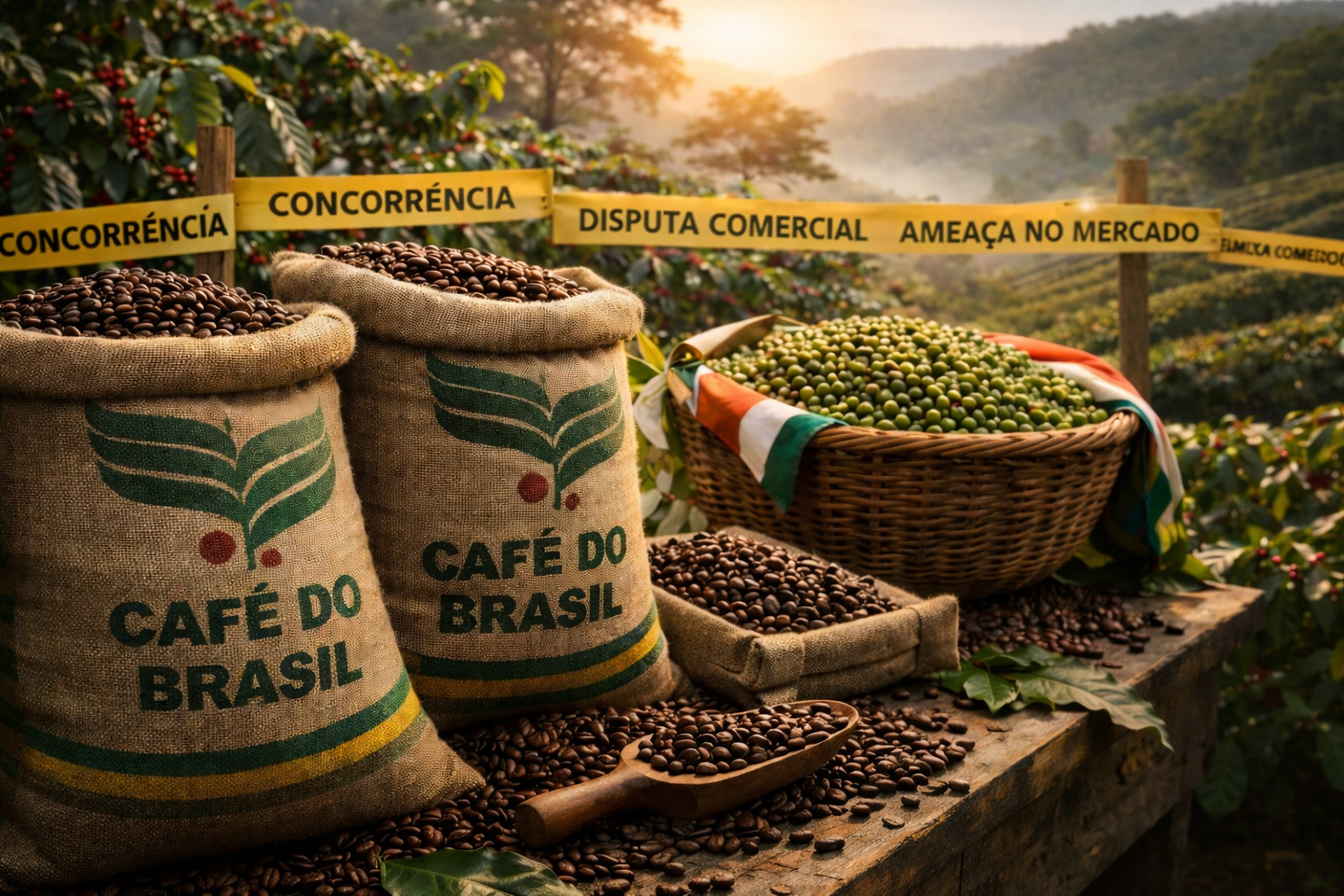
Rapid Growth of the Indian Coffee Industry Draws Attention from the International Market, While Brazil Maintains Hegemony in Volume, Structure, and Influence on Global Prices
Brazilian coffee still serves as the foundation of the global market, maintaining a leadership built over decades. Nevertheless, the recent advancement of India’s coffee industry has started to attract international attention, especially in light of growth projections and strategies aimed at the premium segment.
Currently, Brazil remains the largest producer and exporter of coffee on the planet, holding a significant advantage over other competitors. Even so, Indian growth has begun to be monitored by analysts, although it starts from a much lower level.
India’s Growth Draws Attention from the Coffee Sector
In recent years, the Indian coffee industry has shown significant growth, driven by specific varieties of beans and a strategic repositioning in the global market. According to industry projections released up to 2024, the country is expected to see an expansion of 8.9% by 2028.
-
Middle East War Hits Fertilizers and Transportation and May Strain Brazilian Wallets
-
Russia Considers Suspending Gas to Europe After Surge in Energy Prices

-
How A War Thousands of Miles From Brazil Started Disrupting Global Shipping Routes, Raising Container Costs, and Putting Up to 40% of Brazilian Beef Exports at Risk
-
Iran-U.S. War Drives Up Oil Prices and Pressures Global Financial Markets


As a direct result, the value of the Indian coffee market could reach around US$ 3.2 billion, equivalent to approximately R$ 16 billion. Additionally, long-term estimates indicate that production could reach 9 million tons by 2047, reinforcing the country’s strategic planning.
Despite this, industry experts emphasize that this growth occurs from a small base, which limits immediate impacts on the global supply balance.
Brazil Maintains Historical Dominance in the Coffee Market
Meanwhile, Brazil maintains a largely dominant position in the global coffee sector. For decades, the country has led production and global exports, backed by a robust production chain, established infrastructure, and strategic presence in key consumer markets.
Widely cited data in the international market indicates that Brazil produces about 69.9 million bags of coffee per year. Each bag, according to the official international standard, is equivalent to approximately 60 kilograms, a metric that highlights the scale of Brazilian production.
Moreover, Brazil’s role in setting global prices remains central, as the country combines volume, supply regularity, and bean diversity.
Global Ranking Reinforces Brazilian Advantage
To contextualize the current scenario, the ranking of the largest coffee producers and exporters highlights the significant gap between Brazil and other countries. According to consolidated international market data from 2020 to 2024, the distribution is as follows:
• Brazil: about 69.9 million bags
• Vietnam: approximately 31.3 million bags
• Colombia: about 11.6 million bags
• Indonesia: around 11.0 million bags
• Ethiopia: approximately 8.5 million bags
• India: between 6 and 7 million bags
• Honduras: about 5 million bags
• Peru: approximately 4 million bags
• Mexico: around 3.8 million bags
These figures, widely cited by industry reports and market institutions, reinforce Brazil’s leadership in the global landscape.
Indian Growth Does Not Alter Brazil’s Hegemony
Therefore, although India’s expansion represents a significant movement in the medium and long term, Brazil remains at a much higher level in volume, influence, and production stability. Until 2028 and, subsequently, until 2047, projections indicate Indian growth, but without the capacity to alter, in the short and medium term, Brazil’s hegemony in the global coffee market.
In light of this scenario, the market is closely monitoring India’s evolution, while Brazilian coffee remains the primary global reference, sustaining its historical leadership.
Will this Indian advancement be able to change the industry’s balance or does it merely reinforce the structural strength of Brazilian coffee?










-

-

-

6 pessoas reagiram a isso.