





 Portuguese
  English
  Spanish
  5 min of reading
  0 comments


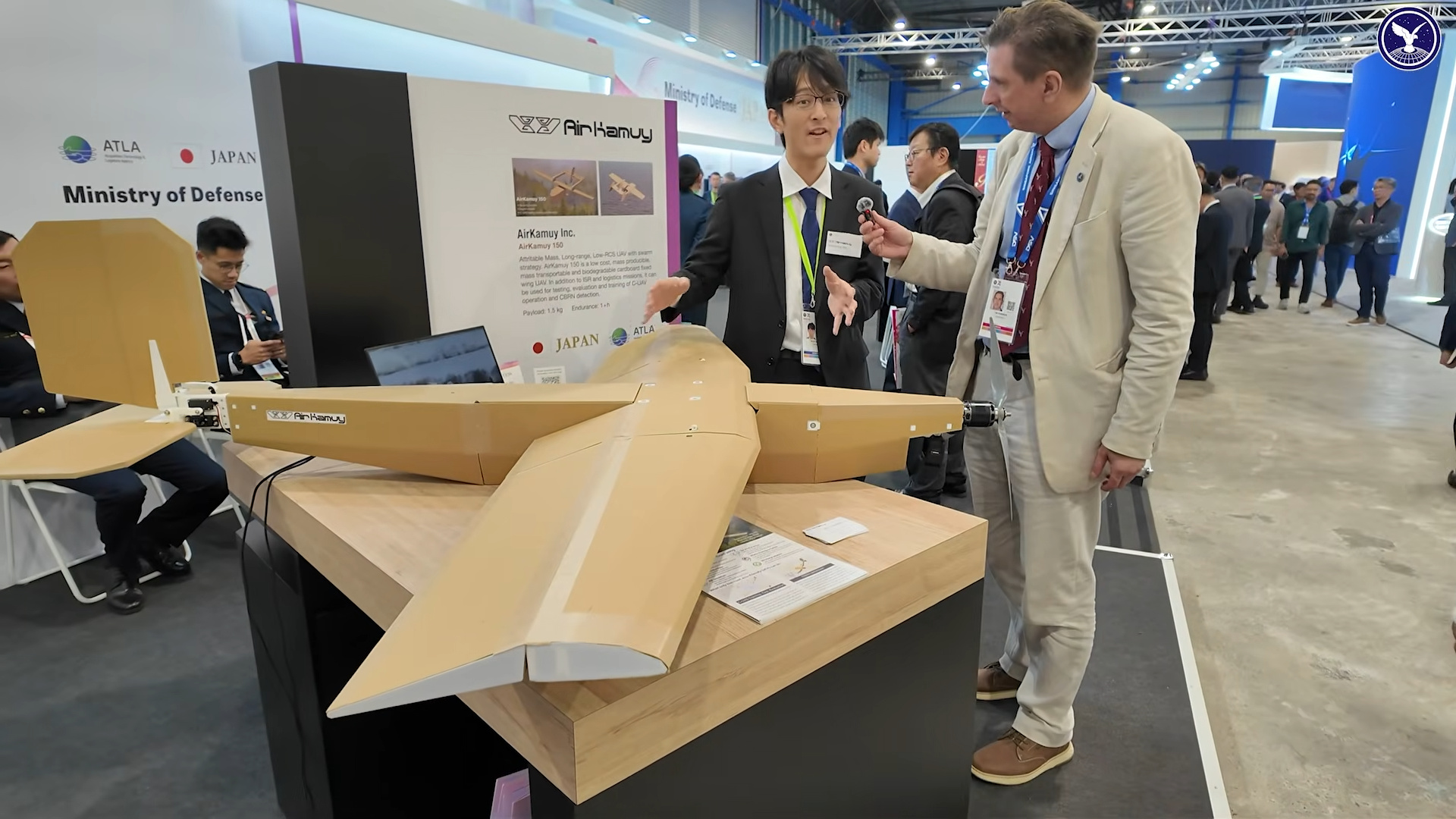
Japanese cardboard drone promises 120 km/h, up to 80 km range, and 2 hours of flight with quick assembly and low cost.
In 2025, a project for a cardboard drone developed in Japan gained attention by presenting a proposal that combines structural simplicity with low production cost. The initiative, associated with the startup AirKamuy, introduced a drone whose main structure is made of cardboard, designed to scale up manufacturing and reduce reliance on more complex materials. According to information released by the company on its official product page, the AirKamuy 150 is described as the first fixed-wing UAV in Japan made primarily from cardboard, developed to offer long-distance and long-duration flight with a focus on cost-effectiveness.
The proposal was already on the company’s public agenda in 2026, when AirKamuy announced participation in the Singapore Airshow 2026 with the exhibition of conceptual models of fixed-wing unmanned aircraft with strong cost-performance appeal, reinforcing that the project was being presented within a relevant technical circuit of the Japanese aerospace industry.
The combination of these characteristics positions the project as a low-cost alternative within a segment dominated by drones with composite structures and greater industrial complexity. In more recent institutional material from ATLA, the acquisition and logistics agency of the Japanese Ministry of Defense, the AirKamuy 150 is described as a fixed-wing UAV made from cardboard, with low cost, suitable for mass production, and for swarm missions, with endurance listed as 80 km or 80 minutes and maximum payload of 1.5 kg.
-
Ceará stands out in the world: it appears in the first photo of Earth taken by Artemis II, and a detail in the Brazilian Northeast catches attention even with clouds covering part of the state.
-
With a 6-liter tank and a door that opens by itself, the Midea countertop dishwasher cleans 30+ items without installation, promises up to 70% less water usage, and 30% faster drying, featuring a display, child lock, and anti-leak system.
-
Enormous carvings over 1,000 years old reappear on a beach in Hawaii after being buried for years, and the impressive details of these ancestral images intrigue locals and experts.
-
Portuguese ship carrying a treasure of $138 million that was taken by pirates in 1721 near Madagascar may have been found after nearly 300 years.

Drone with cardboard structure reduces cost and allows assembly in a few minutes without the need for complex infrastructure
The most evident differential of the project lies in the use of cardboard as a structural base. Unlike traditional drones, which use materials like carbon fiber, metal alloys, or advanced polymers, this model was designed to utilize a widely available, lightweight, and easy-to-handle material.
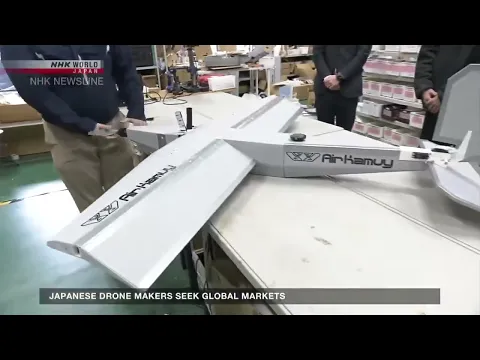

The structure is composed of pre-cut pieces that can be assembled quickly, without the need for industrial tools or complex processes. This type of approach allows the drone to be:
- assembled in a few minutes
- transported disassembled
- produced on a large scale with reduced cost
Despite the simplicity of the structural material, essential components such as the motor, control system, and batteries continue to be manufactured with conventional technologies, ensuring the equipment’s functionality.
Speed of up to 120 km/h positions the project close to more advanced drones in the same category
One of the most striking data is the ability to reach up to 120 km/h, a significant speed for drones in this category. This performance brings the equipment closer to models used in logistical and operational applications that require speed in movement.
The speed is influenced by factors such as:
- aerodynamic design
- reduced weight of the structure
- efficiency of the propulsion system
The combination of these elements allows the drone to operate with competitive performance, even using a structural material considered simple.
Autonomy of up to 2 hours expands usage possibilities in long-duration missions
Another relevant aspect is the estimated autonomy of up to 2 hours of flight, which significantly expands the equipment’s field of application. In practical operations, this time allows covering extensive areas without the need for recharging or battery replacement.
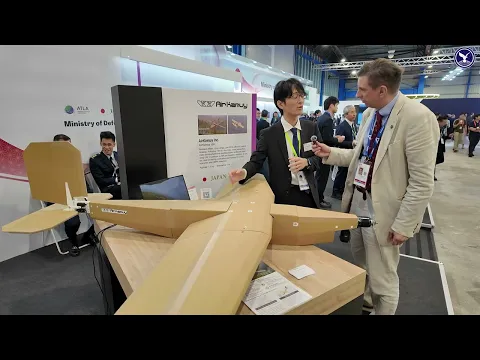
This feature is especially important in scenarios such as:
- monitoring remote areas
- transporting small loads
- logistical support in isolated regions
Autonomy is directly related to the energy efficiency of the system and the low structural weight, which reduces consumption during flight.
Range of up to 80 km positions the drone as a solution for medium-distance operations
With an estimated range of up to 80 kilometers, the drone positions itself as a viable alternative for operations that require movement between distant points. This range allows connecting areas that lack conventional logistical infrastructure.
In practice, this means that the equipment can be used for:
- delivery of supplies
- transporting lightweight equipment
- reconnaissance operations
The actual range may vary according to factors such as payload, weather conditions, and mission profile.
Project bets on scale production as a competitive differential in the global market
The simplicity of the structure allows the drone to be produced on a large scale with relative ease. The use of cardboard as a base material reduces costs and facilitates access to raw materials, which can accelerate manufacturing in situations of high demand.

This production model is particularly relevant in contexts where there is a need for:
- rapid replenishment of equipment
- distribution in large quantities
- reduction of operational costs
The proposal aligns with a growing trend of developing more accessible and adaptable solutions.
Potential applications include logistics, monitoring, and emergency operations
Although the project is still in the development and validation phase, its characteristics indicate a set of potential applications. Among them are logistical operations in hard-to-reach regions, where traditional infrastructure is limited.
Additionally, the drone can be used in environmental monitoring activities, inspection of extensive areas, and support for emergency operations, where rapid mobilization is a critical factor.
The combination of autonomy, range, and ease of assembly expands the possibilities of use in different contexts.
Use of simple materials reflects global trend of simplification and efficiency in engineering
The use of cardboard as a structural material is not only an economic choice but also reflects a broader trend in contemporary engineering: the search for solutions that combine efficiency, simplicity, and functionality.
Projects of this type demonstrate that it is possible to achieve relevant performance without relying exclusively on advanced and expensive materials. This approach may influence the development of new equipment in different sectors.
Despite the potential, the use of cardboard as a structural material imposes technical challenges. Resistance to weather conditions, durability, and load capacity are factors that need to be considered in the development and application of the equipment.
These aspects are part of the project’s evolution process and may influence its adoption on a large scale.
Growth of demand for drones drives innovation in materials and production models
The global drone market has shown continuous growth, driven by the expansion of applications in logistics, agriculture, security, and monitoring. This scenario encourages the development of innovative solutions that can meet different needs.
Projects like the cardboard drone fit into this context, offering alternatives that can complement traditional models.
The proposal presented by the Japanese project raises a relevant question about the future of engineering applied to drones. The combination of simple materials, quick assembly, and competitive performance suggests that new approaches may gain traction in the market.
In light of this scenario, a central question arises: can solutions based on accessible materials and simplified production transform the way drones are manufactured and used in the coming years?
Leave your analysis in the comments.





Seja o primeiro a reagir!