





 Portuguese
  English
  Spanish
  6 min of reading
  0 comments


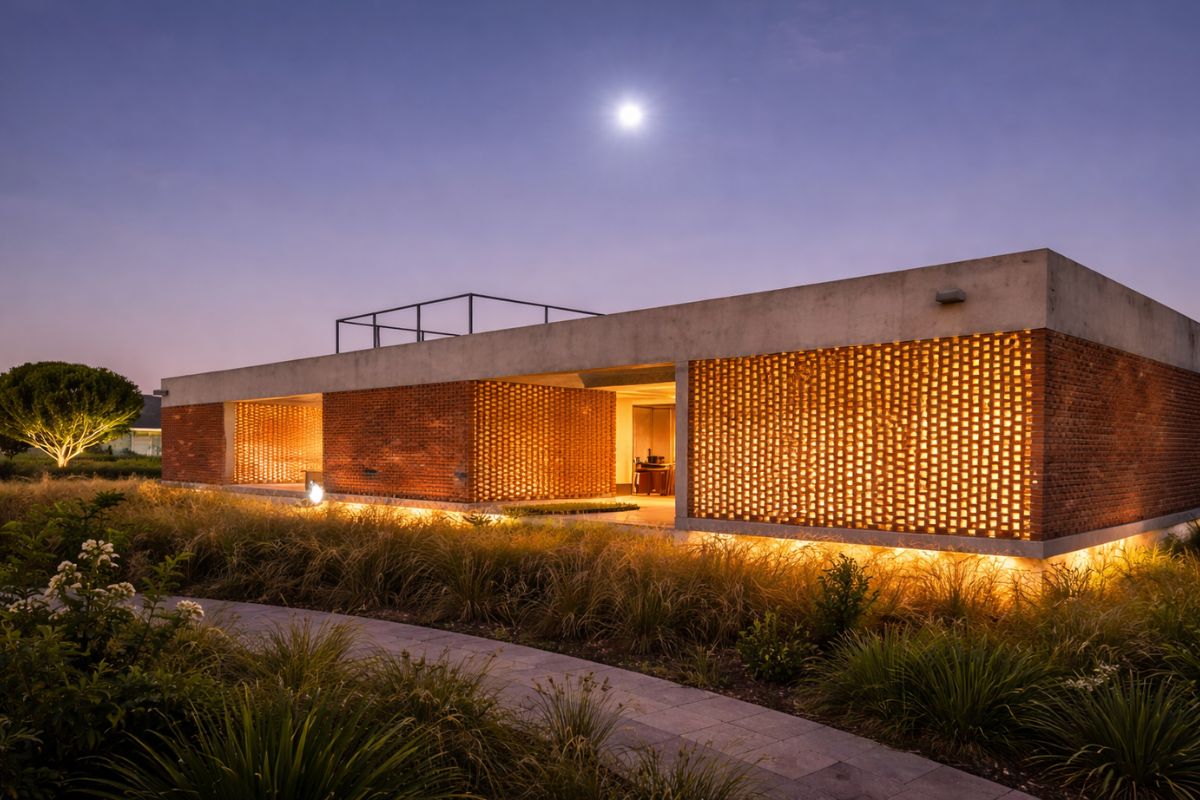
Loco Arquitetos’ Project Bets on Exposed Concrete, Prestressed Beams, Internal Courtyard, and Facade Without Conventional Windows
The Tupin House draws attention in Brasília for combining exposed concrete, prestressed beams, and an elevated structure that creates a sense of lightness even in a large residence. The project, designed by Loco Arquitetos and implemented in the Parkway condominium, relies on only 12 pillars to support the entire construction, in addition to an internal courtyard that reorganizes the relationship between privacy, light, and ventilation.
In the Tupin House, the architectural choice is clear: instead of conventional windows, the residence features floor-to-ceiling openings that can be completely transparent in glass, closed with bricks, or filtered by cobogó. The result is a house that closes off more to the outside and opens widely to its internal yard, with a pool, water mirror, and integrated living areas.
Tupin House Organizes Around an Internal Courtyard

One of the strongest points of the project is the layout organized around an internal courtyard. This space functions as a large backyard for the house, concentrating the more open relationships of the residence and helping to explain why the external facade is more closed.
-
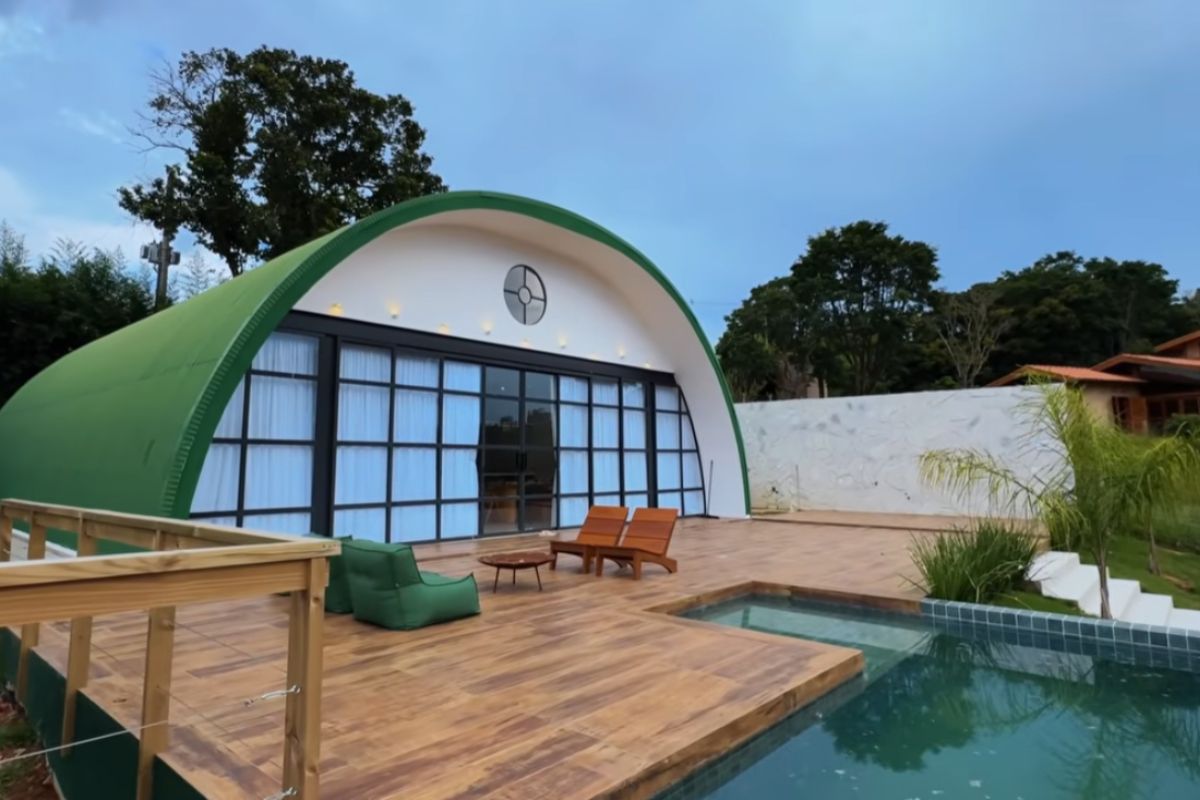
An architect transformed a hangar into a curved house with a view of the reservoir: a metal structure assembled in a week, glass doors, bold colors, toucans in the bathroom, and a design full of stories.
-
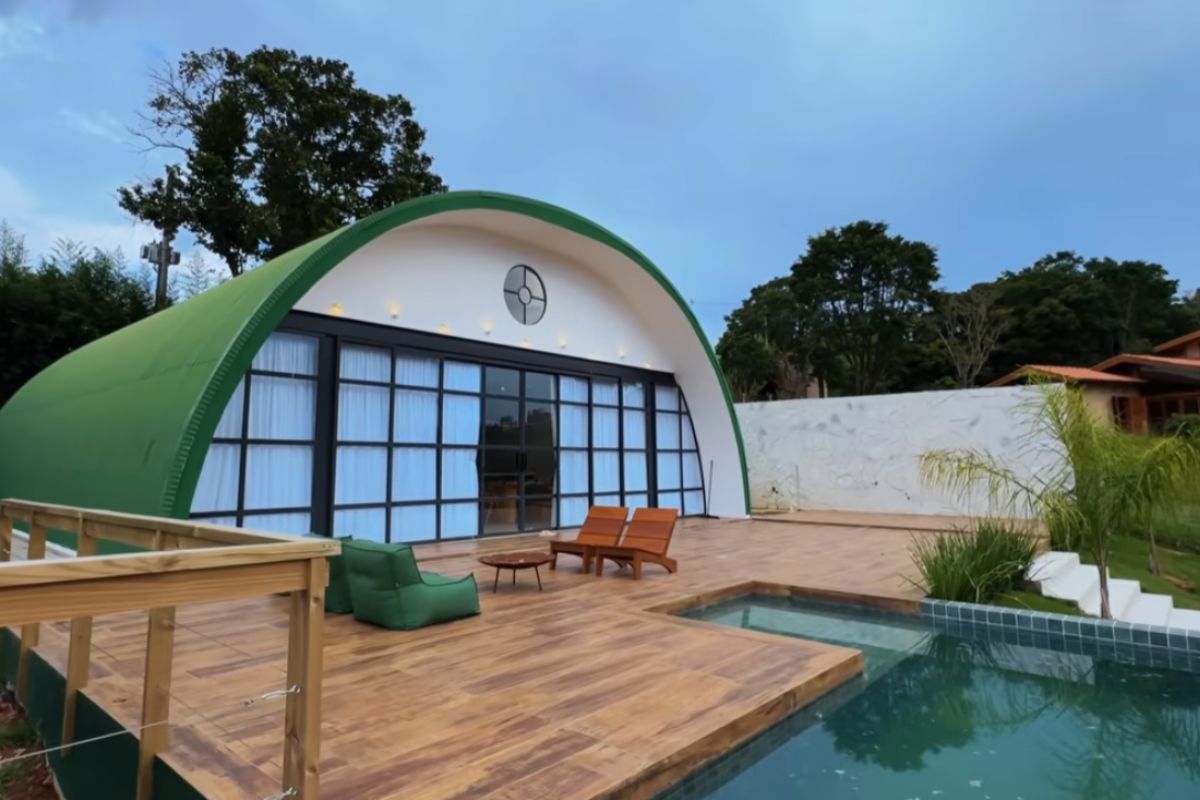
An architect transformed a hangar into a curved house with a view of the reservoir: a metal structure assembled in a week, glass doors, bold colors, toucans in the bathroom, and a design full of stories.
-
In Turkey, the Yusufeli dam nestled in a canyon sets a record: a concrete arch of 275 m, river diverted through a tunnel, 4 million m³ of concrete, 558 MW, and energy for 2.5 million people.

-
The factory shows how PHC piles and precast tubes are made; steel turns into a welded cage, high-strength concrete enters the mold, spins in centrifugation, cures in steam, and is ready in hours.

The Tupin House turns less towards the boundaries of the lot and more towards this central void, where social areas, the master suite, the pool, and the water mirror begin to interact with each other.
This solution creates a house that is introspective outward and expansive inward, reinforcing privacy without sacrificing brightness and connection between the environments.
According to the project presentation, this configuration depends on a wider plot with proportions closer to a square than a narrow rectangular lot. This helps to understand why the implantation is so important in the final reading of the work.
Structure Uses Exposed Concrete, Prestressed Beams, and 12 Pillars

The structural base of the Tupin House is one of the most striking features of the project. The residence works with exposed reinforced concrete, prestressed beams, and only 12 pillars supporting the entire structure.
This choice defines not only the visual aspect of the house but also its spatiality. With fewer visible supports, the environments gain continuity, and the construction reinforces the feeling of a suspended block. The structure ceases to be merely a support and becomes an architectural language.
In the presented images, it is also possible to clearly perceive the exposed concrete in stairs, slabs, beams, and external elements. This material repetition helps to give unity to the residence and consolidate a design of strong plastic presence.
House Without Windows Bets on Glass, Cobogó, and Bricks

Another decisive aspect of the Tupin House is the absence of conventional windows. Instead, the project works with large vertical openings, always from floor to ceiling, using different strategies for closure and transparency.
In some areas, the enclosure is made with glass, ensuring total openness and direct visual contact. In others, cobogó and bricks are used, which maintain the passage of light and air in a more filtered manner. This combination allows for varying privacy, lighting, and ventilation without abandoning the coherence of the whole.
The cobogó, in particular, appears as an important element in filtering light. In certain environments, it creates a sifting effect of external brightness, helping to build softer and visually richer internal scenes.
Social Area Integrates Living Room, Dining Room, and American Kitchen

The organization of the Tupin House concentrates in the social portion an integrated sequence of living room, dining room, and American kitchen. This area appears as the main living space of the project, articulated with the internal courtyard and the external leisure area.
In addition to this core, the layout also includes a powder room, storage room, a support area connected to the kitchen, service area, drying area, and service bathroom. The distribution suggests a residence designed to keep daily life functioning without breaking the formal cleanliness of the main spaces.
The reading of the images also indicates a kitchen that is quite connected to the rest of the house, with a large countertop and visual integration with the living room. In some sections, the floor-to-ceiling cabinetry helps reinforce this continuous design of the interiors.
Intimate Area Opens to the Central Void of the Residence
In the intimate area, the Tupin House gathers suites organized in sequence and a master suite with a more direct relationship with the internal courtyard, the pool, and the water mirror. This proximity ensures that the main private space also participates in the logic of opening up to the interior of the house.
The master suite features a closet, private areas, and a suspended balcony facing this central section. The idea of waking up to a view of the internal lawn, the water, and the exposed beams reinforces the intention of making the courtyard the protagonist of domestic life.
The corridor of the intimate area also draws attention for its floor-to-ceiling cabinetry, which organizes access to the bedrooms and reinforces the continuous aspect of circulation.
Pool, Water Mirror, and Balcony Enhance the Sense of Refuge
In the external area internalized by the courtyard, the pool and water mirror play an important role in the ambiance. Besides the visual effect, this water helps to bring more humidity to the dry environment of the Central Plateau, according to the video’s own explanation.
The balcony connected to the master suite appears suspended over this section, with the possibility of a hammock and contemplative use. It is a space that transforms the external area into a direct extension of the bedroom, without losing the sense of shelter and privacy.
The gourmet area and the concrete countertops molded on-site reinforce the material coherence of the project, maintaining the language of exposed concrete even in leisure and living areas.
Terrace Expands the Use of the Roof and Technical Area
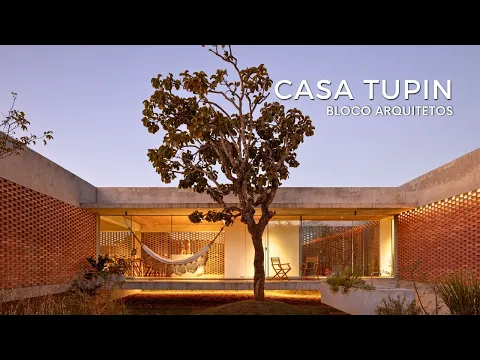

The Tupin House also features a staircase leading to the upper floor, where the terrace of the residence is located. This point functions partly as a visitable area and partly as an area connected to equipment and technical sections.
In the images, the terrace helps to show the house in relation to the horizon and the flat terrain of Brasília. It is also from there that one can better perceive the logic of solids and voids, skylights, and the implantation of the main volume above the natural ground.
This upper reading reinforces the clarity of the project and shows how the roof participates in the overall composition of the residence.
Light, Concrete, and Void Make the Tupin House Seem Suspended
Perhaps the most striking effect of the Tupin House is precisely the sensation of floating. This result comes not only from the elevation of the house or the 12 pillars but from the combination of structure, lighting, central voids, and surface control.
The exposed concrete gives weight and presence. The prestressed beams show robustness. But the light, the setbacks, and the transparent planes make the whole seem less massive than it actually is. The house mixes material brutality and spatial delicacy in a very rare way.
In the end, the Tupin House stands out for managing to transform structural decisions into architectural language. The concrete is not just there as a technique, the pillars do not appear only as support, and the internal courtyard does not function merely as a ventilation resource. All of this becomes part of a house that closes, opens, weighs, and floats at the same time.
And for you, what impresses you the most about the Tupin House: the structure with 12 pillars, the absence of conventional windows, or the internal courtyard that organizes the entire residence?








Seja o primeiro a reagir!