





 Portuguese
  English
  Spanish
  6 min of reading
  1 comment


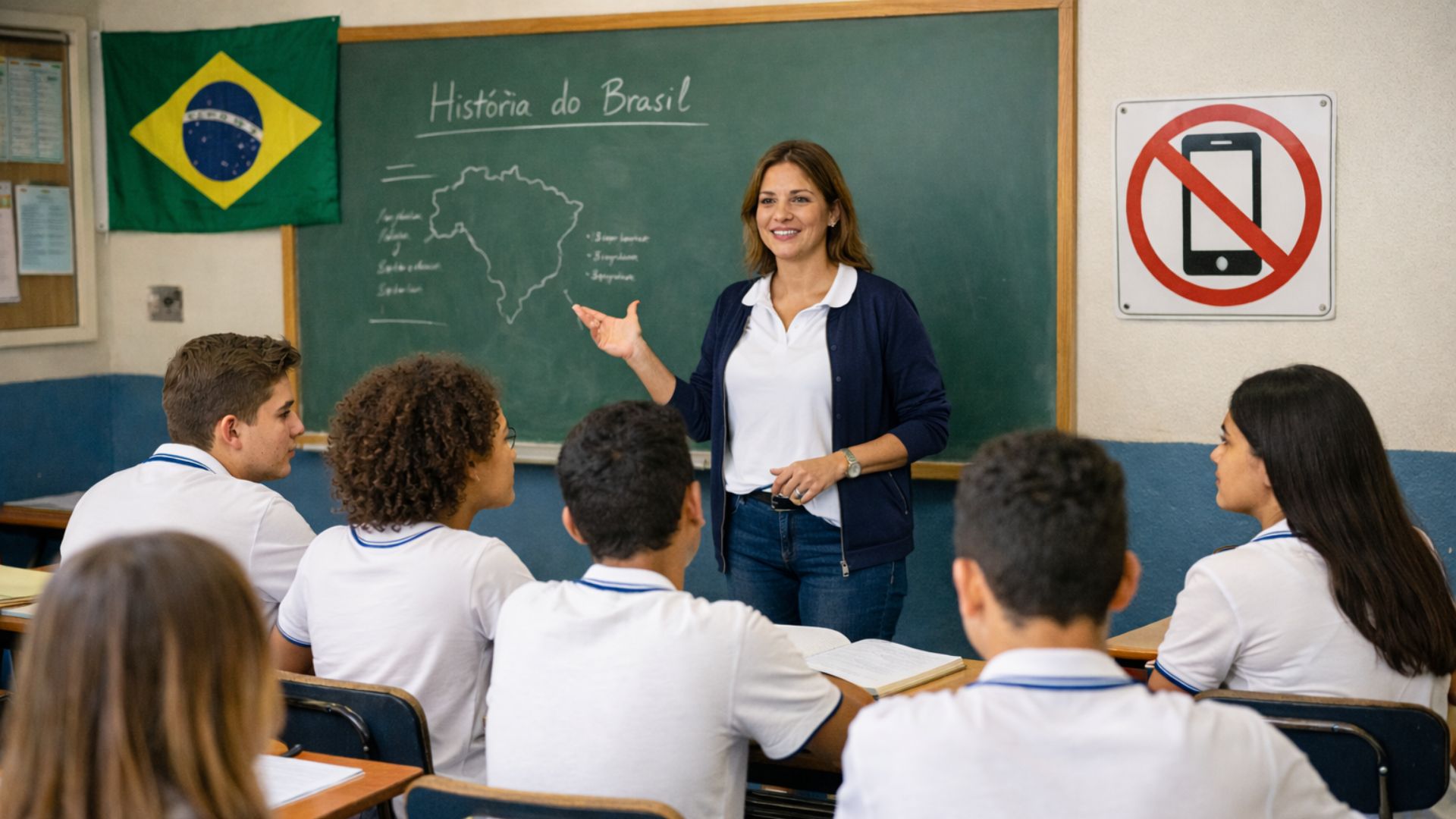

Understand how the restriction of cell phones in schools is transforming the educational routine, elevating student focus, strengthening teachers’ work, and boosting academic performance with results already perceptible in basic education.
The presence of cell phones in schools has always generated debates among specialists, managers, and families. In Brazil, this discussion took a new turn with the enactment of Federal Law No. 15,100/2025, which restricts the use of personal electronic devices in basic education, including classrooms, recesses, and breaks.
According to a report by Breno Marino, published in the Jornal da USP, one year after the implementation of the measure, students and teachers are already reporting significant changes. The first effects indicate improved concentration, increased participation in pedagogical activities, and consistent advances in academic performance.
The decision did not arise in isolation. According to specialists, it reflects a growing demand from educational institutions, which faced difficulties competing with the constant use of smartphones within the school environment.
-
Couple transforms industrial garage into dream home with 5 bedrooms, sauna, garden, and leisure area after million-pound renovation in England.

-
They laughed for 20 years at Roy Hassell’s “junkyard,” but when the agricultural crisis closed the John Deere dealership in Hardin, Iowa, the parts barn saved crops and entire farms in the region.

-
Archaeologists find possible lost temple of Zeus in the ancient city of Limyra after decades of searching; the millennia-old structure buried under historical layers could redefine the religious map of Anatolia and reveal how the Greeks worshipped their gods outside the classical axis.

-
BYD presents an absurd charging speed of 1,500 kW that adds 500 km of range in just five minutes, but BMW warns that this extreme speed could be costly for the battery of your electric car.

Why cell phones in schools have come to be seen as educational problems
The use of technology in education is not, in itself, negative. Digital platforms, educational videos, and online content have expanded the possibilities for teaching and learning. However, the unregulated use of cell phones began to compromise the focus of students.
In practice, many teachers reported difficulty in maintaining the class’s attention. While content was being presented, some students were connected to social media, games, or messages, which hindered the progress of the lessons.
This scenario created a kind of competition for attention. On one side, the pedagogical planning. On the other, constant and highly attractive digital stimuli. The result, in many cases, was a decline in academic performance and lower engagement.
Testimonies from students and teachers show direct impact on academic performance
According to Professor Vivian Batista da Silva from the Faculty of Education at USP, the prohibition meets a demand that is not exclusive to Brazil. According to her, there is a global movement to review the use of technology in the classroom.
After the implementation of the law, positive effects began to appear quickly. Students started to perceive new ways to organize their time and relate to the school environment.
Among the main observed reports are:
- Greater ease in maintaining attention during classes
- More active participation in proposed activities
- Reduction of compulsive use of digital devices
- Improvement in interaction with peers and teachers
These changes contribute directly to academic performance, creating a more favorable environment for learning.


Cell phones in schools and the return of focus in the classroom
One of the most evident impacts of the prohibition was the recovery of students’ attention. Without the constant presence of cell phones, focus was redirected to the content presented in class.
Teachers report that classes began to flow better, with fewer interruptions and greater involvement from the class. This allows for the exploration of more interactive methodologies, debates, and collaborative activities.
In addition, students are better able to follow the reasoning of explanations, which favors understanding of content and contributes to better academic performance over time.
Changes in behavior and relationships between students
Another important effect is related to behavior within schools. With the restriction of cell phones, students began to interact more with each other.
Moments like breaks and recesses, previously dominated by screen use, began to be occupied by face-to-face conversations, games, and other forms of social interaction.
This movement strengthens important skills, such as communication, empathy, and teamwork. For teachers, this change also reduces conflicts and improves the school climate.

Impacts on mental health and the digital balance of students
Excessive use of cell phones is often associated with problems such as anxiety, stress, and difficulty concentrating. By limiting this access within schools, a digital breathing space is created.
Students report feeling less pressure to respond to messages or keep up with social media during school hours. This contributes to a more tranquil environment conducive to learning.
Among the perceived benefits, the following stand out:
- Reduction of information overload
- Less constant social comparison
- More presence during class
- Better emotional balance
Teachers also point out that this scenario favors the development of a healthier and more organized routine.
Academic performance improves with more attention and active participation
The improvement in academic performance is one of the main results observed after the prohibition of cell phones in schools. With fewer distractions, students are able to absorb content better and develop essential cognitive skills.
Teachers highlight that the level of participation has increased significantly. Students who previously appeared distracted have started to contribute more in class, ask questions, and engage in activities.
This increase in engagement has a direct impact on learning. When students participate actively, they consolidate knowledge better and develop critical thinking.

Challenges persist in the application of the law in schools
Despite the advances, the implementation of the law still faces obstacles. Not all institutions have the appropriate structure to store devices, which complicates control.
Additionally, some students attempt to circumvent the rule by sneaking in cell phones or using devices irregularly. This requires constant attention from teachers and school management.
Among the main challenges are:
- Continuous monitoring of device use
- Adaptation of schools to the new rules
- Initial resistance from some students
- Need for dialogue with families
To prevent the law from becoming ineffective, specialists emphasize the importance of awareness and monitoring.
Pedagogical and conscious use of technology remains a challenge
The prohibition does not eliminate the importance of technology in education. On the contrary, it reinforces the need to use it strategically and consciously.
Digital tools continue to be used when there is pedagogical guidance. This includes teaching platforms, interactive content, and even artificial intelligence resources.
However, specialists warn against the superficial use of these technologies. The simple act of searching, copying, and pasting information does not contribute to real learning.
In this context, teachers play an essential role in guiding students on how to use technology critically and productively, without harming academic performance.
Higher education begins to adopt similar measures
The discussion about cell phones in schools has already surpassed basic education. Some higher education institutions, especially private ones, have begun to adopt restrictions on the use of cell phones in class.
The proposal is similar: to ensure greater focus during classes and improve the quality of learning. For teachers, this is an important step in academic training.
University students need to develop autonomy, concentration, and responsibility. Limiting the use of cell phones at specific times can contribute to this process.
What the results indicate about the future of Brazilian education
The data and reports observed over this first year show that the restriction of cell phones in schools can generate relevant positive impacts. Students and teachers are already noticing concrete changes in the school routine.
The improvement in academic performance, the increase in participation, and the strengthening of interpersonal relationships indicate that the balance between technology and learning is possible — and necessary.
More than prohibiting, the challenge lies in educating for conscious use. The current experience suggests that when well applied, the measure does not limit teaching but enhances its results.
The next step will be to consolidate these practices, overcome challenges, and ensure that technology continues to be an ally — and not a distraction — in the development of Brazilian students. And in your opinion, does the restriction on the use of cell phones in schools really improve focus and student performance, or is there still room to better integrate technology into learning?








Provide me 60 different highly-thoughtful, informative messages that adds value that I can use as comments to be placed on different websites to which I have added my website URL.