






 Portuguese


With a length of 134.2 kilometers, the Pinglu Canal creates a direct route between inland southwestern China and the sea, reducing logistical distances and enhancing China’s trade connection with Southeast Asia.
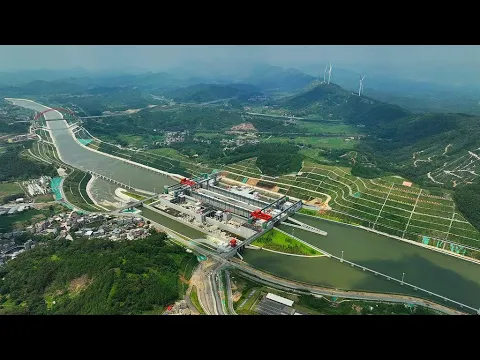
China officially launched the Pinglu Canal on September 16, 2026, a new river link spanning 134.2 kilometers between the interior of the Guangxi autonomous region and Beibu Bay, internationally known as the Gulf of Tonkin.
The canal creates a shorter route for cargo from southwestern China to reach the sea, potentially reducing travel times by over 560 kilometers compared to previous routes heading toward Guangdong’s ports.
Constructed with an investment of 72.7 billion yuan, about US$10.75 billion, the channel began construction in August 2022 and was completed just over four years later.
-
16 brown bears in Alaska will spend a week trying to out-eat each other before winter, and two of the contest’s biggest champions are missing this year

-
A humpback whale named Rio swam 60 miles up a California river past two bridges, and only two other whales have gone this far before
-
A Metal Detectorist Dug Up 10 Pounds of Viking Silver in a Finnish Field, and Finland’s Law Decides Exactly How Much of It He Gets to Keep
-
Delivery Driver Suffers Around 40 Bee Stings Rescuing 12-Year-Old in Ibirité, Receives Heartwarming Surprise


Designed to accommodate vessels up to 5,000 tons, the canal is part of the New International Land-Sea Trade Corridor, a network connecting China’s inland regions to ports and international markets.
According to estimates released by Guangxi authorities, the new route could reduce logistics costs by between 18% and 30% on certain routes and generate savings exceeding 5 billion yuan annually in transportation.
However, these percentages represent projections for traffic served by the corridor. They do not mean that all cargo shipped from southwestern China will automatically enjoy the same reduction in costs.
Canal creates a shortcut between inland China and the sea
The Pinglu Canal starts in the Hengzhou region, administered by Nanning, the capital of Guangxi, and heads south through Qinzhou to reach Beibu Bay.
Before the opening, some of the cargo transported via the inland waterways in the southwest had to travel east through the Xijiang river system and arrive in Guangzhou before reaching the coast.
With the new link, vessels can travel directly south.
This reduction exceeds 560 kilometers of inland navigation compared to the traditional route via Guangzhou.
For provinces and major economic centers in the interior, this difference may change the way goods reach ports.
Yunnan, Guizhou, Sichuan, and Chongqing are among the regions identified as potential beneficiaries of the new infrastructure.
Some of this cargo may reach Guangxi by rail or through existing river networks before entering the Pinglu Canal.

Vessels up to 5,000 tons can navigate the route
The canal was built to Chinese standard for Class I inland waterways, allowing traffic for vessels with capacities up to 5,000 tons.
Three major navigation complexes were constructed along the 134.2 kilometers: Madao, Qishi, and Qingnian.
These structures include lock systems that are necessary due to a total height difference of approximately 65 meters between the water levels along the route.
The locks raise or lower ships between different sections, allowing loaded vessels to traverse the route without needing to unload their cargo at each level change.
The project also incorporates water-saving systems in the locks.
At the Madao complex, for instance, the maximum height difference reaches 29.6 meters.

Testing Began Before the Inauguration
The official opening in September was preceded by weeks of testing with real vessels.
The evaluation phase along the entire length of the canal began on August 12, 2026, with four types of ships that represented expected traffic.
These included an empty vessel of 5,000 tons, another loaded with the same capacity, along with ships loaded with 3,000 and 1,000 tons.
The tests did not only verify whether the ships could complete the journey.
Teams assessed passage through the locks, crossing and overtaking of vessels, maneuvering in curves, docking influenced by tides, and navigation at night.
Situations less favorable were also simulated, such as strong winds, increased flow from tributaries, and changes caused by reservoir discharges.
In total, more than 200 navigation aids and signals were evaluated before the opening.
First Commercial Routes Launched on Inauguration Day
Commercial operations began immediately.
On September 16, two new connections were launched: an international route between Nanning and Can Tho, Vietnam, and a domestic route between Nanning and Yangpu, on Hainan Island.
About 30 cargo vessels passed through the canal on the first day, transporting products such as construction materials, coal, ores, steel, and fertilizers.
This activity indicates that the project was inaugurated not merely as a new physical work.
China had previously prepared railway, port, and river connections so that goods from the interior could use the passage from the start of operations.
Just days before the opening, trains from cities like Chongqing, Chengdu, and Zigong were already transporting goods to Nanning for connection with river and maritime vessels.
Hunan Train Demonstrates How Integrated Transport Will Work
One of the central proposals of the project is to combine different modes of transport.
In September, a railway link between the international dry port of Huaihua in Hunan Province and the Pinglu Canal became operational.
The train primarily carried construction machinery produced by Sany and other goods manufactured in Huaihua, which could later travel by water to maritime ports.
This model allows regions not directly connected to the canal by rivers to send products by train to Guangxi and transfer them to vessels.
Rail integration is particularly significant for Sichuan and Chongqing, large industrial centers located hundreds of kilometers inland.
Logistics savings could exceed 5 billion yuan per year
Guangxi authorities estimate that the Pinglu Canal could generate savings exceeding 5 billion yuan (approximately US$700 million) annually in transportation costs.
This estimate primarily relates to reduced travel distances and the use of water transportation for large-volume cargo.
According to regional estimates, total logistics costs for routes served by the new corridor could decrease by 18% to 30%.
These figures are still projections.
As the canal only began operations in September 2026, it will be necessary to monitor transported volumes, tariffs, port costs, and vessel utilization to determine how much of these savings will be realized in practice.
New route connects southwest China to Southeast Asia
Another priority of the project is to enhance connections with countries of the Association of Southeast Asian Nations, or ASEAN.
The location of Beibu Bay facilitates maritime access to markets such as Vietnam, Malaysia, Indonesia, Thailand, and other countries in the region.
ASEAN is China’s largest trading partner in goods, and the new canal has been incorporated into China’s strategy to enhance transportation infrastructure between inland regions and ports oriented towards Southeast Asia.
This importance is not limited to Chinese exports.
The corridor may also facilitate the entry of raw materials and imported products through Beibu Bay ports, which can then be transported inland via waterways and railways.
Port of Nanning gains more direct link to the sea
One of the most significant transformations is occurring in Nanning.
The city is over 100 kilometers from the coast, but now has a much more direct navigable connection to the sea.
On September 8, even before the official inauguration, the Panamanian-flagged cargo ship Beigang Nanning Borun, with a capacity of 4,443 tons, became the first international vessel to reach a terminal at the Port of Nanning via the new route.
The ability to use vessels designed for both river and sea operations reduces the need for successive cargo transfers.
This river-sea transportation model is a key component of the logistics strategy associated with the canal.

Canal is part of a much larger logistics network
The Pinglu Canal does not operate in isolation.
The project is one of the main components of the New International Land-Sea Trade Corridor, which combines railways, highways, waterways, and ports.
In 2025, the rail services of this corridor handled 1.425 million TEUs, the unit used to measure containers, a growth of 47.6% compared to the previous year.
As of July 2026, the network spanned 593 ports across 128 countries and regions.
The opening of Pinglu adds a high-capacity waterway to this system.
For the more remote regions of China away from the coast, this represents an alternative to the long journey to the eastern and southern ports of the country.
After four years of construction, China is now entering the phase of measuring the practical results of the new infrastructure.


