





 Portuguese
  English
  Spanish
  10 min of reading
  6 comments


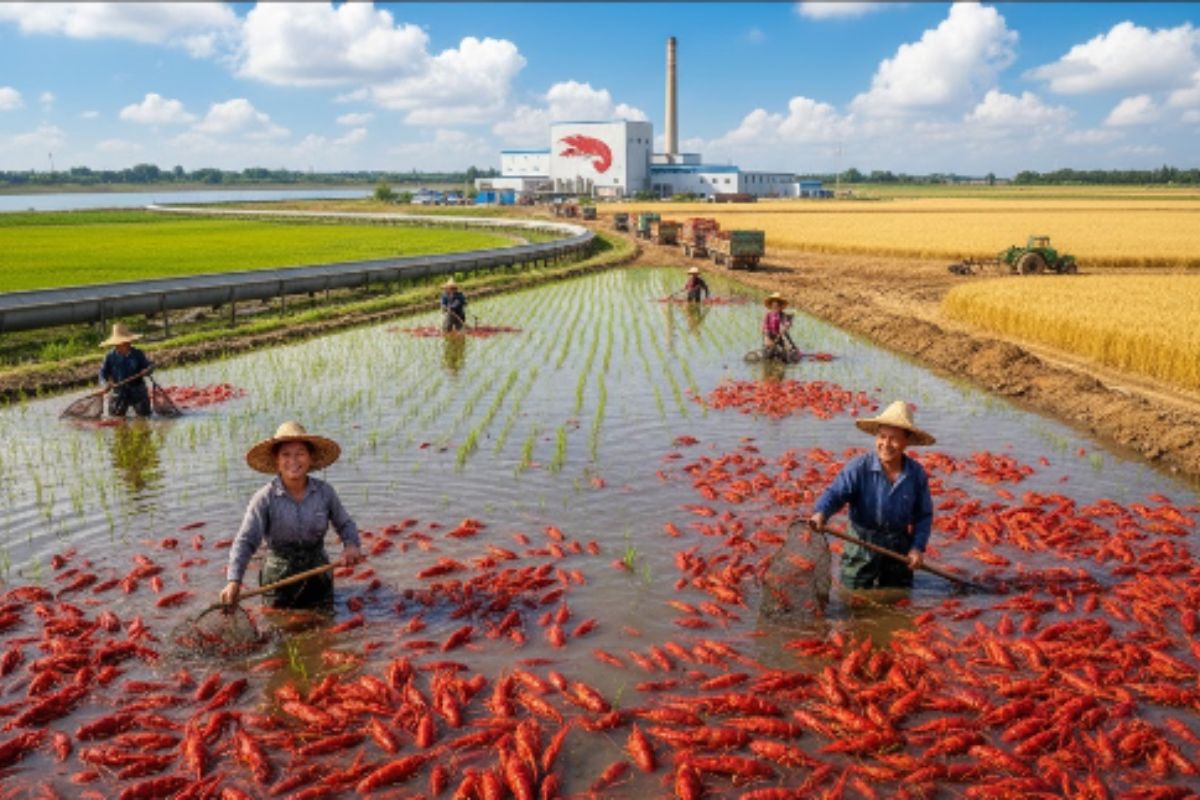


Red Swamp Crayfish Became the Centerpiece of the Rice-Crayfish System; China Transformed an Invader into a Solution, Created a Billion-Dollar Crayfish Industry, and Exposed Its Food Security to New Risks.
China is in a race against time to feed 1.4 billion people while agricultural land disappears. In just ten years, the country lost about 6% of its arable land, equivalent to 1,279,455 km², and about 40% of what remains already shows clear signs of degradation. In this scenario of extreme pressure, the country transformed an invader into a solution by turning the American crayfish into a driver of a new agricultural and economic frontier.
The crustacean Procambarus clarkii, the red swamp crayfish, arrived in Asia as a problem and ended up becoming an opportunity. Listed among the most dangerous exotic species on the planet, it destroys canal banks, carries lethal fungi for native crayfish, and reproduces at an alarming rate. Still, China transformed an invader into an economic and ecological solution, creating a billion-dollar industry that revitalizes degraded rice fields, generates income for hundreds of thousands of rural families, but also replaces wheat with stagnant water and increases dependence on a fragile system.
From Global Enemy to Favorite Dish of China

The starting point of this story is not China, but the southern United States. The red swamp crayfish is native to the Mississippi River basin and, almost everywhere else in the world, it has been seen as a pest.
-
“No one will make us change the Pix,” says Lula after the US report.

-
Lula responds directly to Trump and says that Pix is from Brazil and will not change under pressure from anyone, after a report from the United States pointed out the Brazilian payment system as an American trade barrier.

-
Amazon has just announced a new fee on all deliveries, and your online purchases will become more expensive starting April 17, including for those buying from the United States here in Brazil.

-
He sold his share for R$ 4 thousand, saw the company become a giant worth R$ 19 trillion, and missed the opportunity of a lifetime.


In California, it digs tunnels up to 1.5 meters deep and weakens the banks of rice paddies and irrigation canals, forcing the state to spend millions of dollars each year on repairs and control.
In Europe, since the 1970s, its arrival has caused the collapse of over 90% of native crayfish populations in some watersheds, largely because it carries a fungus capable of killing almost all local crayfish while remaining practically immune.
In light of so much damage, the European Union banned the cultivation and release of this species outright, classifying the crustacean as a mandatory eradication organism. In summary, the whole world looked at the Procambarus clarkii and saw only an ecosystem destroyer.
In China, the story took a different turn. The crayfish arrived in East Asia during the Second Sino-Japanese War, between 1937 and 1945, and spread quietly after the conflict, neither being cultivated nor combated.
It found a perfect environment in the provinces connected to the middle and lower reaches of the Yangtze River, filled with flooded rice fields and canals.
When the population exploded, almost every country would think about extermination. In China, the question was different: how to cook this. From then on, the process began in which China transformed an invader into a culinary and economic solution.
From Pan to Billion: When China Transformed an Invader into a Market Solution
It was farmers from regions like Hubei and Hunan who started stir-frying the crayfish with chili, garlic, and intense spices to disguise the smell of mud.
The result was surprising: the firm and sweet meat combined with chili became a national addiction. Soon, regional variations in preparation emerged, from the extremely spicy mala style to dishes steamed with beer, light sauces, and milder flavors.
Within a few years, crayfish moved from street stalls to upscale restaurants. Dish names with crayfish began to appear on menus all over the country, and a culinary craze took hold.
At the height of this wave, China began to consume over 90% of all the crayfish in the world, reaching more than 1 million tons per year, while all of the United States together consumed only about one-twentieth of that volume.
The demand grew so much that wild crayfish harvests were no longer sufficient. Thus began the phase in which the country transformed an invader into an industrial solution, with large-scale farming. In 2007, production was around 265,000 tons.
By 2016, it had reached 850,000 tons. Just six years later, in 2022, production reached about 2.5 million tons.
From 2003 to 2018, crayfish production increased more than 30 times and gave rise to a supply chain valued at around 53 billion dollars, a figure exceeding the GDP of many small countries.
With the help of smartphones, live sales, cold chain logistics, and festivals dedicated to crayfish, China transformed an invader into a comprehensive agribusiness, gastronomy, and digital commerce solution.
Rice-Crayfish System: The Engineering That Transformed an Invader into a Solution in the Field
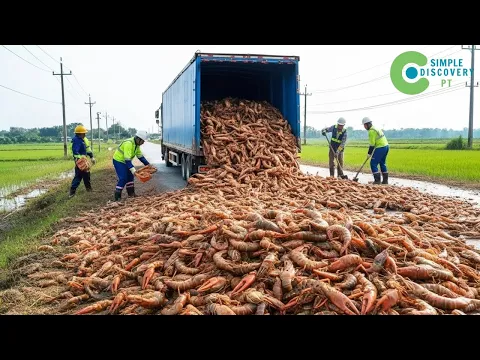

The next leap was decisive. Instead of keeping crayfish only in separate ponds, China began to integrate them into rice fields.
This transition was made with planning, precisely to avoid the disaster already seen in other countries, where the animal destroyed crops.
The integrated rice-crayfish system was born, officially recognized as a food production strategy, soil degradation recovery, and rural poverty reduction.
In this model, rice continues to be planted in the central area of the field, while deep ring-shaped canals are dug around it, allowing the crayfish to circulate without directly reaching the rice root zone.
After harvest, the straw is neither burned nor removed. The field remains flooded, and the layer of straw serves as a natural blanket for young crayfish, providing warmth, shelter, and food.
When the rice grows back, the plants’ canopy helps reduce water temperature and animal stress.
The rice paddy ceases to be monoculture and becomes a planned ecosystem, where China literally transformed an invader into an ecological solution to recycle nutrients, control pests, and recover soil.
The state subsidizes canal digging, distributes selected larvae, offers technical training, and even agricultural insurance, sharing the risk with farmers.
In regions like Qianjiang, known as the crayfish capital, adoption was so intense that by the mid-2010s, around 93% of local rural properties had migrated to some form of the rice-crayfish system.
How Crayfish “Fix” Degraded Rice Fields
Within this system, crayfish start working for the farmer. As omnivores, they consume plant residues, decaying organic matter, bottom organisms, and insect larvae.
When the rice field remains flooded with 20 to 40 centimeters of water and the straw is kept in the field, decomposition accelerates, and the density of microorganisms and plankton increases significantly.
Research in regions like Hubei indicates that the biomass of benthic organisms in rice fields with the rice-crayfish system is 1.5 to 2 times greater than in monoculture rice fields.
This provides a stable food source for the crayfish, which, while feeding, also reduce pests such as stink bugs, mosquitoes, and caterpillars even before the new crop begins.
As a result, pest pressure decreases at the start of the cycle, not in the middle, when pesticides are usually resorted to.
In some field studies, integrated rice fields with crayfish displayed pest densities 20% to 30% lower, with reductions reaching 40% for specific species.
In practice, this allows reducing pesticide use from two or three sprayings to zero or one per crop, and about 15% to 20% of the analyzed areas required no pesticides at all.
The soil also changes. The waste and the crayfish that die in the field introduce organic carbon, nitrogen, and potassium in more easily absorbable forms.
Chinese studies indicate that after 3 to 5 years of the rice-crayfish system, the average organic carbon content of the soil increases by 15% to 25%, water retention capacity grows by 10% to 18%, and compaction decreases significantly.
Agronomically, it’s as if the rice field gained a continuous fertility recycling program, and once again China transformed an invader into a solution for regenerating tired soils.
Doubled Income and Increasing Dependence

In farmers’ pockets, the effects are clear. In counties like Qianjiang, the average net income reaches about 3,000 yuan per mu per year, approximately 45,000 yuan per hectare, at least double what is obtained from the exclusive cultivation of rice.
This happens because crayfish generate cash flow over several months since they can be harvested in multiple stages, while rice has a stricter calendar.
At the same time, the rice produced in these systems often receives ecological or low-chemical-use labels, allowing it to be sold for 10% to 30% more than common rice.
From an economic standpoint, it seems like the perfect scenario in which China transformed an invader into a solution for rural poverty, soil degradation, and the growing demand for protein. But behind this apparent balance, there are structural risks that are beginning to emerge.
The Hidden Cost: Lost Wheat, Water at Risk, and Volatile Market
The first invisible problem lies in the agricultural calendar. The rice-crayfish system requires prolonged flooding, often almost the entire year.
This means that the integrated areas are no longer available for winter crops like wheat, which need dry and cold soil.
Wheat, however, continues to be a pillar of Chinese food security, with annual production around 140 million tons.
In various areas of the middle and lower Yangtze, studies have recorded the disappearance of millions of hectares of winter crops, converted into permanently flooded fields.
If one day the crayfish market experiences a sharp price drop, it won’t be easy to quickly reverse this conversion and return to wheat.
The second risk is market-related. The crayfish craze heavily depends on urban consumption, young people willing to pay for delivery, themed festivals, and social media trends. In some regions, crayfish prices vary by 30% to 50% from one season to another.
When demand falls, it is not the large restaurants that absorb the losses, but the farmers who dug the canals, invested in infrastructure, and cannot switch models overnight.
Finally, everything depends on one central factor: water. The system that transformed an invader into an agricultural solution is extremely dependent on a stable and clean supply of fresh water.
Meanwhile, central and eastern China are already facing more frequent droughts and sharp variations in the Yangtze River’s level, forcing some provinces to pump groundwater.
If water runs out or its quality worsens, crayfish will not only cease to be a solution but may become yet another large-scale management problem.
Introducing an Entire Ecosystem into the Rice Field

To further reduce pesticides and better utilize resources, some Chinese models don’t stop at crayfish.
In certain regions, rice fields have started to receive ducks, hairy crabs, and fish, creating even more complex integrated systems.
The ducks are released at specific moments when the density of young crayfish and insects starts to rise.
They eat the excess of young crayfish, pests, sprouting weeds, and even fallen rice grains, while fertilizing the field with nitrogen-rich manure.
Reports from pilot projects indicate that the presence of ducks can reduce the need for pesticides and herbicides by about 70%.
Next come the Chinese hairy crabs, which in many countries are also seen as potentially dangerous invasive pests. Each female can produce between 250,000 and 1 million eggs per cycle.
In Chinese systems, they are used to consume weeds, organic remains, and stir up silt, releasing nutrient-rich feces.
In some models, production reaches 300 to 450 kilograms of crab per hectare, in addition to rice and crayfish.
The fish occupy another layer of water, help oxygenate the environment, accelerate the mineralization of organic matter, and improve nutrient absorption by the roots of rice.
In consolidations of different integrated models, net profit can increase from 45% to 270% compared to rice monoculture, depending on local conditions.
All of this reinforces a central idea: China not only transformed an invader into a solution but used crayfish as a starting point to design entire agricultural ecosystems within a single field.
Louisiana: The Same Creature, Another Choice
Interestingly, the place that gave rise to the red swamp crayfish took a much more conservative path.
In the American state of Louisiana, the rice-crayfish model was adopted back in the 1950s and 1960s, but always as part of the regional culture and not as a national food security strategy.
The area dedicated to farming in Louisiana is around 120,000 to 160,000 hectares, with an average annual production of 70,000 to 90,000 tons, peaking at about 93,000 tons in 2019.
The sector generates about 300 to 400 million dollars a year, enough to sustain the local economy but without making crayfish the absolute protagonist of the agricultural system.
There, the fields do not remain flooded all year. After the crayfish season, the water is drained, and the soil dries, recovering its structure. Rice continues to be the main crop, while crayfish provide supplementary and seasonal income.
If prices drop or the weather doesn’t help, it’s relatively simple to revert to traditional cultivation without major reforms. Americans know that even there, crayfish are aggressive diggers, and they don’t romanticize the animal.
Culinary practices reflect this stance. The famous crawfish boil is a spring ritual, not a daily habit. Families and friends gather around a large pot for just a few months of the year. Once the season ends, so does the crayfish.
While China transformed an invader into a large-scale solution to buy time in the face of soil loss and population pressure, Louisiana maintained the same organism as a limited element within a system still centered on rice.
In the End, It’s Not About the Crayfish, It’s About Choices
The trajectory of the crayfish shows how the same organism can be, in one place, an ecological disaster, in another, a seasonal dish, and in yet another, a temporary tool to relieve pressure on soil, rural income, and food security.
The crayfish is neither good nor bad in essence. What changes everything is the context and how we transform an invader into a solution or an even bigger problem.
China has succeeded, in just a few decades, to transform an invader into a productive solution, regenerate part of its rice fields, create a billion-dollar industry, and reduce rural poverty, but at the cost of relinquishing wheat lands, depending on abundant water, and tying farmers to a volatile market.
And you, after knowing this story, do you think it’s worth transforming an invader into a solution on a national scale, or is it safer to use such species only as a complement, as Louisiana does?








Essas imagens de IA estão acabando com a vontade de abrir as matérias, que são boas.
Pra que Deus deu inteligência ao Ser Humano?
Pra fazer o bem sem olhar a quem!
Transformar o impossível no possível!
Fazer o próximo acreditar que fazer o bem só traz felicidade e prosperidade na vida Sempre!
La traduccion a cangrejo no esta correcto. Debe ser cauque.