





 Portuguese
  English
  Spanish
  4 min of reading
  0 comments


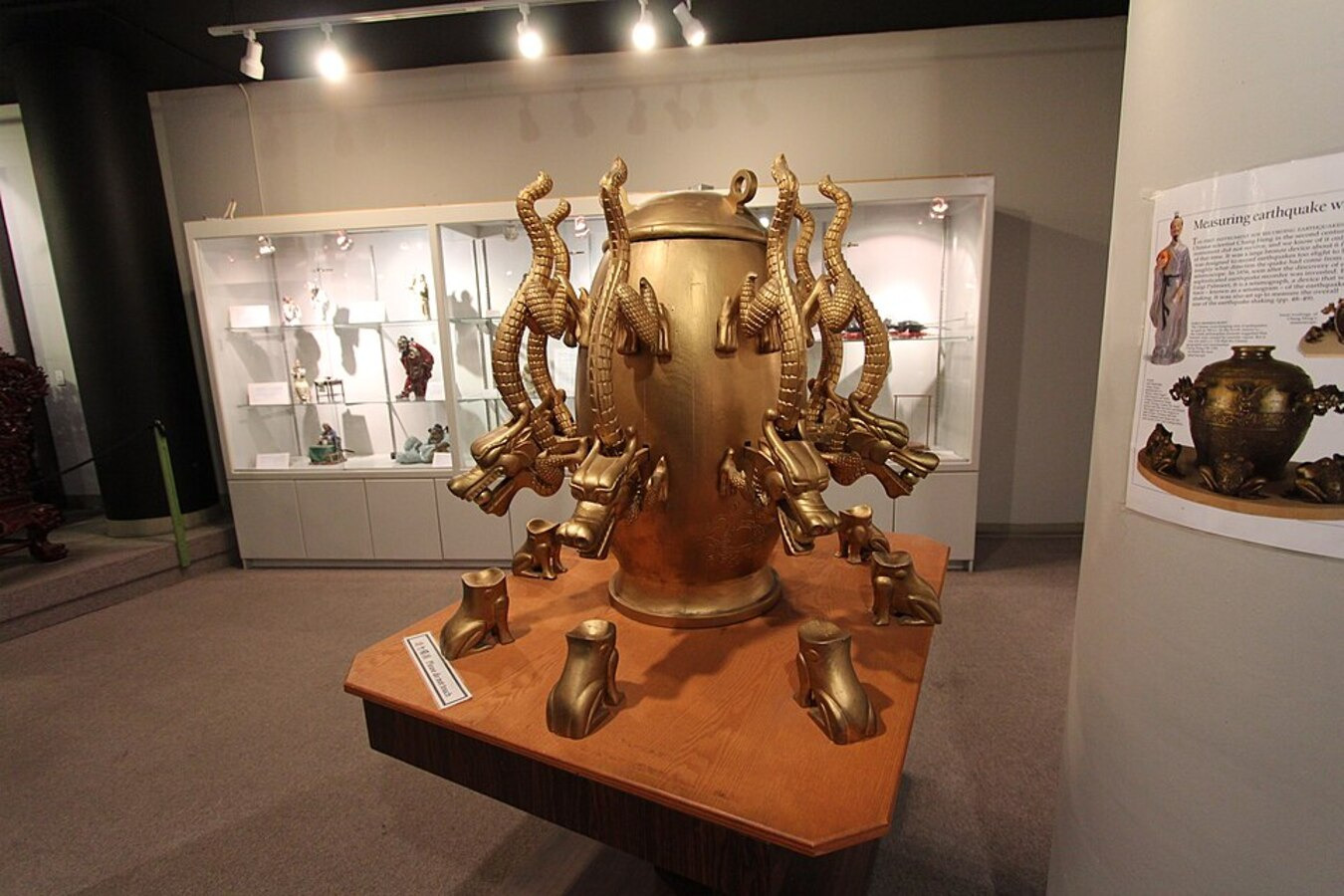
Chinese Researchers Try to Recreate the Legendary Seismograph of Zhang Heng Using Only Materials and Techniques from the 2nd Century, Like in Ancient Records
Almost two thousand years ago, China witnessed the creation of a device that, according to records of the time, could detect earthquakes over great distances. The mastermind was the scholar Zhang Heng, who lived during the Eastern Han dynasty.
His invention, called Houfeng Didong Yi, was a mechanical vessel decorated with bronze dragons and frogs and was said to be capable of identifying seismic shocks invisible to human senses. Now, this mysterious object may gain new life in China.
A Legendary-Looking Machine
According to ancient texts, the seismograph was shaped like a urn surrounded by eight dragons. Each dragon held a bronze sphere facing the mouth of a frog.
-
They were brilliant! Scientists discover that our ancestors in China were already making super advanced tools 160,000 years ago, changing everything we knew.

-
Scientists unveil 3 million years of climate secrets hidden in the ice of Antarctica.

-
Ancient farmers created “aggressive plants” that changed nature forever.

-
Astronomers find a “backward” solar system that ignores all the rules of space and leaves scientists scratching their heads!

The device’s operation was impressive: when an earthquake occurred, a sphere would drop from the mouth of a dragon, indicating the direction of the epicenter.
The book Han Posteriores reported that the device was so accurate that it “touched the divine.” Nevertheless, over time, it vanished from historical records and came to be treated as a legend.
In 2017, its study was even removed from school curricula due to a lack of concrete evidence that it had truly existed or functioned as claimed.
Researchers Want to Bring the Machine Back
A Chinese team, led by Professor Xu Guodong from the Hebei Disaster Prevention Institute, is attempting to recreate the ancient instrument.
The mission is ambitious: to rebuild the machine using only materials and techniques from the 2nd century. To achieve this, the researchers combined literary descriptions with modern knowledge of structural engineering.
They believe the device consisted of three main systems: an excitation mechanism, a transmission mechanism, and a locking mechanism.
The center of the structure would have a pendulum-like arm that moved at the slightest sign of vibration in the ground. With this movement, an “L”-shaped lever would be activated, releasing a sphere that fell into the frog’s mouth in the direction of the earthquake.
The other dragons remained still, respecting the logic of the machine: “one dragon that speaks and seven that are silent.”
Tests Indicate the System May Work
Simulations conducted by the team showed that the mechanism responds to movements of just 0.5 millimeters. In addition, it does not emit false alarms.
Even with the limitations of modern knowledge about seismic waves, Xu argues that the records from the time match the geological directions known today.
As an example, he cites the Longxi earthquake in 138 A.D. At that time, the seismograph reportedly detected a tremor 850 km away.
In Luoyang, the capital of the empire at the time, no one felt anything. But, days later, messengers confirmed the tremor.
Another data point cited by Xu is the increase in the number of earthquakes recorded after the adoption of the device.
In the 85 years prior, only three local quakes had been recorded. In the following 58 years, the number jumped to 23.
Zhang Heng’s Trajectory and Political Challenges
Zhang Heng was not just an inventor. In 115 A.D., he was appointed imperial astrologer, an important position linked to sky observation.
He created an armillary sphere—a model of the universe—and demonstrated deep knowledge of astronomy and mathematics.
But his creation may have caused political discomfort. At that time, natural disasters were seen as warnings from heaven, which could affect the emperor’s authority.
A device that “predicted” earthquakes could be interpreted as a threat to imperial power. Zhang retired in 138 and died the following year. Some scholars believe this was not a coincidence.
Additionally, Xu suggests that the original seismograph and its technical drawings may have disappeared due to wars, political disputes, or even actions by powerful families that concealed the invention.
A Sacred Symbol and a Milestone in Science
According to Xu, only two bronze objects have been considered sacred in Chinese history: the Nine Tripods of the Xia dynasty and Zhang Heng’s seismograph. Therefore, restoring the machine is also a symbolic gesture.
The project aims not only to recover the physical structure. The idea is to show the world that the ingenuity of ancient China sought to understand earthquakes long before the modern era.
If the reconstruction is successful, Zhang Heng’s feat may cease to be treated as a legend and return to its place in the history of science.
With information from Xataka.









-

2 pessoas reagiram a isso.