





 Portuguese
  English
  Spanish
  6 min of reading
  0 comments


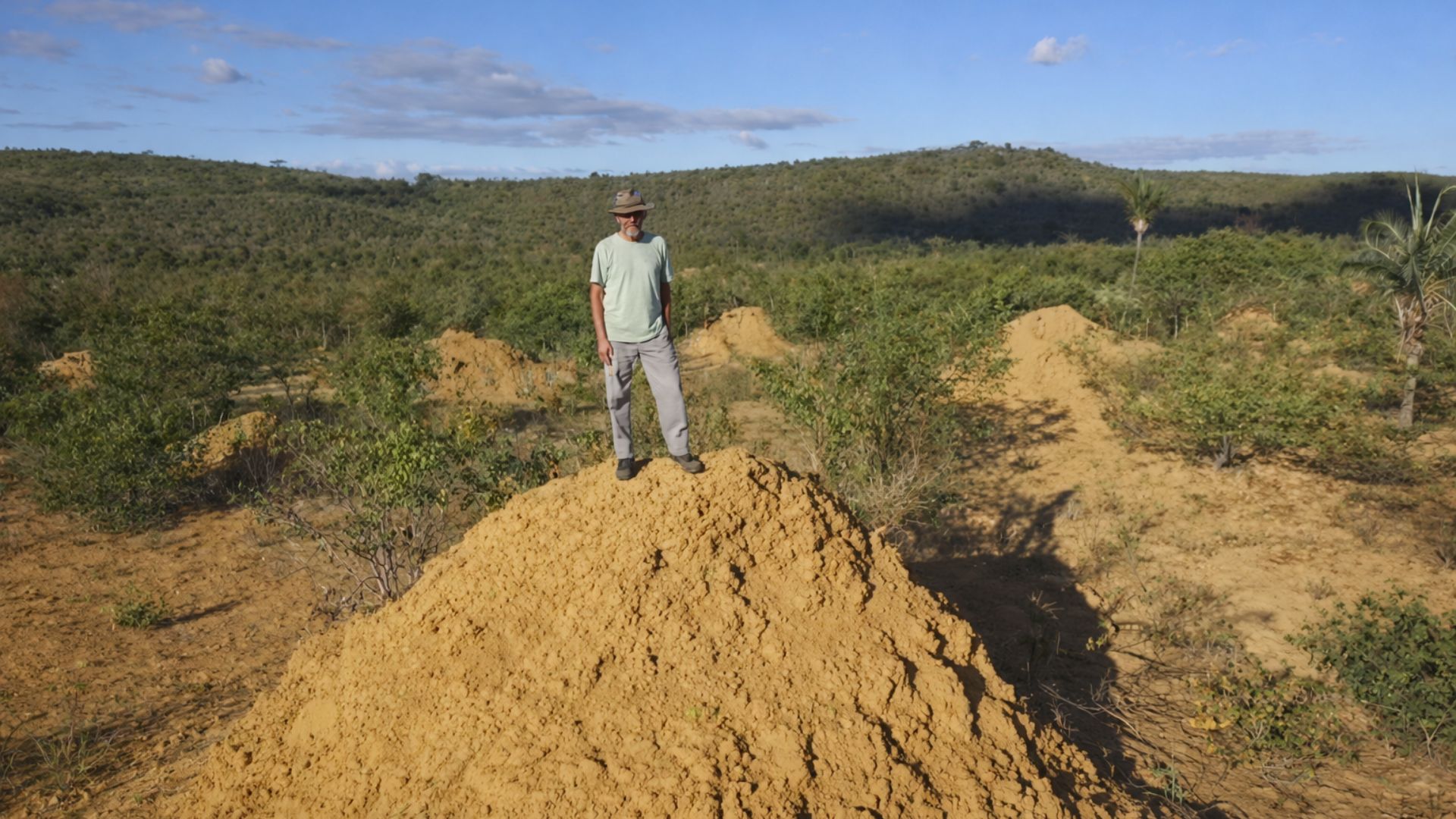
Geometric Pattern in Brazilian Semiarid Reveals Silent Work of Termites That Moved Gigantic Volumes of Earth for Thousands of Years, Forming Millions of Regularly Spaced Mounds Visible in Satellite Images When Vegetation Is Removed.
An extensive network of earth mounds scattered throughout the Brazilian Northeast forms a design so regular that it can be recognized in aerial images and satellite platforms.
What, from a distance, looks like a kind of geometric mesh on the terrain was not planned by machines or human work: it is the result of thousands of years of activity by termites that live underground and move earth on a monumental scale, according to researchers who studied the phenomenon in the Caatinga.
Termite City Visible by Satellite in the Northeast
Estimates gathered by scientists point to about 200 million mounds distributed across a vast area of the semiarid region, with conical structures that, in many places, reach approximately 2.5 meters in height and about 9 meters in width.
-
Rio Pardo, the most mysterious city in Rio Grande do Sul: untouched Pampas castle, the missing treasure of the Devil Boy, bride’s saint, invisible tunnels, and a 200-year curse today.

-
China retires the J-7 fighter after years of military protection and can now transform military items into drones, following more than 60 years of operation of the J-7, derived from the MiG-21, with thousands of units produced and strategic use in the PLAAF and PLANAF.

-
Volunteers are sought to live in the mountains for a month: a study pays people to stay at 2,500 meters, with 24-hour monitoring of sleep, metabolism, and blood pressure.

-
Goodbye to kitchen cabinets: innovation retires the traditional furniture of Brazilian kitchens by introducing modern pantries with modules of up to 2.40 m, 40% more organization, ergonomic access, adjustable shelves, and smart lighting in 2026.


Together, the field of mounds covers an area comparable in size to Great Britain in international scientific reports, and its pattern draws attention for maintaining relatively uniform spacing between one formation and another.
Although the volume of earth suggests “giant nests,” the interpretation presented by researchers is different.
The mounds would primarily be deposits of soil removed during the slow and continuous excavation of an interconnected underground tunnel system.
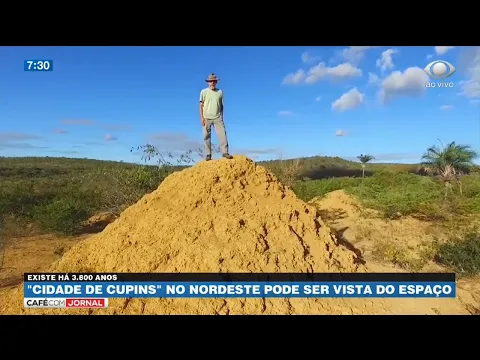

How Termites Build Mounds and Underground Tunnels
The logic, as explained by scientists involved in the research, is functional: termites need to move under the protection of the soil to access dried leaves scattered on the forest floor, gathering food without exposing themselves too much to predators and the extreme heat of the environment.
The species associated with this engineering is Syntermes dirus, a large termite by group standards, which feeds on dead plant material and lives in underground galleries.
However, the construction does not occur like a concentrated site in a single point.
Over time, the earth removed from the excavations is pushed outward and accumulates in “discard mounds,” which harden under the sun and can remain preserved for long periods, especially in stable and dry environmental conditions.
Caatinga and Deforestation Expose the Geometric Pattern
This detail helps to understand why the “termite city” remained off the public’s radar for so long.
In the original landscape, the mounds are largely hidden by the typical vegetation of the Caatinga, with thorny bushes and trees that lose their leaves in the dry season.
The set gained broader visibility when sections were cleared for the opening of pastures and cultivation areas, exposing the repetitive relief and allowing the pattern to be perceived by those flying over the region or analyzing aerial images.
Scientific Research with Satellite and Dating of Mounds

The scientific investigation combined satellite observation and fieldwork.
Soil samples collected from within specific mounds were analyzed to estimate the age of the formations and indicate how long the material had been deposited.
According to data released in scientific press materials related to the study, the dating of samples taken from the centers of 11 mounds indicated that they were filled at different times, with ages estimated between about 690 and 3,820 years.
The result reinforced the idea of a cumulative process, in which the current landscape is a “photograph” of an excavation and deposition effort that spanned many generations of insects.
Why Are Termite Mounds So Spaced
In addition to age, another question intrigued researchers: why do the mounds appear with such regular spacing?
In ecology, repeating geometric patterns can arise from competition between individuals or neighboring colonies, which establish “boundaries” and maintain distance.
To test whether this mechanism could explain the distribution of the mounds, scientists assessed the behavior of termites and the interaction between groups.
The tests described in communications related to the work indicated little aggression among termites at the scale of nearby mounds, in contrast to more aggressive responses when individuals were collected at greater distances.
This type of observation was used to discuss that regularity may have origins in spatial organization processes associated with environmental use, without necessarily relying on direct confrontations between neighboring colonies.
Volume of Dug Earth and Comparison with Pyramids

The numbers help to dimension what this means in physical terms.
Researchers cited in scientific communications related to the study calculated that the total volume of soil excavated over time exceeds 10 cubic kilometers.
To make the scale more comprehensible, scientists even compared this amount of material to thousands of pyramids of Giza.
While such comparisons are pedagogical approximations, they indicate why the case has been presented as one of the largest examples of bioengineering attributed to a single insect species.
Ecological Impact of Termites on Soil and Water
The impact, however, is not just a visual curiosity.
Termites are known to modify soil structure, influence water infiltration and the distribution of organic matter, and interfere with nutrient dynamics.
In dry ecosystems, where small gains in moisture can change the survival of plants and the availability of food for other organisms, persistent structures and underground excavations can have relevant ecological effects.
In the case of the Caatinga, the presence of the mega-field of mounds offers a rare opportunity to observe, on a regional scale, how the continuous activity of a small animal can leave marks on the landscape for periods comparable to those of large human civilizations.
How Remote Sensing Identifies the Mounds

From a remote sensing perspective, the phenomenon also has a particular component: the “signature” only becomes clear under certain conditions.
Where the vegetation cover is preserved, the layer of shrubs and trees reduces contrast.
In open areas, the set appears clearly in aerial images and can be identified even by ordinary users browsing satellite maps.
For science, this combination of gigantic scale and visibility facilitates surveys and mappings but also raises debates about preservation, as part of what made the pattern evident was precisely the conversion of natural areas.
Mountains of Earth, Rural Life, and an Archive of Nature
In local routine, the mounds are known and, in some cases, seen as an obstacle by landowners, because the compacted and “cooked” soil by the sun can hinder land use and mechanization.
For researchers, these formations serve as a geological and biological archive: each mound records a stage of sediment transport and tunnel excavation, making it possible to reconstruct aspects of insect behavior and the environment in which it lives.
The “city” of mounds in the Brazilian Northeast, therefore, is not an abandoned ruin nor a completed work.
It is a landscape shaped by a slow, persistent, and distributed process, which continues to attract attention for uniting three rare elements in the same story: extraordinary numbers, a visible mark from space, and the confirmation, in the field, that seemingly enigmatic structures can have practical explanations related to the way of life of an animal that spends almost its entire existence underground.
If a species so small can reorganize the terrain on a continental scale, what other “invisible works” of animals might still be hidden in ecosystems that almost no one observes up close?







-

-

-

-

-

-

14 pessoas reagiram a isso.