





 Portuguese
  English
  Spanish
  5 min of reading
  3 comments


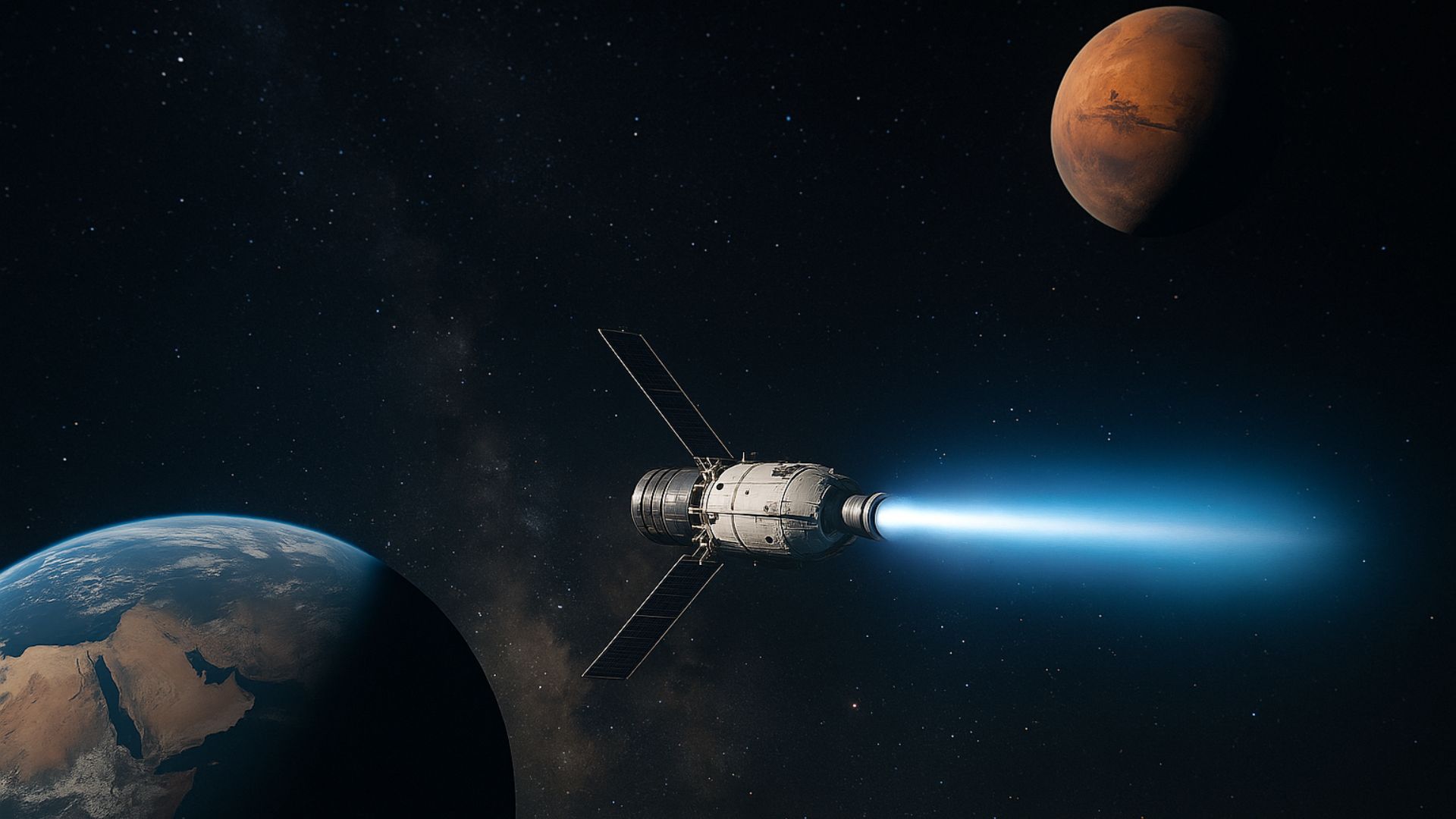


Russian Prototype Revives Debate on Faster Interplanetary Travel and Continuous Electric Propulsion in Deep Space, Promising to Reduce Transit Time to Mars from Months and Potential Impact on the Design of Future Space Missions.
A prototype of a plasma electric engine developed by scientists linked to the Russian state company Rosatom reignited, in 2025, the debate on how to shorten the travel time between Earth and Mars to something between 30 and 60 days.
The proposal is not to replace chemical rockets for launch, but to accelerate the spacecraft already in space, with low but continuous thrust, in a strategy that, according to the project’s leaders, can significantly reduce the interplanetary cruise period.
The information was disclosed by Rosatom itself and echoed by international and Brazilian media throughout 2025, highlighting the fact that it is laboratory-stage equipment, still far from operating on a real mission.
-
They were brilliant! Scientists discover that our ancestors in China were already making super advanced tools 160,000 years ago, changing everything we knew.

-
Scientists unveil 3 million years of climate secrets hidden in the ice of Antarctica.

-
Ancient farmers created “aggressive plants” that changed nature forever.

-
Astronomers find a “backward” solar system that ignores all the rules of space and leaves scientists scratching their heads!

Even so, the promise of reducing routes that are currently planned to last several months has allowed the technology to gain traction in discussions about mission architecture and the type of infrastructure needed for faster flights to the Red Planet.
Russian Plasma Engine and the Promise of Mars in 30 Days
The announced prototype is described as a plasma engine based on a magnetic accelerator, capable of operating in pulsed mode with an average power of about 300 kilowatts.

According to Rosatom, the idea is to achieve speeds in space that chemical engines cannot sustain for long periods, with much more efficient propellant consumption.
In practice, the estimate of “Mars in 30 days” appears as a scenario associated with the continuous use of the engine during the journey, and not as a demonstration that has already taken place.
The project’s own communication addresses the reduction to 30 to 60 days as a potential of the concept, contrasting with journeys that take almost a year in certain mission profiles when considering the window, trajectory, and limitations of conventional propulsion.
Meanwhile, the timeline is also a central point.
The news reports and the company’s announcement indicate that the current stage involves ground testing and the construction of infrastructure to simulate the space environment.
In some publications, the goal of a flight model by around 2030 appears, indicating that operational application is not immediate.
What Is a Plasma Engine and How Does Electric Propulsion Work
The term “plasma engine” is often used for families of electric propulsion that accelerate charged particles using electric and magnetic fields.
Instead of releasing energy through combustion, as in chemical engines, these systems use electricity to ionize a gas, form plasma, and eject this material at high speed, producing thrust.
The key gain lies in efficiency.
By increasing exhaust velocity, the engine can generate thrust using less propellant over time.
On the other hand, this type of propulsion typically delivers low thrust compared to chemical rockets.
This is why the operational logic is different.
It’s not a strong “kick” for a few minutes, but continuous acceleration for weeks or months.

This detail helps understand why many proposals combine technologies.
The spacecraft launches from Earth and enters orbit with traditional rockets, which provide the necessary thrust to overcome gravity and the atmosphere.
Then, already in the vacuum, electric propulsion takes over to accelerate gradually and, in the end, can also function for trajectory corrections.
Power, Thrust, and Physical Limits of the Plasma Engine
The numbers released in 2025 help to size up the challenge.
Publications that reported the announcement indicated that the system could expel plasma jets at speeds in the range of tens to hundreds of kilometers per second.
The thrust of the prototype would be on the order of a few newtons.
This contrast is the heart of the proposal.
Little force applied for a long time, which can result in a large speed variation throughout the journey.
Still, transforming a laboratory prototype into an interplanetary transport system depends on factors that go beyond the engine itself.
Energy generation and management are crucial, as electric motors require a robust source to maintain power over long periods.
Also factored in are heat dissipation, the durability of components, and real performance in conditions that replicate the vacuum and variations of the space environment.
Ground Testing and Infrastructure to Simulate Space
It is at this point that the infrastructure mentioned by Rosatom comes into play.
A large vacuum chamber is described in reports as equipment about 14 meters long and 4 meters in diameter, designed to test the engine in conditions similar to those in space.
The construction of facilities of this scale is usually considered a necessary step to validate the stability, repeatability, and operational limits of the system.
Without this type of testing, there is no way to estimate securely the behavior of the engine in long-duration missions.
Impact on the Planning of Missions to Mars

The possibility of shortening the cruise time to Mars draws attention for practical reasons.
The less time spent on the journey, the shorter the exposure time to radiation.
It also reduces the duration of critical life support phases in the case of manned missions.
At the same time, it is important to separate theoretical and engineering potential from proven mission capability.
The announcement refers to a prototype and ground tests.
Moreover, the very dynamics of journeys to Mars involve launch windows and trajectories that vary according to the relative positions of the planets.
The estimate of 30 days appears as a target associated with acceleration in space.
This does not, by itself, eliminate the need for orbital planning and margin for maneuvers, insertion, and possibly return.
Electric Propulsion in the Context of the Space Race
Another layer of the debate is that electric propulsion is not new in the space sector.
Different types of electric thrusters are already used in satellites and some missions, especially for attitude control and orbit adjustments.
What the Russian announcement highlights is the ambition to scale this type of propulsion to play a central role in long-distance journeys.
The goal is to aggressively shorten timelines. Even though the coverage of 2025 emphasizes Rosatom’s prototype, the topic is not restricted to a single country.
Agencies and research groups in the West are also investigating alternatives to reduce travel time and improve mission efficiency.
This interest grows especially when the goal includes cargo transport, building infrastructure in orbit, and, in the long term, more frequent crewed missions.








Qual ė a velocidade atingida por esse plasma que levará uma nave espacial da terra até Marte em 30 dias?
Uns 100.000 km/h…
111,600km/h