





 Portuguese
  English
  Spanish
  5 min of reading
  0 comments


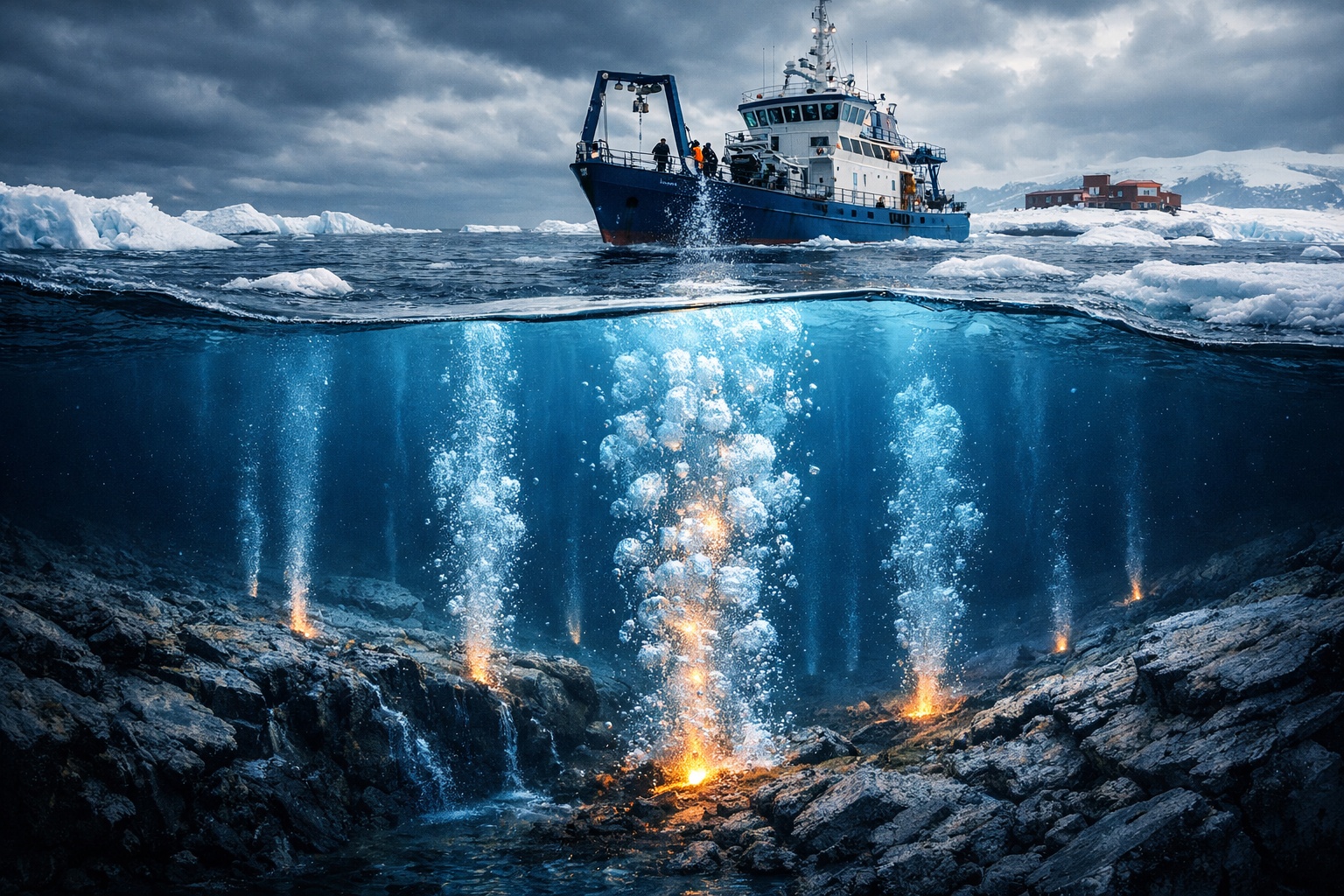
Study Published in Nature Communications Reveals More Than 40 New Methane Sources in the Ross Sea, Antarctica, in Areas Considered Stable for Decades.
A discovery published in October 2025 in the scientific journal Nature Communications altered the perception of climate stability in one of the most monitored regions on the planet. Researchers led by marine scientist Sarah Seabrook identified more than 40 new methane sources on the seafloor of the Ross Sea, Antarctica, in areas that had been studied for decades without any prior record of emissions.
The data is noteworthy not only for the number of new leaks but also because, until now, only one methane source had been confirmed throughout Antarctica. The simultaneous emergence of dozens of active points suggests a recent change in the geological and biogeochemical behavior of the region.
Where the New Methane Sources Were Found
The emissions were detected at depths ranging between 5 and 240 meters, characterizing a shallow coastal environment. The Ross Sea is one of the most researched areas of Antarctica due to its ecological and climatic importance.
-
Supercomputer calculates when humanity may disappear from Earth, predicts a scorching supercontinent, temperatures of up to 70 degrees, and a planet moving towards becoming uninhabitable.
-
INMET danger alert: heavy rains between the 3rd and 4th may drop up to 100 mm/day and winds of 60 to 100 km/h in several regions of Brazil require extra caution.
-
The parts crisis may bring back the drop notch and microSD in 2026; while Windows 11 promises to become lighter, leaks mention batteries of up to 10,000 mAh and 200 MP cameras.

-
In Kenya, engineer Nzambi Matee created “bricks 2.0” using packaging plastic: a mixture with sand, heated and pressed; they are 5 times more resistant, already have official licensing, and are being used in streets and construction projects.

The team used combined methods of:
- Acoustic surveys of the seafloor
- Sealed chambers installed directly in the sediment
- Technical diving and remotely operated vehicles
At one of the monitored points, known as Cinder Cones, measurements taken in 2022 recorded approximate rates of 1 millimole of methane per square meter per day, with higher peaks in shallower locations.
The most relevant aspect is that these areas had been monitored for years without any prior evidence of significant gas release.
Why Methane Is More Concerning Than CO₂ in the Short Term
Methane (CH₄) is recognized as one of the most potent greenhouse gases in the atmosphere. In the first 20 years after its release, its warming potential can be approximately 80 times greater than that of carbon dioxide (CO₂).
Although its atmospheric permanence is shorter than that of CO₂, the immediate impact on global thermal balance is much more intense. This means that abrupt increases in methane emissions can amplify global warming on relatively short time scales.

The discovery of multiple new sources in a region considered stable raises questions about possible climate feedbacks that are not yet fully understood.
Antarctica: An Hidden Reserve of Methane
Antarctica stores methane in different forms:
- Gas hydrates trapped in cold sediments
- Subglacial deposits
- Subterranean brines isolated beneath ice layers
Methane hydrates are crystalline structures formed under high pressure and low temperature, typical of polar environments and deep continental margins. If the thermal or pressure stability of these formations is altered, the gas can be released.
Although the study does not directly attribute the new emissions to climate change, researchers highlight that the origin of the phenomenon is still under investigation.
Scientific Paradox: The Most Monitored Region Begins Emitting Gas Unexpectedly
The Ross Sea is one of the most studied regions of Antarctica. The emergence of new sources in areas monitored for decades reinforces the hypothesis that the phenomenon is recent — not just a late discovery of something already existing.
This emergent nature is one of the central points of the study. The coldest continent on the planet, historically seen as stable in terms of coastal methane emissions, now shows signs of unprecedented activity.
Local Ecological Impacts
In addition to climatic implications, researchers also observed biological changes near the leakage areas. Cases of sea star wasting disease were detected in regions close to the methane sources.
Although there is still no confirmation of a direct causal relationship, methane can alter the local chemistry of sediment and the water column, impacting benthic communities and food chains.
Expert Statements and Potential Risk
Scientist Andrew Thurber from the University of California, Santa Barbara, compared the new sources to a “dangerous animal”: fascinating from a scientific point of view but potentially devastating if underestimated.

The analogy highlights the dual aspect of the phenomenon: advancement in knowledge about underwater processes and, simultaneously, a warning about climatic and ecological risks.
Could There Be a Climate Feedback Cycle?
One of the fears discussed in the scientific literature about polar methane is the possibility of positive feedback:
Global warming → destabilization of hydrates → release of methane → additional warming.
There is still no evidence that the Ross Sea case represents the beginning of an irreversible process. However, the identification of dozens of new sources suggests that mechanisms previously considered rare may be becoming more frequent.
What Is Still Unknown
Despite the impact of the discovery, several questions remain open:
- What is the exact trigger for the emergence of these sources?
- Is there a direct relationship with the regional warming of waters?
- Are the leaks temporary or permanent?
- What is the total volume released annually?
The study highlights the need for continuous monitoring to assess the evolution of emissions over the coming years.
The detection of more than 40 new methane sources in the Ross Sea represents one of the most relevant discoveries regarding gas dynamics in the polar environment in recent years. The phenomenon occurs in areas previously considered stable and involves a gas with high warming potential in the short term.
Although it is not yet possible to assert that Antarctica is entering a phase of massive methane release, the data indicates a significant change in the geological behavior of the coastal region.
The emergence of these sources in one of the most studied environments on the planet reinforces the complexity of climate systems and the need for ongoing scientific monitoring in polar regions.








-

-

-

-

4 pessoas reagiram a isso.