





 Portuguese
  English
  Spanish
  4 min of reading
  0 comments


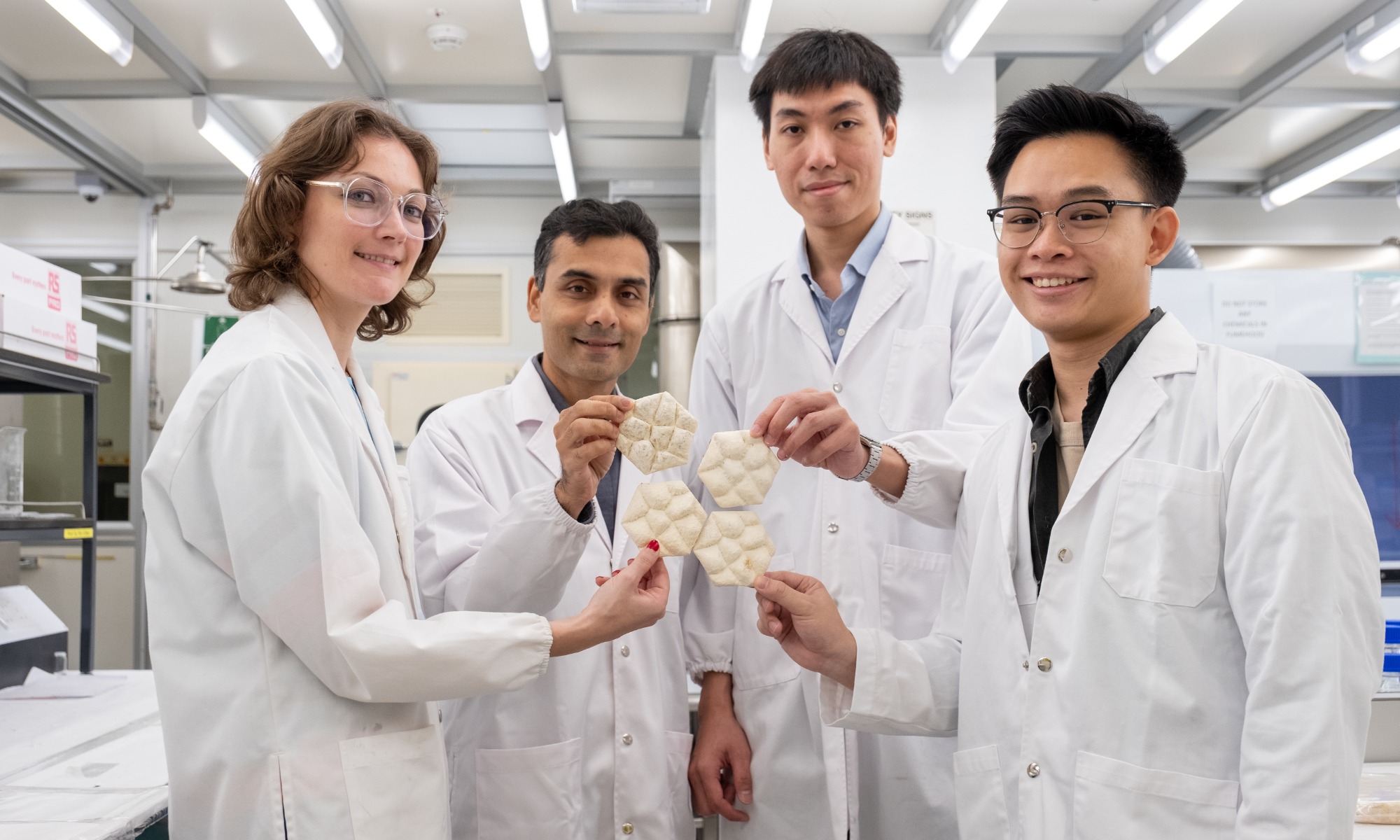
Mycelium Tiles Inspired by “Elephant Skin” Cool Environments and Offer Innovative Aesthetics. Sustainable Solution for Architecture and Hot Climates
A new combination of unusual materials could transform the way buildings face heat and humidity. Engineers from Singapore have developed a durable and eco-friendly tile made from mushrooms and leftover bamboo furniture, which promises to keep buildings cooler.
The tile, created based on biomimicry, mimics elephant skin, with bumps and grooves that help resist natural elements and provide passive cooling.
The creation of the eco-friendly tile was led by scientists from Nanyang Technological University (NTU Singapore). They call the new material “fungal tiles” and claim that the goal is to improve the energy efficiency of buildings, especially in tropical climates where high temperatures and heavy rains are common.
-
An engineer designs a solar plane to fly on Mars at an altitude of 1,000 meters and a speed of 300 km/h, covering 16,000 kilometers in a Martian year, 900 times the distance traveled by the Ingenuity helicopter in three years on the planet before experiencing a rotor failure, and NASA is already funding the feasibility study.

-
A new phenomenon of contactless magnetic friction intrigues scientists and questions a theory that has been valid since the 17th century.

-
An impressive phenomenon in Northern Brazil causes rivers of different colors to flow side by side, revealing secrets about sediments, currents, and biodiversity.

-
While many schools are still struggling with the basics, a teacher in China went viral for having elementary school students build a two-stage rocket using plastic bottles, water, and pressurized air in a science class that caught the attention of the entire world.


Ecological Alternative to Synthetic Insulators
“Insulating materials are increasingly integrated into construction walls to enhance energy efficiency, but these are mostly synthetic and come with environmental consequences throughout their life cycle,” explained Hortense Le Ferrand, Associate Professor at the School of Mechanical and Aerospace Engineering (MAE) and Materials Science and Engineering (MSE) at NTU.
She emphasizes that the new eco-friendly tile is made from mycelium, the structural part of fungi, which is highly porous and biodegradable. This porosity makes it a good thermal insulator, with conductivity comparable or even superior to currently used synthetic materials.
Mycelium has gained traction as a base for new biotech materials. It has been explored for acoustic insulation, cement manufacturing, and even as a tool to contain oil spills.
In the case of the tiles created in Singapore, researchers used the mycelium from the common oyster mushroom (Pleurotus ostreatus), combined with recycled bamboo shavings from a furniture store.
Slow Yet Efficient Growth
The core mixture also includes oats and water. This mass was pressed into special molds shaped like bubbles and rough lines.
After molding, the eco-friendly tiles underwent a growth process in the dark for four weeks—half the time inside the mold and half after being removed. Then, they were dried for three days in a hot oven.
The mold, with its elephant-skin-inspired design, was developed in collaboration with the design company bioSEA, which specializes in ecology and biomimicry. The elephant skin was chosen as a model because of its efficiency in temperature control.
New Eco-Friendly Tile: Elephants as a Reference for Architecture
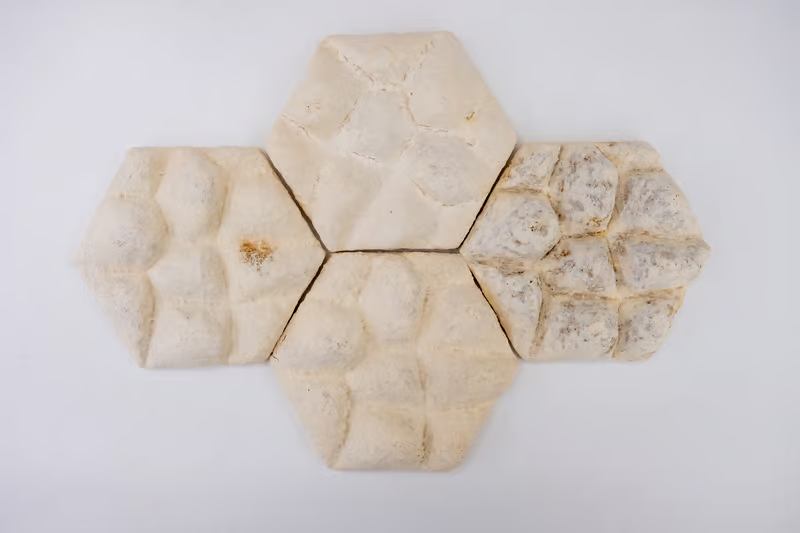
“Elephants are large animals that live in hot and sometimes humid tropical climates,” explained Anuj Jain, Founding Director of bioSEA. “To withstand the heat, elephants have evolved to develop very wrinkled skin, which increases water retention and cools the animal through evaporation.
According to Jain, the project aimed to replicate these natural mechanisms of shading, water retention, and increased surface area for evaporation. The goal was to apply these principles in the design of the tiles, which also work without the use of electrical energy.
Researchers tested the thermal performance of the tiles by placing them on a surface heated to 100 °C for 15 minutes. Using an infrared camera, they monitored how heat propagated.
The elephant skin-inspired design delayed heat absorption. The underside of the tile remained cooler for longer and cooled down faster at the end of the test.
Cooling with the Help of Water
Simulated rain tests were also conducted. Water droplets were retained in the grooves of the tiles but were not absorbed. This behavior favored evaporative cooling.
According to Eugene Soh, the lead author of the study and researcher at NTU, the “fungal skin” that forms on the surface of the tile helps in this process.
“The fungal skin that develops on the surface of the tile repels water, allowing droplets to remain on the surface instead of rolling off immediately,” explained Soh. “This promotes evaporative cooling, increasing the cooling rate.”
Challenges for Eco-Tile Growth
The team is now testing the durability of the eco-friendly tile, as well as exploring other mushroom species that may offer improvements. The project is already being scaled up with the help of the local startup Mykílio, which is working to increase production and conduct tests in outdoor environments.
Despite the advancements, there are limitations. The main one is the time required for mycelium growth. A month to produce a single eco-friendly tile means that large-scale application would require ample growing space. This issue continues to be examined by the researchers.
According to Le Ferrand, the project represents a promising and eco-friendly alternative to construction materials. “We have developed a promising and environmentally friendly alternative that transforms waste into a valuable resource while rethinking conventional thermal management materials,” she stated.
She also highlighted that the success of this research could pave the way for new models inspired by elephant skin, as well as allow the use of different strains of mycelium. The aim is to overcome current challenges and turn this type of tile into a viable solution for the construction industry.
With information from New Atlas.







Seja o primeiro a reagir!