Portuguese
  Spanish


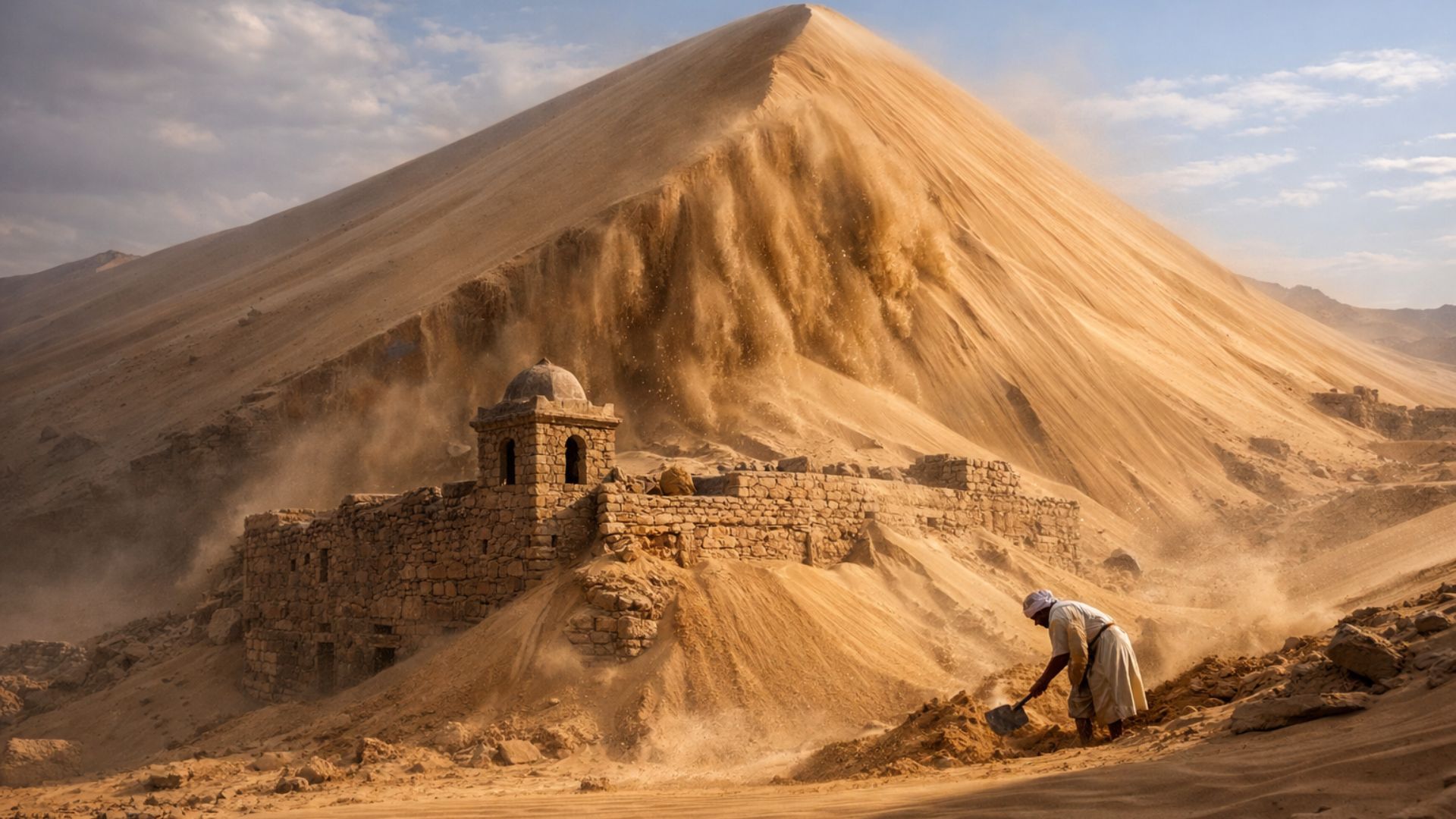

Historical city in the Sahara faces continuous advance of sand dunes, risk of disappearance and threat to rare manuscripts preserved for centuries, while climate change and population exodus aggravate the scenario and put in check the survival of one of the most important Islamic cultural centers.
An ancient city in the Sahara desert, in Mauritania, faces the constant advance of dunes that already cover streets and threaten historical structures, putting at risk one of the most important cultural legacies of the Islamic world preserved for nearly a thousand years.
Historical origin and cultural importance of Chinguetti
Founded between the 11th and 12th centuries, Chinguetti emerged as a strategic point on trans-Saharan trade routes, connecting caravans that transported gold, salt, and other valuable products across the desert, also consolidating itself as a center of religious and scientific learning.
Over the centuries, the economic role of the city has diminished, but its historical and intellectual value has remained evident, especially due to the preservation of family libraries that hold rare manuscripts and fundamental documents for understanding medieval Islamic culture.
-
Former Hairdresser Turns $20 Investment into Thriving Business with 7,000 Monthly Deliveries from a 40 Square Meter Garage.

-
Drilling a Well? These 5 Locations in Brazil Could Turn Your Water Dream into a Costly Mistake

-
90 Years Before Disney, an “Original Moana” Made History in Cinema by Depicting Life in Samoa and Shaping the Documentary Genre

-
Study in Barcelona Reveals Giraffes Can Add Quantities and Memorize Changes, Surprising Scientists



Advance of the dunes threatens historical structures
Currently, the advance of the dunes represents a concrete and visible threat, as mounds of sand invade entire neighborhoods and reach heights surpassing the buildings, requiring residents to remove large amounts of sand daily to maintain usable basic access.
In addition to the physical pressure exerted by the sand, the wear on traditional buildings, constructed with materials adapted to the arid climate, becomes accelerated in the face of recent environmental changes, complicating the conservation of an urban set that has resisted for centuries under adverse conditions.
Rare manuscripts face accelerated deterioration
Among the most valuable assets of Chinguetti are thousands of ancient manuscripts, some over 700 years old, addressing topics such as astronomy, mathematics, Islamic law, and theology, forming a collection considered essential for scholars of Islamic intellectual history.
These documents, often written on parchment or animal skins, require specific storage conditions but face temperatures that frequently exceed 40 degrees Celsius, along with constant dust and low humidity, factors that accelerate their deterioration.
Without broad access to modern preservation technologies, the responsibility for conservation mainly falls on local families, who keep the manuscripts protected in boxes and dark environments, adopting traditional practices to minimize damage caused by the extreme climate.
Population exodus aggravates heritage preservation
Another factor that aggravates the scenario is the continuous population decline of the city, driven by the lack of economic opportunities and increasingly difficult environmental conditions, leading mainly young people to migrate to urban centers in search of better life prospects.
This process significantly reduces the local capacity to preserve both historical structures and the documentary collection, leaving an aging population responsible for maintaining a heritage of international relevance with practically no sufficient support.
UNESCO heritage under increasing threat
Since 1996, Chinguetti has been on the UNESCO World Heritage list, a recognition that highlights its cultural and historical importance, but which, in practice, has not been sufficient to contain the increasing impacts of desertification and climate change in the region.
In recent years, the intensification of sandstorms and the reduction of native vegetation have contributed to accelerate the displacement of the dunes, eliminating natural barriers that previously helped stabilize the soil and protect the city from the advance of the desert.
Local and international initiatives are attempting to contain this process through the planting of vegetation barriers around the city, a strategy aimed at reducing sand mobility and protecting inhabited areas, although it faces limitations imposed by water scarcity.
Prolonged droughts make it difficult to maintain these actions, making the success of containment attempts uncertain, especially in a scenario of climate change that tends to aggravate the already severe environmental conditions of the region.
Meanwhile, parts of the old city continue to be gradually buried, in a slow but persistent process that compromises not only historical buildings but also the collective memory associated with this important center of knowledge.
Experts warn that, without more effective and sustainable interventions, entire areas may disappear in the coming decades, significantly reducing the physical presence of one of the most emblematic cultural centers of the Sahara.
The preservation of Chinguetti depends on a combination of local efforts and more structured international support, capable of simultaneously addressing the environmental, social, and economic challenges that threaten its historical continuity.