





 Portuguese
  English
  Spanish
  6 min of reading
  35 comments


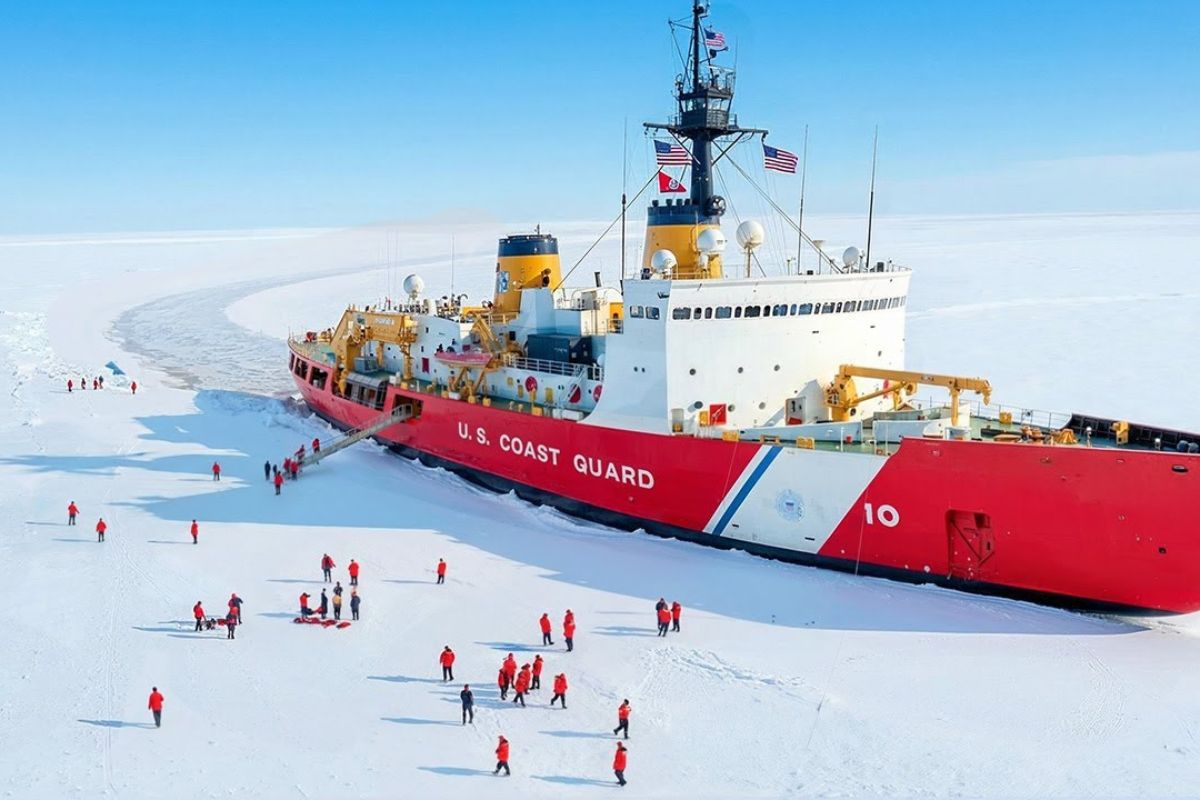


The Polar Star Icebreaker, Heavy and Unique Capable of Reaching Antarctica, Opens a Channel of More Than 70 Miles to Escort a Tanker with Millions of Liters of Diesel to the McMurdo Sound Station. The Mission Depends on Short Windows of Time, Extreme Engineering, and Crew Shift Routines.
The icebreaker moves forward where the ocean seems still, but it is in constant contention between wind, current, and cold. When the channel closes, logistics come to a halt, and a research station may begin to ration heat in the coldest place on the planet.
From the outside, the job seems simple: break the ice, open a passage, and escort the supply ship.Inside, it’s an equation of time, power and risk, where each technical decision becomes the difference between completing the mission or getting stuck in the ice.
Why a 70-Mile Channel Becomes a Matter of Survival
The icebreaker is not there to “pass.” It needs to create a navigable corridor for dozens of miles, keeping that path open long enough for a tanker to safely advance to the McMurdo Sound Station. As the tanker waits at the edge of the Ross Sea ice shelf, every hour counts.
-
Drones have become “insects” and spread native seeds to recover inaccessible areas; the Bacias & Florestas program, for 15 years, has planted 3 million trees and restored 15 thousand hectares, despite costs of up to R$ 25 thousand/ha.

-
Alert in the underwater tunnels: the rubber sealing the entrance of the sea in a structure in China is deteriorating from the inside faster than expected.
-
A cyclone with unprecedented behavior will form in the Atlantic in the coming hours and will move from the sea to the continent instead of following the normal path, with gusts of up to 90 km/h and a risk of hail and waterspouts in southern Brazil.

-
The “white gold” of Thacker Pass: the McDermitt caldera could be worth $1.5 trillion and hold nearly half of the world’s lithium; 40,000 tons/year could provide batteries for 800,000 electric cars already in the U.S.

The good weather window is not elastic. If the channel remains closed for too long, a new layer of ice begins to form in just a few hours, especially with outside temperatures around -22°F.
And then what was opened becomes an obstacle again, requiring the icebreaker to repeat impact after impact, consuming fuel, time, and safety margin.
How the Bow Ramp Breaks Ice Instead of Cutting
The most visible detail of the icebreaker is exactly what contradicts the idea of “cutting” through the ice. The bow is not knife-shaped.
It functions like a shallow ramp, inclined at about 30° to horizontal. Instead of slicing through the ice, the ship climbs over it.
As the icebreaker moves forward, part of the forward thrust transforms into vertical force. In operational terms, 75,000 horsepower generates about 400 tons of thrust, and approximately half can turn into upward push on the ramp.
The result is a combination of weight and gravity working against hard, compacted ice that has formed over several years, which does not “bend” but fractures, with cracks radiating as pressure exceeds 300 PSI.
Steel, Micro-Alloys, and the Risk of Extreme Cold
Breaking the ice is only half the problem. The other half is surviving the repeated forces in the cold that alters metal behavior.
At -20°F, regular steel plate can become brittle and crack instead of deforming. For an icebreaker, this is the type of failure that gives no warning.
The described solution involves micro-alloys in the steel, with small amounts of nickel, chromium, and manganese, below 5% total.
In practical terms, these atoms act like microscopic “shock absorbers” in the metal’s crystal lattice, dispersing energy and causing any crack to zigzag instead of running straight.
This is the type of material choice that supports a thick hull under thousands of impact cycles during a deployment.
Diesel-Electric Propulsion and the “Balance” that Loosens the Ship

The icebreaker operates with a type of resistance that changes in milliseconds. The propeller can spin almost freely in the water with crushed ice and, in the next moment, hit a block as dense as concrete.
In a direct mechanical system, this pushes torque spikes back to the gears and shaft, risking breaking teeth or even the shaft itself. That’s why here, the mechanical connection is “broken” on purpose.
In the described setup, diesel engines turn generators, and power goes through cables to electric motors mounted directly on the propeller shafts.
The advantage is quick control: RPM can swing widely, for example from 150 to 60 and back to 140, without destroying a mechanical drivetrain.
And when the icebreaker gets stuck in thick ice, a resource that seems counterintuitive but is crucial comes into play: side tanks and pumps transferring 100,000 gallons of seawater from one side to the other in less than a minute, making the ship roll 5° and then 10°. This balance breaks the “seal” of friction with the ice and restores useful water to the propellers.
Life Aboard: Water, Food, Shifts, and Science Under Impact
The mission is not just machine. The icebreaker carries 155 crew members and can take up to 35 scientists, totaling about 190 people who need to eat, sleep, breathe, and stay warm for months.
This includes a routine of about 600 meals a day coming from a compact kitchen, as well as freshwater production because there is no port “just nearby.”
Everything becomes internal logistics, and everything consumes energy.
Water, for example, comes from the ocean itself through reverse osmosis units, pushing seawater through membranes at about 800 PSI to separate salt.
This energy cost directly relates to available fuel and what the generators can sustain.
And human routine has to fit within this structure: tight accommodations, stacked bunks, little personal space, and a work rhythm with 4-hour service shifts and 8 hours of rest.
In the Antarctic summer, when the sun does not set for months, the biological clock falters, and operational discipline prevails.
What Can Go Wrong: Fire, Flooding, and Diving Under the Ice
The greatest risk on a ship is not the ice outside. It’s fire inside. In sealed compartments, toxic smoke forms quickly, and in minutes, temperatures can reach 1,000°F during a flashover, when everything ignites almost simultaneously.
In polar waters, the response is from the crew itself because no one arrives “in time.”
Flooding is the other nightmare. The real defense is compartmentalization, with watertight doors sealing with gaskets and levers, and closing a door can mean isolating a problem before it spreads.
In this context, a shaft seal alert is not treated as a detail: engineers monitor indicators, lock the shaft with physical clamps, and when necessary, divers enter.
Diving under ice is described as one of the most dangerous evolutions: dry suit for water at -2°C (28°F), safety line as the only connection to the surface, and an environment where losing the line can mean being pulled by the current under a layer of ice that extends for miles. This maintenance is done at the limit, to keep the mission alive.
From the Channel to the Ice Dock: Fuel, Cargo, and the Base That Continues
Opening the channel is half the journey. The other half is ensuring that the tanker advances, docking at what functions like an ice dock, reinforced in layers.
The transfer of diesel is described at a rate of 500 gallons per minute, for a period that can take the best part of two days, while containers rise and fall in parallel with food, scientific equipment, building materials, medical supplies, and parts for vehicles.
When the base relies on a single logistical window, everything needs to happen simultaneously and without waste.
In the end, the operation paints a clear picture of what an icebreaker really does: it does not “explore.” It sustains.
It enables critical resupply to happen, allows a station to get through another year, and ensures scientific teams work with instruments and samples that few platforms on the planet can reach.
And yet, nothing is permanent: the channel can close, the ice can move, and the ship is ready to reopen routes if the way out narrows.
If you were in command, what would you prioritize first: speed to beat the time window, or caution to reduce the risk of mechanical failure? And should an isolated scientific base rely every year on a single icebreaker to continue operating, or do you think this model needs alternatives?









Supply submarines, anyone?
Deep Freeze 78. I was a ice conning officer on USCGC GLACIER. She cleared the channel from 1953 to into the 80s
Had to save a polar class in 78 that was was stuck in the ice in 78.
Alternatives. Definitely. Supplies, equipment. Machinery should be brought to that part of the world to make them self reliant.
That should be the priority. Part of all the effort and money invested to bring goods to that part of the world, should be out into finding a more suitable, permanent solution.
DEFINITELY “ALTERNATIVES”, REASONATES! I’M SURE THAT THERE’S ONLY A SINGLE SUPPLY LINE DUE TO THE SCIENTIFIC NATURE OF OPERATIONS AT THE SOUTH. HOWEVER, IF THIS WERE A MILITARY OPERATION YOU NOT RELY ON SUCH A SINGLE ASPECT OF LOGISTICAL SUPPORT. THAT’S A RECIPE FOR DISASTER UNDER SUCH DRASTICALLY CHANGING ENVIROMENTAL CONDITIONS. HOW ABOUT SPECIALLY MODIFIED/WINTERIZED C-5 & C-17 LOGISTICAL SUPPORT FOR ANTARTIC SCIENTIFIC MISSIONS?