





 Portuguese
  English
  Spanish
  7 min of reading
  0 comments


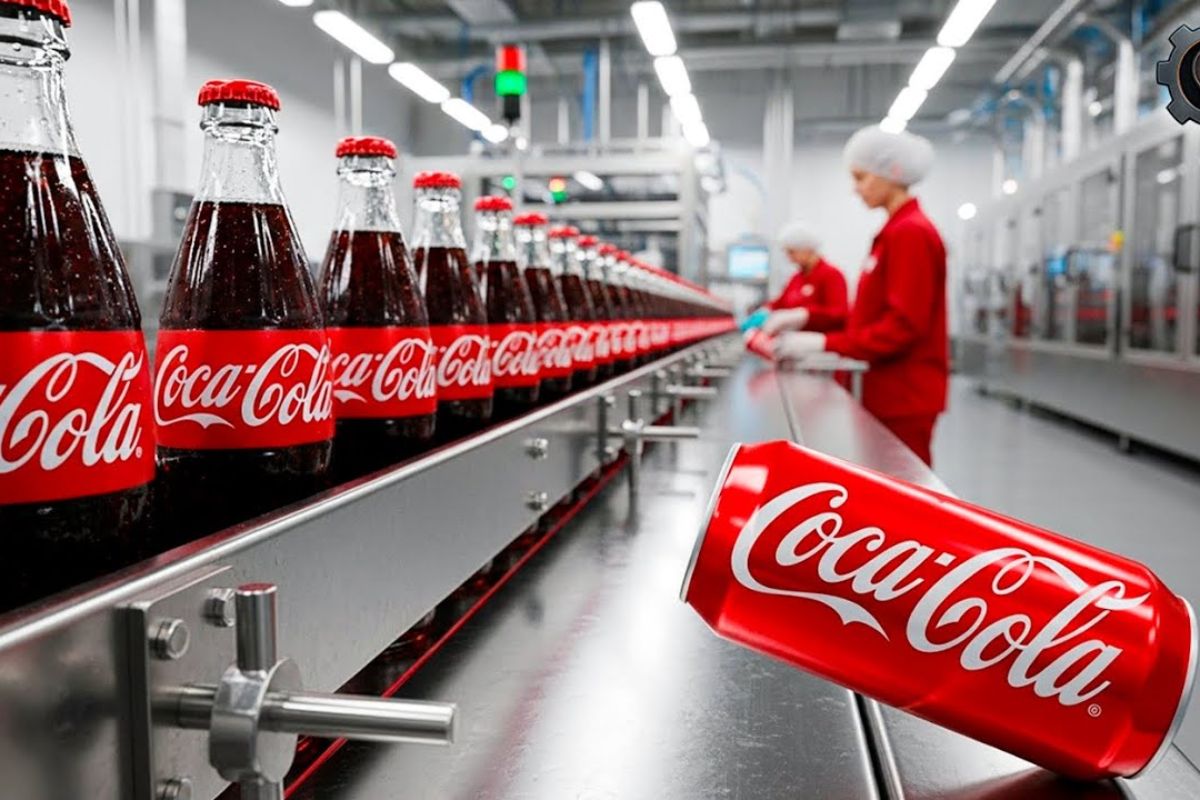
How Coca-Cola Transforms Purified Water and Secret Formula Into Millions of Bottles in One of the Most Precise Industrial Chains in the World
Coca-Cola is born from rigorously treated water, a concentrate kept in a vault, millimeter precision addition of sugar, acid and carbon dioxide and bottling lines that can fill up to 2,000 bottles per minute, in a process that combines advanced chemistry, industrial automation, real-time digital control and one of the greatest secrets ever constructed by the food and beverage industry on a global scale.
Behind the image of a “simple” soft drink, Coca-Cola relies on a global infrastructure that starts at water purification stations, passes through pressurized tanks monitored by sensors, integrates logistics of concentrates sent in sealed containers around the world, and ends in production lines that sanitize, fill, carbonate and seal bottles and cans with microscopic precision, ensuring that the taste is recognized the same way in Atlanta, Tokyo or Rio de Janeiro.
Why Coca-Cola Became a Global Consumption Machine

Every second, more than 19,000 Coca-Cola products are consumed on the planet, making the beverage a symbol of modern industry and mass consumer culture.
-
This climbing plant covers the walls of the house, blocks up to 80% of solar radiation, and reduces the internal temperature by up to 5 degrees in the summer without spending a dime on the electricity bill, and it also produces bunches of grapes in the backyard.

-
The first city in the world to reach 1 million inhabitants houses a museum with 139,000 ceramic bricks and advanced construction engineering with a steel structure inspired by a Chinese symbol that refers to the walls of the Ming dynasty.
-
A German man installs a nearly 10-meter “wind tree” with 36 microturbines in his garden, combining wind energy with solar panels, and aims to power his home, office, and electric car without paying anything on his electricity bill.

-
Brazilian fish that lives out of water and hides inside dry logs intrigues scientists and reveals one of the rarest adaptations of mangroves.

Coca-Cola has evolved from just a soft drink to a complex industrial system, with strict standards of quality and repeatability across all continents.
This trajectory did not start with a sophisticated corporate plan, but with a pharmacist from Atlanta seeking a plant-based substitute for morphine.
From this aromatic syrup, sold as a tonic for fatigue and headaches, Coca-Cola was gradually standardized, repackaged and transformed into a mass-produced product, supported by aggressive marketing and industrial expansion until it became one of the most recognized labels in the world.
Curious Origin of a Recipe That Went From Pharmacy to Planet

The invention of Coca-Cola traces back to John Steves Pemberton, a veteran of the American Civil War and pharmacist in Atlanta, who in 1886 developed an aromatic syrup for use in soda fountains.
The original formula mixed coca leaf extract, which produced a small amount of cocaine, with caffeinated kola nut from Africa, diluted in carbonated water and sold for a few cents.
In the early years, sales were modest and Pemberton, weakened and in debt, sold parts of the formula to different partners.
Asa Candler took control in 1891 and it was he who transformed Coca-Cola from a local remedy into a mass-consumed product, standardizing production and leveraging coupons, giveaways, and posters as marketing tools.
By the early 20th century, cocaine was removed from the recipe, but the secret of the formula was rigorously maintained, consolidating Coca-Cola as a symbol of the new American industry based on standardization and scale.
The Industrial Secret Behind Coca-Cola’s Formula

The Coca-Cola formula is treated as a strategic asset, closer to an industrial code than a simple recipe.
Since the 19th century, the exact composition has been kept secret and is now guarded in a vault at the World of Coca-Cola in Atlanta, protected by biometric authentication and security protocols that can only be accessed by high-level executives.
According to the company itself, only two people know the complete formula at the same time, do not travel together, and cannot reveal it even by contract.
It is known that the base is a concentrate called merchandise 7X, a mixture of essences and botanical extracts like citrus oils and spices, combined with caffeine, phosphoric acid, sugar or corn syrup, caramel coloring, and purified water.
More than just protecting a flavor, the mystery surrounding Coca-Cola fuels an aura of intrigue that enhances the cultural value of the brand.
Purified Water: The Backbone of Coca-Cola
Despite the myth surrounding the formula, Coca-Cola is primarily water in a controlled state.
More than 90% of the beverage’s content is water, which compels the company to treat this raw material as the highest priority in all production units around the world.
The water used in Coca-Cola is not simply drinkable.
It undergoes mechanical filtration to remove sediments, reverse osmosis to eliminate salts, metals, microorganisms, and even pesticide residues, and disinfection with ozone or ultraviolet light to ensure the absence of bacteria and viruses without leaving chemical residues.
Next, there is a controlled remineralization stage, where calcium, magnesium, and potassium are added in precise doses to adjust pH, texture, and influence the final flavor.
Digital sensors monitor the entire process, ensuring that the sensory profile of Coca-Cola remains consistent across different countries and geological conditions.
How the Concentrate Transforms Water into Coca-Cola
With purified and remineralized water, the phase begins where Coca-Cola truly gains its identity.
The secret concentrate, internally known as Merchandise 7, is produced in maximum-security facilities and sent to factories worldwide in hermetically sealed, numbered containers monitored by temperature and tracking sensors.
Upon arrival at the bottling plant, each unit is checked in detail.
Seals, codes, and labels are verified to ensure that nothing has been tampered with and that the contents meet exactly the specifications defined at headquarters in Atlanta.
Only after this verification is the concentrate transferred to stainless steel tanks lined with anticorrosive material, where it will be mixed with purified water and other ingredients.
The ratio of concentrated Coca-Cola to water is controlled by high-precision digital systems, parameterized by algorithms that consider packaging type, local climate, and expected sensory profile.
The type of sweetener varies by region, with formulas based on high fructose corn syrup or cane sugar altering the body and aftertaste of the beverage.
Phosphoric acid and caffeine are added by automated pumps, under constant monitoring of pH, density, temperature, and viscosity.
Any deviation causes the system to halt production and alert the technical team.
The result is the so-called master syrup, a concentrated Coca-Cola before the addition of gas, that condenses all the work of chemistry, engineering, and process control necessary to replicate, batch after batch, the same global flavor.
Carbonation of Coca-Cola: The Engineering of Bubbles and the “Tingle” in the Throat
With the master syrup ready, the stage that transforms the liquid into Coca-Cola as consumers know it comes into play.
Carbon dioxide is not only responsible for the visible bubbles; it is a central part of the sensory experience of Coca-Cola.
The carbonation occurs in pressurized tanks, with the liquid maintained between 1 and 3 degrees Celsius to maximize gas dissolution.
CO2 is injected into sealed systems and temporarily combines with the water, forming carbonic acid, responsible for the mild tingle in the throat and the refreshing sensation typical of Coca-Cola.
The level of gas varies according to the type of packaging, the country, and even the climate, with adjustments in hotter regions or at high altitudes to maintain pressure balance and freshness.
This calibration is not empirical. It results from studies on flavor preservation, product durability, and gas behavior during transport and storage.
After carbonation, bottles and cans are immediately sealed with caps designed to maintain internal pressure for long periods.
Seal and strength tests check, batch by batch, whether Coca-Cola will reach consumers with the correct effervescence and without the risk of quality loss.
Lines That Fill Up to 2,000 Bottles of Coca-Cola Per Minute
In the bottling phase, Coca-Cola enters one of the most automated sections of the entire chain.
Production lines can fill up to 2,000 bottles or cans per minute, integrating sensors, cameras, and robotic systems that maintain a constant and synchronized flow.
Before receiving Coca-Cola, each package undergoes rigorous sanitation.
PET bottles, glass, and aluminum cans are washed with antibacterial solutions, pressurized steam, and jets of ionized air, a procedure that removes impurities and electrically neutralizes the surface to reduce risks of invisible contamination.
The filling is done in a sterile environment, with pressure and temperature control, while flow sensors deposit exact volumes in each unit, already taking into account the expansion of the carbonated liquid.
Once the cycle is closed, Coca-Cola proceeds to labeling, bundling, palletizing, and shipping.
From an industrial perspective, each bottle is the result of a global chain that combines logistics, formulation, and high-scale automation, always aiming to replicate the same flavor experience.
Tradition, Innovation, and the Future of Coca-Cola in a Transforming Planet
The future of Coca-Cola depends on the ability to maintain the taste recognized by generations while adapting processes to a planet that demands more in terms of natural resources and industrial efficiency.
The same structure that ensures the repeatability of the formula and precise carbonation must at the same time adjust the consumption of water, energy, and inputs in a scenario of increasing environmental pressure.
Still, the industrial logic remains the same.
Coca-Cola continues to be built on purified water, secret formula, master syrup, and high-speed bottling lines, always supported by sensors, recipe vaults, and a narrative of mystery that reinforces the symbolic value of the product.
In any macroeconomic scenario, the image of the bottle being opened, with its characteristic sound and gas release, continues to encapsulate a moment of universal pleasure for millions of consumers.
And you, after learning about the industrial backstage of Coca-Cola, which part of this process surprised you the most and why?




-

-

-

3 pessoas reagiram a isso.