





 Portuguese
  English
  Spanish
  4 min of reading
  15 comments


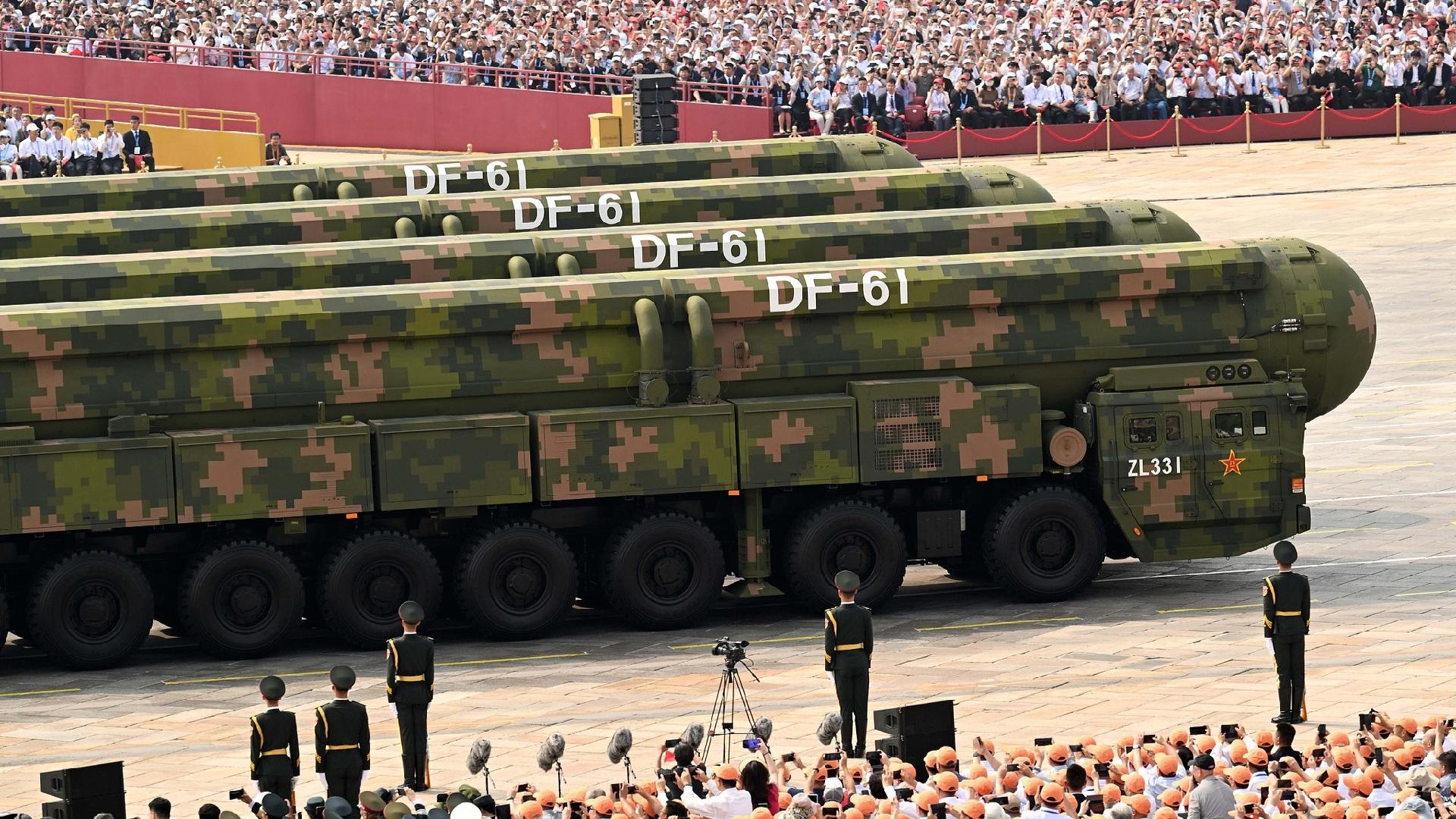


With an Estimated Range of Up to 15,000 km and Mobile Launch from 16-Wheel Platforms, the DF-61 Signals the New Generation of Chinese Intercontinental Nuclear Dissuasion Missiles.
The public presentation of the DF-61 represented a clear message from Beijing to the rest of the world: China’s nuclear dissuasion has entered a new phase. Unlike older systems designed in a context of limited retaliation, the DF-61 emerges as a modern intercontinental missile, highly mobile and designed to survive a first strike, maintaining the ability to respond even in extreme scenarios.
Although many of its details remain officially unconfirmed, the set of information released by open sources, intelligence analyses, and military parade images indicates that the DF-61 is not just an incremental evolution, but a structural leap in Chinese strategic architecture.
A Range That Redefines the Concept of Dissuasion
The most striking data is the estimated range of between 12,000 and 15,000 kilometers. This range firmly places the DF-61 in the category of global-range ICBMs, capable of reaching any target on the planet from the continental territory of China.
-
More than 500 Marines, robots, drones, and armored vehicles are deployed in Rio de Janeiro for the UN to certify Brazil at the highest level of readiness for peacekeeping missions. It is the first force in the country to achieve this status in all of history.

-
With 24-meter wings, two turbodiesel engines, 49 hours of autonomy, and the ability to launch sonobuoys to hunt submarines, the Turkish drone Aksungur can monitor an area the size of Brazil for two consecutive days without landing.

-
Pentagon wants to transform drones into mass ammunition, produce 340,000 units in two years, and lead the US Army to a fleet of 1 million disposable aircraft for modern warfare.

-
The Brazilian Army observes armored vehicles of up to 45 tons, 120 mm cannons, and network warfare technologies presented at military fairs in Europe, while Romania prepares a billion-euro investment of €8.33 billion in new combat vehicles.





In practice, this means that the missile does not rely on advanced positioning, submarines, or external bases.
All strategic dissuasion can remain deeply within national territory, reducing vulnerabilities and increasing the system’s survival time in a high-intensity conflict.
Extreme Mobility as a Central Pillar
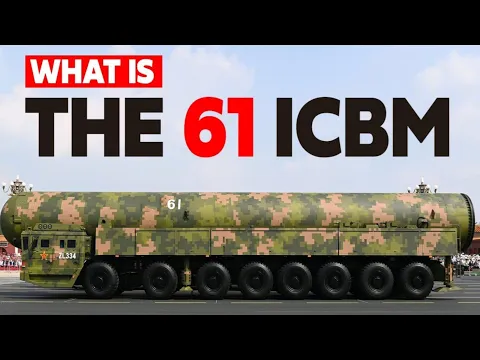
Another decisive element of the DF-61 is its ground mobile platform, mounted on a 16-wheel transporter-erector-launcher (TEL). This choice is neither aesthetic nor logistical: it is strategic.
Mobility turns roads, rural areas, and remote regions into potential launch sites. For an adversary, this exponentially multiplies the challenges of tracking, surveillance, and preemptive neutralization.
Instead of known fixed silos, the DF-61 operates in an environment of perpetual uncertainty, where mere detection does not guarantee neutralization.
Nuclear Capability and Strategic Role
Although Beijing maintains deliberate ambiguity about specific configurations, the DF-61 is widely regarded as a strategic nuclear capability missile, designed to integrate the core of the Chinese triad alongside submarines and bombers.
There are speculations about compatibility with multiple independently targetable reentry vehicles (MIRV), something that, if confirmed, would further enhance its dissuasion value by allowing a single missile to engage multiple independent targets or saturate missile defenses.
Even without official confirmation, the mere fact that the DF-61 is designed in the modern era already suggests architecture compatible with future evolutions.
Survival in First Strike Scenarios
The DF-61 seems to have been conceived with a clear focus: to ensure second strike capability. Mobility, extreme range, and possible integration with modern command and control networks indicate a system prepared to operate even after initial neutralization attempts by a technologically advanced adversary.
This changes the strategic equation. It is not just about offensive power, but about dissuasion credibility, the most important element in any modern nuclear doctrine.
The emergence of the DF-61 occurs at a time of global reconfiguration. Expansion of missile defense systems, modernization of Russian and American arsenals, and the advancement of hypersonic weapons have created an environment in which old systems are now seen as insufficient.
In this scenario, the DF-61 acts as a political and military signal: China does not intend to remain dependent on legacy vectors or interim solutions. The country demonstrates industrial, technological, and doctrinal capacity to operate next-generation intercontinental missiles on a large scale.
A Missile Surrounded by Strategic Silence
Part of the strength of the DF-61 lies precisely in what is not disclosed. The lack of detailed official data does not weaken the system; on the contrary, it increases uncertainty for any potential adversary. This opacity is a classic component of nuclear dissuasion, historically exploited by all great powers.
As tests, images of parades, and independent analyses continue to emerge, the DF-61 remains a symbol of a China that prefers to be underestimated only until the moment it needs to be taken seriously.
A Milestone in the Evolution of Chinese ICBMs
If the capabilities attributed to the DF-61 are confirmed, it consolidates as one of the pillars of the next generation of Chinese intercontinental missiles, combining global range, extreme mobility, and architecture compatible with the future of strategic warfare.
More than just a new missile, the DF-61 represents a paradigm shift: from robust regional dissuasion to a truly global, resilient, and modern dissuasion.







Se um míssil destes chegar a sair do solo chinês, em segundos será detectado e explodido.
A China e a maior doença do mundo.
CHINA: a maior potência mundial, sem dúvida alguma.
Enquanto isso o laranjão megalomaníaco fica falando m…