





 Portuguese
  English
  Spanish
  3 min of reading
  0 comments


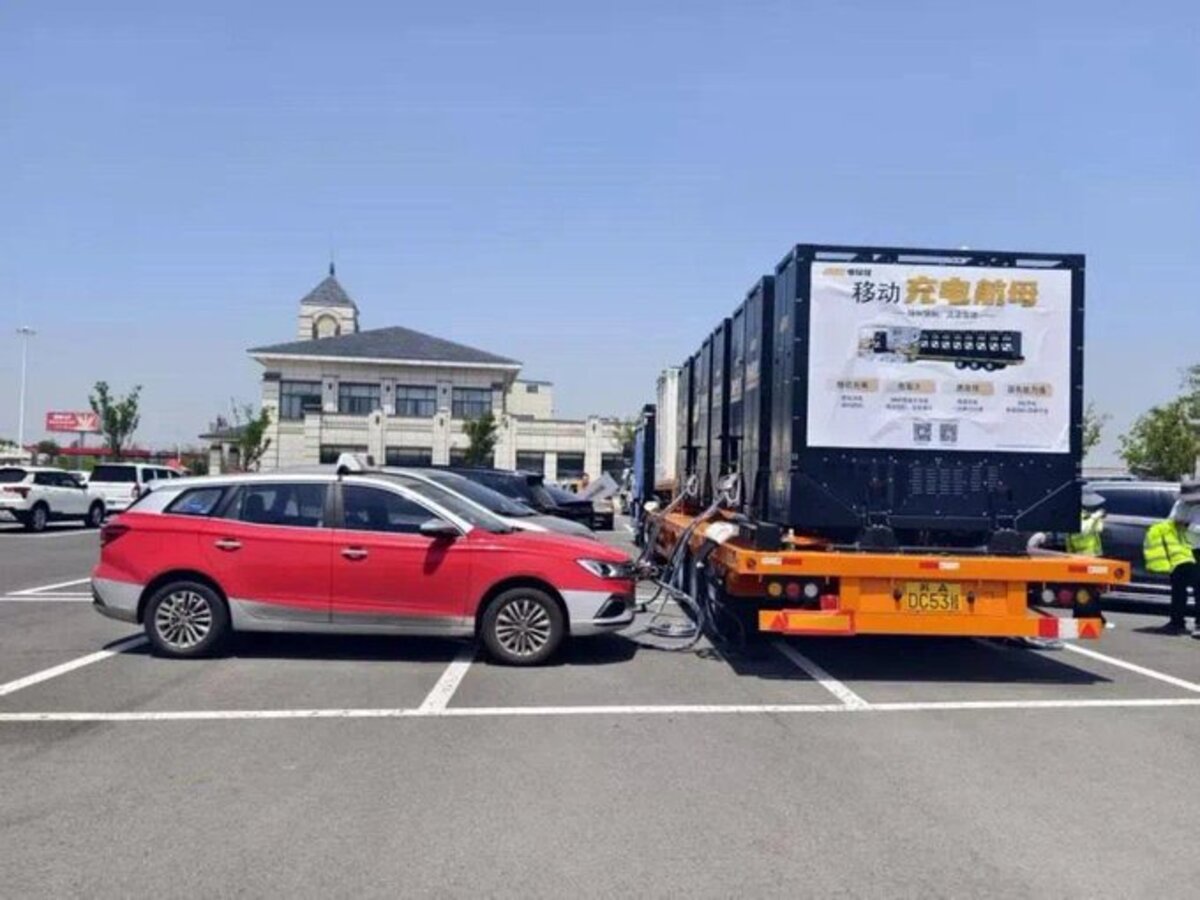
Trucks With 3,600 kWh Fuel Up to 100 Cars and Help Reduce Congestion on Chinese Roads During Extended Holidays
China has the largest fleet of electric vehicles in the world. In 2024, 11 million fully electric vehicles were sold in the country. This impressive number brings new challenges, especially during holidays when millions of people travel at the same time. One of these critical periods occurs in May during the Labor Day holiday.
In China, Labor Day has been extended and takes up the first five days of May. Like Holy Week in Spain, this is one of the busiest times on Chinese roads.
Thousands of vehicles crowd the highways, such as the one connecting Beijing to Shanghai, which spans over 1,300 kilometers. On these long trips, recharging electric cars becomes a logistical challenge.
-
The German economist Wolf-Peter Schill has no doubts: “Electric cars are already far superior to cars with internal combustion engines.”

-
Largest public charging network in Brazil: BYD reaches 125 fast chargers and accelerates national expansion of electric mobility.
-
Goodbye expensive popular car: electric vehicle for less than R$ 70,000 starts being sold in Brazil with a range of 200 km and targets those looking to escape gasoline.
-
China Surprises Automotive Industry With Battery That Promises Electric Car Able to Run Up to 1,000 km Without Recharge

Recharging Time Becomes a Problem on the Roads
The major issue is the recharging time. Even with advancements, charging an electric car can still take 20 to 30 minutes. With the volume of vehicles on the road, there is a risk of huge queues at charging points, turning the process into a long waiting time.
Power Station Trucks: The Mobile Solution
To tackle this situation, China began testing a different solution this year: trucks equipped with enormous batteries.
These vehicles function as mobile charging stations and have been nicknamed “power station trucks.” Each truck can serve up to eight cars simultaneously and provide power for up to 100 vehicles before needing to be recharged.
Special Recharging Operation During the Holiday
During the holiday, the system helped expand charging options along major routes. The highway between Beijing and Shanghai, for example, saw an 80% increase in available charging points.
A total of 238 battery-equipped trucks were mobilized across the 49 busiest service areas. Additionally, another 246 temporary charging stations were set up to meet demand.
The operation was organized by the Jiangsu Provincial Department of Transportation in partnership with Jiangsu Dlala New Energy Technology Co.
When a truck runs out of charge, it moves to a base equipped with solar panels to recharge its batteries. With renewed energy, the truck returns to serve drivers in locations with the highest need.
Range for 180 Kilometers Per Charge
Each truck has a total capacity of 3,600 kWh of energy. With this charge, it is possible to fuel up to 100 cars on average, considering that each receives approximately 36 kWh.
This volume represents about 180 kilometers of range in vehicles with an average consumption of 20 kWh per 100 kilometers.
In China, many electric cars are plug-in hybrids, known as “range extenders.” They have batteries with a capacity of around 40 kWh, making the mobile recharging system even more efficient for this type of vehicle.
System Was Already Used in Emergencies
Although the use of charging trucks is not a complete novelty in China, their large-scale deployment during the holiday represented a significant advancement. Previously, they were mainly used in emergency situations when a car ran out of charge or at overloaded stations.
The power of these trucks far exceeds that of existing assistance models in the market. For example, the Wuling brand has trucks with 141 kWh batteries, sufficient to recharge 1.5 to 3 cars depending on the model. Companies like CATL are also developing similar solutions, but still on a smaller scale.
Experience Could Indicate Future Path
The experience conducted this year could indicate new pathways to handle the growth of the electric fleet. With mobile solutions, China seeks to ensure that the popularization of electric vehicles does not lead to bottlenecks on the roads during peak times.
With information from Xataka.








Seja o primeiro a reagir!