





 Portuguese
  English
  Spanish
  9 min of reading
  0 comments


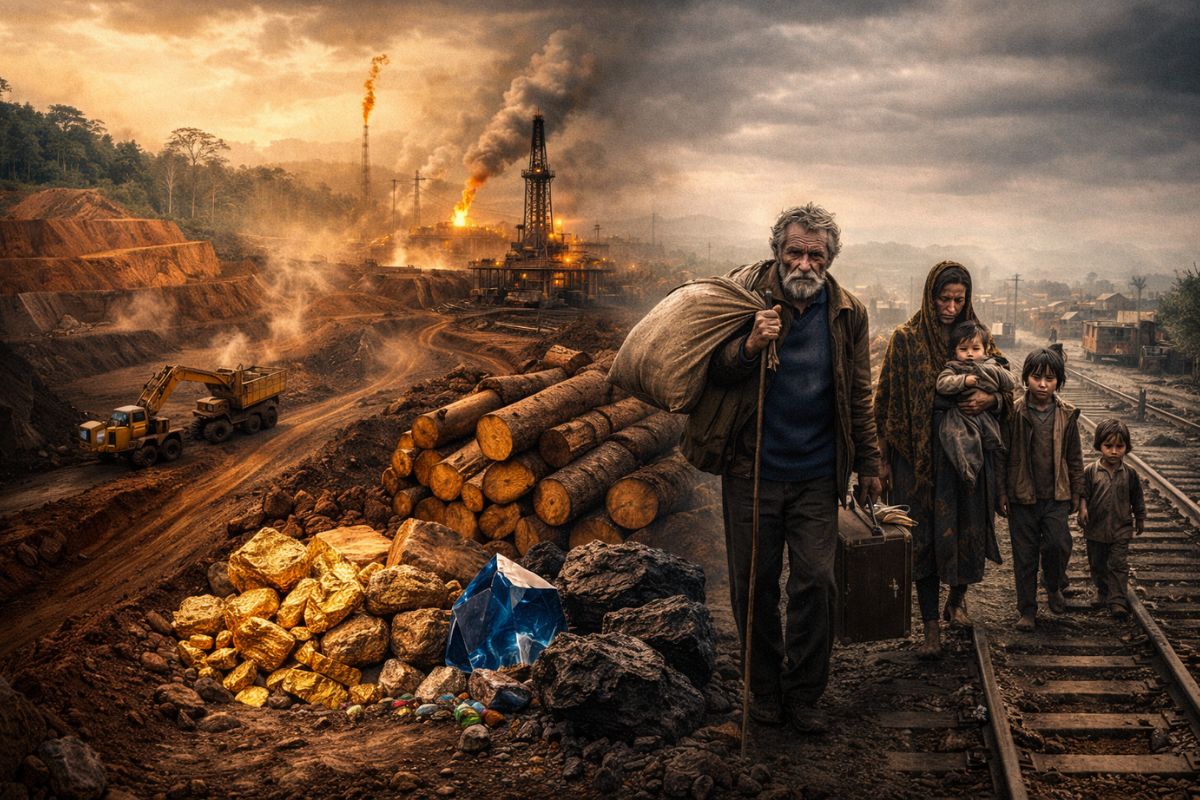
In This Mountainous State of the Appalachians, Rivers and Narrow Valleys Limited Cities and Roads, While Accessible Bituminous Coal Attracted Railroads and Barons After the Peak of 2.552 Million in 1950, Mechanization Cut Jobs, Started the Hillbilly Highway and the Population Fell to 1.77 Million, with Aging, Opioids and Seat Loss
The history of this state diverges from the demographic pattern of the United States over the past 75 years: while the country more than doubled since 1950 and places like Florida and California surged, West Virginia became the solitary anomaly, the only unit in the country with fewer residents today than in the Harry Truman era.
The paradox is straightforward and uncomfortable: how does a state described as sitting on literally trillions of dollars in natural resources, which was once an industrial engine and energy of the industrialized world, shrink for decades, slowly losing people, continually resistant to attempts at recovery?
The Demographic Anomaly: The Only State Smaller Than in 1950

In 1950, the United States had about 151 million people; today, the cited number exceeds 335 million, a rise of over 120%. Almost every place kept pace with the wave, from the deserts of Nevada to the tundra of Alaska. Florida grew 600%, California by about 270%, and even cold states like North Dakota have more population today than in 1950.
-
Volunteers are sought to live in the mountains for a month: a study pays people to stay at 2,500 meters, with 24-hour monitoring of sleep, metabolism, and blood pressure.

-
Goodbye to kitchen cabinets: innovation retires the traditional furniture of Brazilian kitchens by introducing modern pantries with modules of up to 2.40 m, 40% more organization, ergonomic access, adjustable shelves, and smart lighting in 2026.

-
After the union of Brazil and China, BRICS plays a leading role in the merger between two powers: Egypt and India move forward with agreements exceeding US$ 4 billion, expanding industrial capacity in strategic sectors and accelerating the establishment of factories and global production chains.

-
Church from 1888 becomes a mansion of over 330 m² in Canada after a renovation of R$ 3.4 million and is eventually sold for nearly R$ 4.3 million.


West Virginia went the other way. The peak of the state appears in the 1950 census, when it would have reached 2.552 million residents. In the current scenario described, that number falls to approximately 1.77 million, transforming the shrinkage into a structural mark rather than a momentary drop.
Geography That Shapes Everything: The Mountainous State That Does Not Allow Expansion

West Virginia belongs to a geographical category of its own. It is the only state entirely within the Appalachian Mountain region. There are no extensive coastal plains or wide prairies. The nickname “mountain state” is regarded as one of the most accurate in the country: the average altitude is 1,500 feet higher than any other state east of the Mississippi River.
The terrain is not described as pointed peaks in the style of the Rocky Mountains but as a dissected plateau, eroded over hundreds of millions of years, creating a sea of steep ridgetops and narrow, winding valleys with little sunlight hitting the bottom during parts of the day. This topography becomes a natural fortress and, at the same time, a straitjacket for urbanization, infrastructure, and diversification.
Physical geography dictates human geography. In flat places, it is possible to expand cities in a grid. In this state, there is almost no flat land. Building housing, large retail, or highways literally involves moving mountains, blasting rocks, widening valleys, and paying dearly for every kilometer of infrastructure.
Cities appear as examples of this confinement: Charleston, the capital, squeezed along the Kanawha River; Huntington facing Ohio; Morgantown clinging to slopes along the Monongahela. With no space for metropolises to sprawl, the population remains dispersed, rural, and isolated.
Water That Isolates, Does Not Connect: Ancient Rivers and Valleys That Turned Into Corridors

Rivers generally facilitate trade and circulation, but here the river system often dictates isolation. The state is drained by a complex network, with the Ohio River forming the western border and the Potomac the eastern border.
In the interior, the geography “gets wild” with the New River: despite its name, it is described as one of the oldest on the planet, at around 300 million years old. It cuts through the Appalachian Plateau in a deep, rugged gorge, which has been practically impassable for centuries. The result is a settlement pattern compressed into narrow floodplains, between flowing water and steep rock walls, reinforcing insular communities.
This layout has a long-term economic effect: when modern transport finally arrives, it does not distribute freely. The mountains channel movement and economy into a few controllable corridors, concentrating power in those who dominate rails, bottlenecks, and access.
Trillions Beneath the Ridges: Accessible Bituminous Coal and The Trap of the State
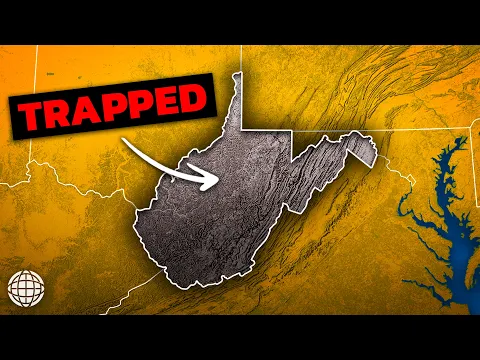

The geological destiny is written in the Carboniferous period when the area was a tropical swamp. Dead plants buried under sediments, heat, and pressure turned into coal, including high-quality bituminous coal.
The geology is described as a layered cake, with horizontal veins straddling mountains. This makes extraction cheaper: instead of drilling deep wells, it was possible to enter from the slope, “sliding” into the hill. It was accessible, abundant, and ubiquitous.
The paradox of the state arises there: the mineral wealth that promises prosperity also encourages dependence on a single extractive sector, with infrastructure, politics, and education shaped to serve it, making adaptation difficult when technology and market change.
A Secession of a Secession: Birth of the State in 1863 and Internal Scars
In 1860, West Virginia did not exist. It was the western portion of Virginia, but with deep economic and cultural differences. To the east, Tidewater elites sustained tobacco plantations and slave labor. In the mountains, plantation agriculture was unviable; Scottish-Irish immigrants, mountaineers, and subsistence farmers predominated, valuing independence and rejecting taxes, resentful of Richmond.
When Virginia votes for secession in 1861, at the start of the Civil War, the western counties refuse to fight for a cause and for an economic system in which they did not participate. They gather in Wheeling, form their own government, and on June 20, 1863, West Virginia joins the Union as the 35th state, the only one in American history born directly from the secession of another state.
Independence comes at a high price: families separated, brother against brother in a neighbor-against-neighbor guerrilla war, with scars persisting long after the surrender at Appomattox. The state is born in chaos, but sitting on timber and coal, exactly what the industrial revolution desired.
Railroads, Mineral Rights, and Company Town: When Connection Becomes Ownership
At the end of the 19th century, railroads conquer the mountains by following river valleys and piercing the isolation. The arrival of the tracks shifts the balance: agents from New York, Philadelphia, and London offer money for the mineral rights of farms, often for just 50 cents an acre.
Many farmers believe they are selling “useless” rocks from below and retaining the farm’s surface. They sign broad deeds without realizing they are relinquishing the future. Contracts often grant companies the right to do what is necessary to extract minerals, including destroying the surface.
Almost overnight, the state exchanges agricultural frontier for industrial colony. Immigrants from Italy, Poland, and Hungary, along with African Americans from the South, arrive to work in the mines. The company town becomes the norm: the coal company controls housing, store, church, and even the police. Payment comes in scrip, currency valid only at the company store. It is feudalism within modernity.
The Coal Wars and Blair Mountain: 10,000 Armed Miners in 1921
Total control collides with the local independent spirit. As conditions worsen and coal barons tighten their hold, the state erupts into labor conflicts culminating in the Battle of Blair Mountain in 1921.
About 10,000 armed miners march to free imprisoned union members in Mingo County and face a private army hired by coal companies, supported by planes dropping homemade bombs. The episode is described as the largest labor uprising in U.S. history and the largest armed insurrection since the Civil War. The miners lose the battle, but unionization advances, consolidating the United Mine Workers as a force capable of dictating state politics for decades.
The Industrial Peak and the 1950 Peak: Coal, Chemistry, and Urban Prosperity
In the 1940s, West Virginia is portrayed as the machine room of the industrialized world. The coal from the state fueled steel for tanks and ships in World War II. In the Kanawha Valley, the “Chemical Valley” produced synthetic rubber and materials for the war effort.
Prosperity translates into vibrant cities, with cinemas, dealerships, and bustling main streets. The 1950 census records the peak: 2.552 million residents. From the outside, it seemed a destination for continuous growth as the energy capital of the east. Inside, there was a ticking time bomb: the industry that attracted millions was about to swap human arms for machines.
The Technological Turn: Coal Remains High, but Human Labor Disappears
The decline begins almost immediately after 1950. Coal production does not vanish overnight, but the need for bodies to extract it plummets. Mechanization substitutes pick and shovel with continuous mining, trading mule for conveyor belt.
The comparison is brutal: a mine that employed 500 men now operates with 50 men and machines. Proud miners do not compete with equipment that does not sleep, eat, or unionize. The shock is not just economic, it is demographic, because those who leave tend to be young, at family-forming age, taking away children and grandchildren who will never be born in the state.
Hillbilly Highway: The Mass Migration to Ohio, Michigan, and Illinois
The great internal migration is called Hillbilly Highway. Route 119 becomes the artery of exodus. Hundreds of thousands leave the state heading to the industrial North: Akron to make tires, Detroit to build cars, Chicago for steel mills.
This is not just a loss of population, but a loss of reproductive potential and human capital. The flight of young people creates a void that the state cannot recover from, feeding decades of aging and structural decline.
Why Diversification Failed: The Astronomical Infrastructure Cost in the Mountainous State
When industries leave traditional regions, other areas reinvent themselves. Here, diversification hits a wall with the terrain. To replace a labor-intensive industry like coal, industrial parks, housing, and fast, direct transportation networks are needed.
West Virginia has virtually no terrain for this. Building a four-lane highway through the Appalachians costs significantly more per kilometer than paving roads in the plains of Ohio. Companies looking for factories in the 1970s and 1980s faced a logistical nightmare: why set up in a narrow valley where you have to blast rock to expand parking when you can build on flat land for a fraction of the cost?
The mountains that provided wealth to the state become a barrier to diversification. Dependence on an extractive industry fits what economists call the resource curse: political and economic infrastructure designed for one sector, education focused on training miners rather than engineers, and a tax base fluctuating with coal prices, making long-term planning nearly impossible.
Aging, Deaths Outnumber Births, and Opioids: The Demographic Spiral
Decades of young people leaving accelerate aging. The state is described as having one of the highest average ages in the country, even higher than retirement havens like Florida and Arizona. It is cited as one of the few places where deaths regularly exceed births.
The crisis is exacerbated by the opioid epidemic, described as affecting these communities more than almost anywhere else, fueled by despair from economic stagnation and the physical pain of manual labor jobs. The 2020 census confirms continuity: the state lost the largest percentage of population in the country over the last decade and also lost a congressional seat, reducing political power in Washington.
Recent Signs: Remote Work, Tourism, and Localized Growth in the Extreme East
Despite the general trend, pockets of change are emerging. With the increase in remote work, people seek low living costs and natural beauty, two attributes abundant in the state. The New River Gorge, recently designated a national park, appears poised for tourism expansion.
In the extreme east, areas serving as transportation corridors for those working in Washington D.C. show growth. Berkeley County is the numerical example: rising from 122,000 people in 2020 to over 136,000 in 2024, a significant growth for a state accustomed to shrinking. Still, these pockets do not compensate for the deeper decline in the southern coalfields.
The Destiny Written in Stone: Geography as a Cage and as Identity
The final synthesis is geographical. The mountains kept the state wild, placed coal in its layers, and then cornered it when the economy changed. Rails and corridors turned connection into control. Mechanization transformed wealth into structural unemployment. And migration took away not just residents but future generations.
West Virginia becomes the portrait of how natural resources do not guarantee growth when terrain, technology, and economic structure push in the opposite direction.
In your opinion, was the main cause of this state‘s decline the mechanization of coal or the geography that hindered diversification when human labor was no longer needed?






-

-

-

-

7 pessoas reagiram a isso.