





 Portuguese
  English
  Spanish
  5 min of reading
  0 comments


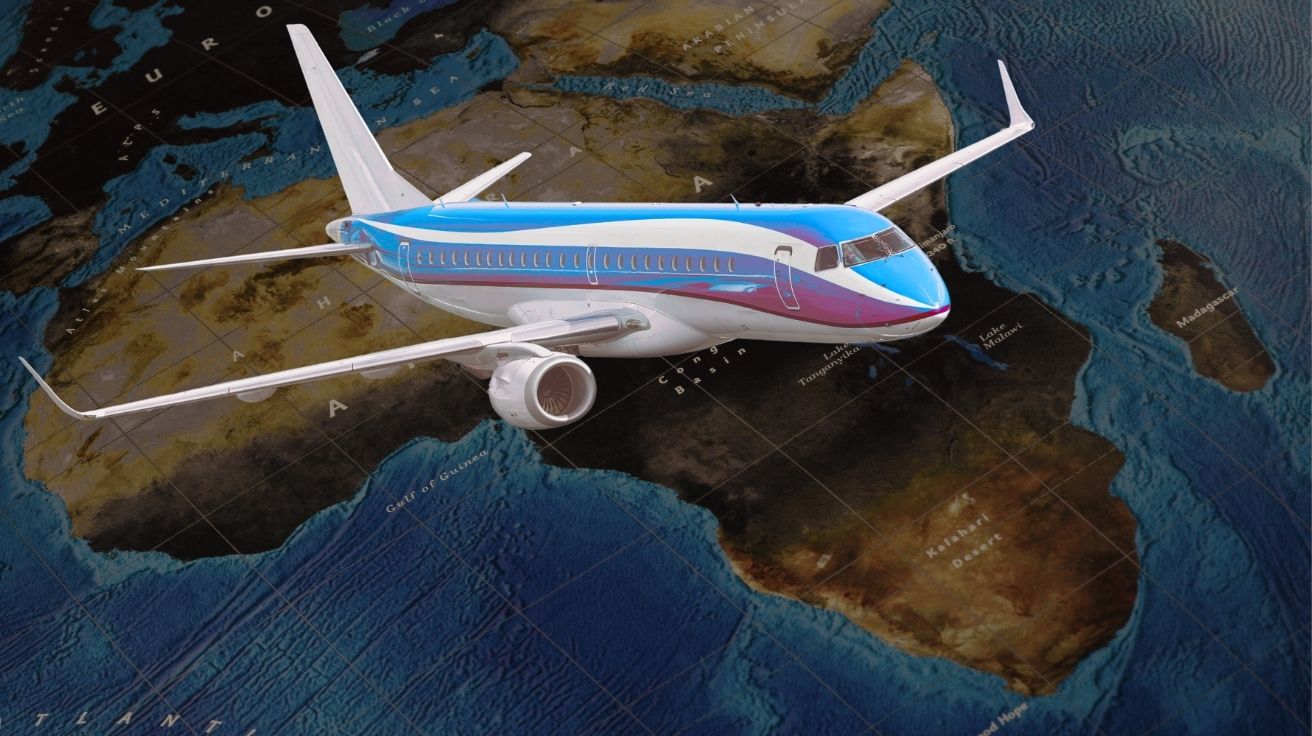
With Only 2.1% of Global Air Traffic, African Continent Hides Billion-Dollar Potential in Regional Connectivity; Embraer Report Identifies Routes, Hubs, and Ideal Aircraft to Unlock This Growth
Despite representing 18% of the world’s population, Africa remains one of the most disconnected regions on the planet when it comes to air transport. A new study by Embraer, released during the AviaDev 2025 conference in Zanzibar, exposes an alarming reality: 64% of African regional air markets operate with only seven flights per week or fewer.
The Brazilian manufacturer projects that, with the right aircraft and well-structured direct routes, the continent could experience a growth of 4.4% per year in revenue per passenger kilometer (RPK) over the next 20 years, surpassing Europe and North America. The solution? Focus on efficient regional flights, smart hubs, and jets with fewer than 150 seats, such as the E2 family.
The Vast Ignored Air Potential of Africa
The new Embraer report reveals that, although Africa has 1.5 billion inhabitants, its share of global air traffic is still only 2.1%. This logistical bottleneck directly impacts the economic growth of the continent, which represents less than 3% of global GDP. The disparity between population and air transport infrastructure is one of the major obstacles to African development.
-
Chaos On Airplane Could Be Expensive: Proposal Aims To Prevent Disruptive Passengers From Flying For Up To 1 Year In Brazil And Face Fines Of Up To R$17,500

-
Man Arrested After Halting Takeoff of Fire Department Helicopter During Child Rescue in Guaratuba

-
With 37 Tons of Cargo, Over 8,000 km Range, and Ability to Land on Unpaved Runways, the Airbus A400M Demonstrates How Europe Created a Military Giant That Transports Armored Vehicles, Aerially Refuels Fighters, and Operates in Conflict Zones and Humanitarian Missions Worldwide
-
Emergency Landing in Campos Amarais After Bird Strike on Small Plane


Currently, most trips between African cities require connections in distant hubs such as Dubai or Paris, making travel expensive, time-consuming, and impractical. This hampers the advancement of tourism, regional business, and even the educational sector. Embraer estimates that 45 intra-African routes currently lack direct flights, despite the unmet demand.
To change this scenario, the company analyzed a decade of data (2014 to 2024), utilizing market information from Sabre. This led to the creation of a “stimulus curve,” showing how the introduction of a direct route can increase demand by up to 80%, especially in markets with initially low traffic.
The report also highlights the importance of routes between capitals with strong economic and cultural ties, such as Abidjan–Douala and Lagos–Cape Town. With aircraft the size of the Embraer E195-E2, these connections could be operated with three to five weekly flights with commercial viability.
In addition to point-to-point routes, the study advocates for the consolidation of African hubs to multiply regional connections. This strategy, combined with the use of smaller and more efficient aircraft, is seen as key to unlocking growth in African aviation.
The 10 Destinations with the Highest Unmet Demand in Africa
Embraer identified 10 city pairs with high traffic potential and no direct flight offerings. Among them, Abidjan–Douala (Ivory Coast–Cameroon), which connects two major Francophone economic centers with intense business and cultural tourism flows. This route alone could sustain five weekly flights with 120-seat aircraft.
Another highlight is Cape Town–Lagos, which connects the tourism center of South Africa to the business hub of Nigeria. Currently, the connection requires stops in Johannesburg or Addis Ababa, increasing costs and time. Embraer estimates that this route could operate with four direct weekly flights.
Other examples include Cotonou–Dakar, Brazzaville–Bamako, Abuja–Nairobi, and Cape Town–Dar Es Salaam, all with significant unmet demand and a combined urban population of over 5 million inhabitants.
The report further details how the lack of direct flights forces passengers to make complex and costly connections, often in hubs outside the continent. This not only complicates mobility but also limits regional economic growth.
In addition to the impact on passengers, the lack of air connectivity also harms intra-African trade, the events sector, and the development of regional health and education services.
Based on PDEW data (passengers per day in each direction), each of these routes could be opened with reduced risk if operated with aircraft in the 100 to 120-seat category, such as the E195-E2, which offers a balance between range, cost, and occupancy.
African Hubs: Challenge and Opportunity for Smart Connections
African hubs still operate with low efficiency compared to their counterparts in Europe or Asia. Airports like Johannesburg (JNB), Addis Ababa (ADD), and Nairobi (NBO) already function as regional centers, but with less frequency and reach than necessary to meet the continent’s real demand.
While Amsterdam and Frankfurt offer more than 3 daily flights per destination, African hubs barely reach 2. The study points out that by adding a single new flight to a well-structured hub, dozens of new itineraries become possible due to the “multiplier effect” of connections.
The organization of schedules into “connection banks” (synchronized arrivals and departures) is crucial to minimize wait times and optimize aircraft usage. This not only improves passenger experience but also enhances the commercial attractiveness of the hub.
The modernization of infrastructure and the use of smaller and more frequent aircraft, like the E-Jets, allow medium hubs to be transformed into competitive connection points, boosting regional aviation.
Additionally, countries like Ghana, Angola, and Tanzania can strengthen their domestic hubs, creating feeder traffic for international and regional routes, consolidating their local airlines.
Efficient connectivity also has a positive environmental impact: by avoiding long and indirect routes via Europe, emissions per passenger are significantly reduced, promoting a more sustainable aviation.
The Right Aircraft for the Right Continent: Why the E2 May Be Embraer’s Key
Embraer argues that choosing the ideal aircraft is the difference between success and loss in new markets. This is even more relevant in fragmented regions like Africa, where demand may be uncertain and volatile.
The E2 family, with models like the E175+ (76 seats), E190-E2 (96 seats), and E195-E2 (120 seats), covers the full spectrum of short and medium flights with low cost per trip and high efficiency. These aircraft are designed to reduce operational risks and increase profit margins.
The report highlights that, while larger aircraft need maximum occupancy to be viable, the E2 can operate with fewer passengers and still maintain profitability, thanks to its lightweight structure, optimized aerodynamics, and low fuel consumption.
With a range of up to 6 hours of flight, the E2 can cover almost all intra-African routes without stops, connecting smaller markets that would be economically unviable with larger aircraft.
This “size-targeting” strategy also allows for creating new frequencies in already saturated hubs, feeding connections without creating excess capacity and keeping the air network agile and matched to real demand.
Finally, the E2 is ideal for both point-to-point airlines and operators that rely on the hub-and-spoke system, ensuring flexibility and scalability for the growth of African aviation.










Seja o primeiro a reagir!