





 Portuguese
  English
  Spanish
  6 min of reading
  0 comments


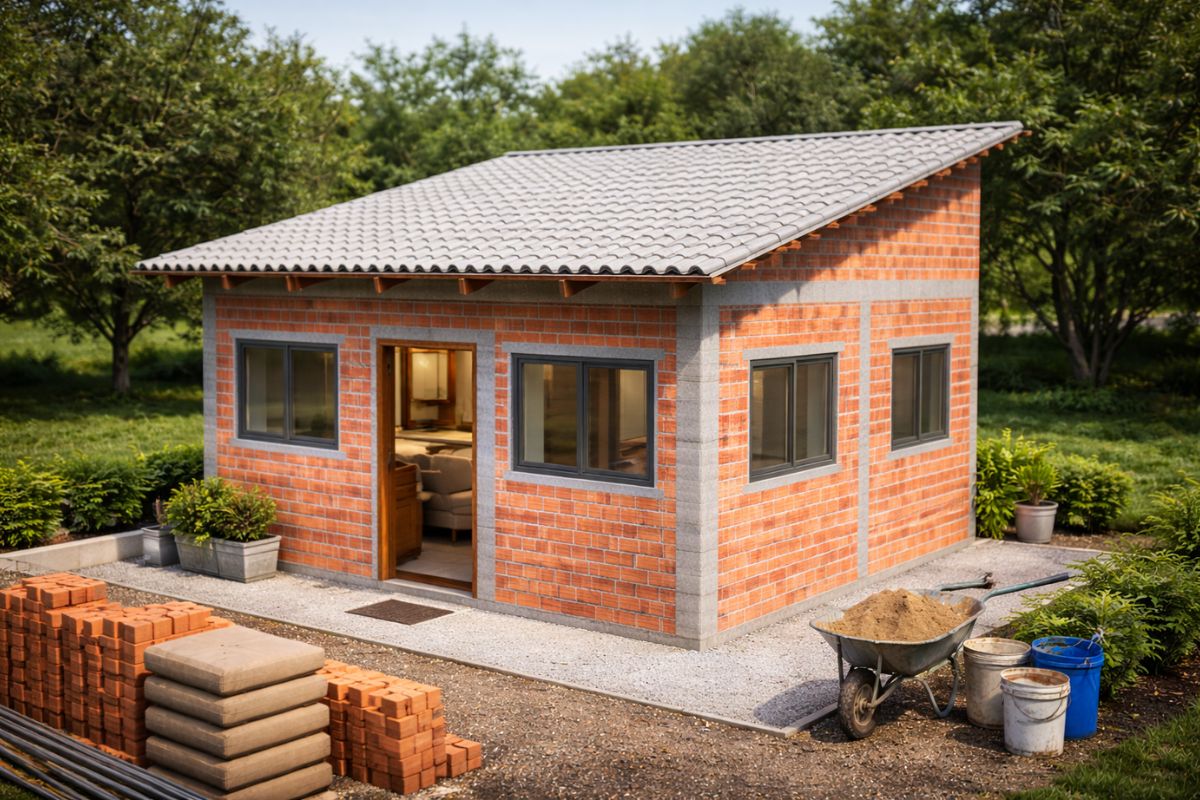
The Proposal Details the Construction of a Compact House of 36 m² in a 6×6 m Plan, with About 1,500 Bricks, Nine Columns, Simple Structure, and Options for Slab or Visible Roof, Showing a Low-Cost Path for Narrow Lots with Suite, Living Room, and Integrable Kitchen in Small Plot.
The 36 m² compact house presented in the project relies on a straightforward logic, reducing area without eliminating spaces that are often sacrificed in small plans. Instead of a single solution with bedroom and kitchen, the proposal organizes a suite, living room, and kitchen within a 6×6 m layout, focusing on simple construction and controlled material consumption.
The difference lies less in the final size and more in the balance between layout, structure, and lot feasibility. The project was designed to fit even in a minimum width of 6 m, maintaining openings at the front and back, which broadens the possibility of use in smaller lots and in contexts of affordable housing.
Project Implementation and Internal Distribution of the 36 m²

The implementation reference used in the presentation considers a 10 by 10 m lot, with the construction centered. This larger area appears as a base to illustrate possible additions, such as a porch and window adjustments, but the proposal makes it clear that the 36 m² compact house can be executed in a minimum width of 6 m, as long as the openings remain concentrated at the front and back.
-
Every day, before the sun rises, tractors go out to clear a road that the desert tries to swallow throughout the night, because in the United Arab Emirates there is a highway that cuts through the largest continuous sand sea on the planet, passing alongside dunes 300 meters high and melting the soles of any shoe that touches the asphalt in the summer.

-
In León, potholes become craters and burst tires and suspensions, but the city hall blames the drivers, saying that the road was marked and that at 30 km/h it was possible to swerve, and they only cover at most half of the repair costs.

-
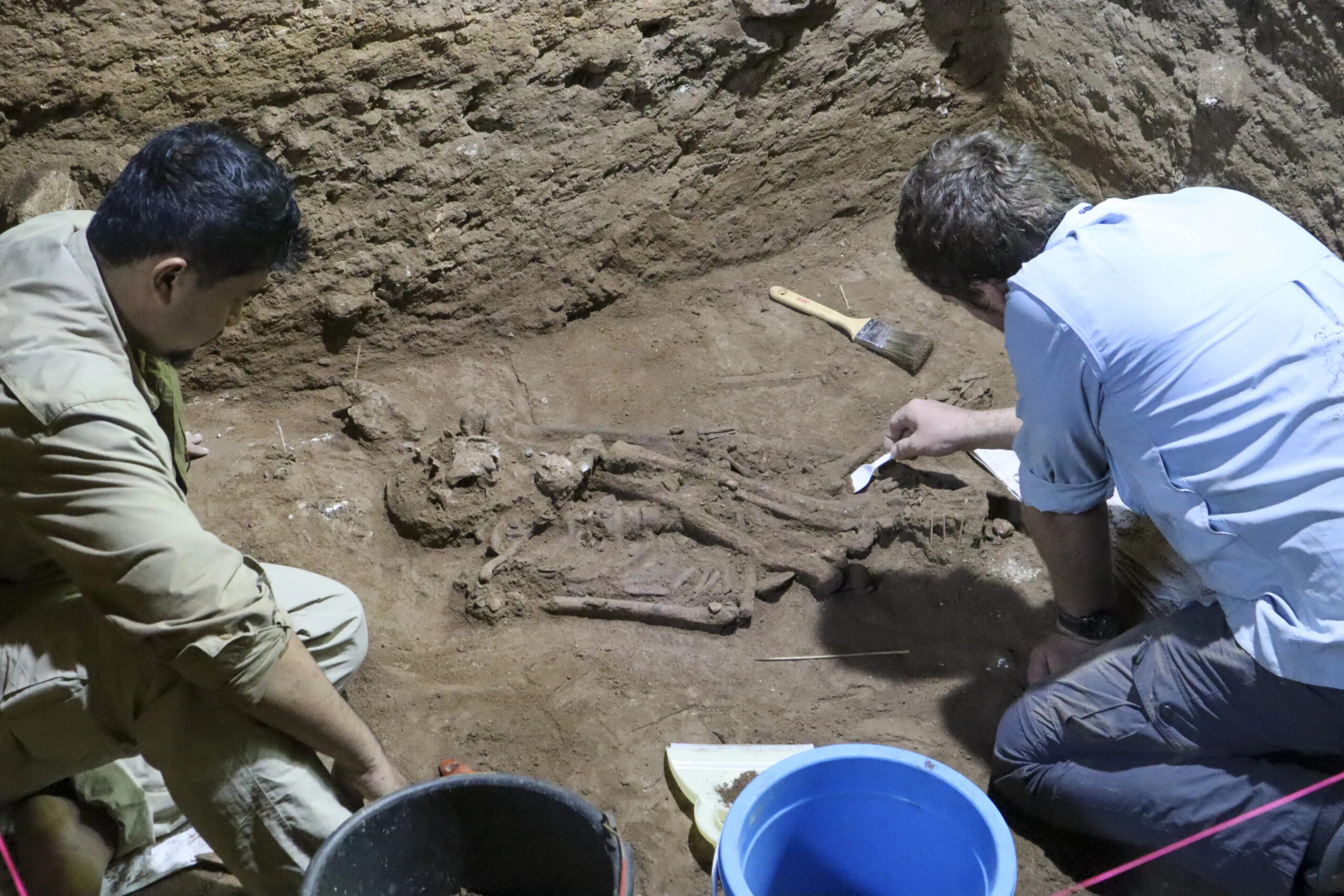
31,000 years ago, humans were already performing complex amputations with surgical precision without antibiotics, modern anesthesia, or a sterilized environment, and they made patients survive for years, as evidenced by the skeleton found in Borneo that rewrites the history of medicine on the planet.
-
A fragment of moss the size of a grain of sand helped the FBI uncover a shocking tomb raiding scandal in the U.S. and exposed a scheme that lasted for years in Chicago.

In the internal design, the division is practically in half. At the back, there is a suite with a bathroom on the left side. At the front, there are the living room and kitchen on opposite sides. This simple zoning helps gain comfort compared to even smaller plans, especially the ranges of 25 m² to 30 m² cited as references for tighter units.
The reading of the layout also shows an important project decision: to avoid excessive compartmentalization. In a small area, every additional wall reduces circulation and flexibility. By maintaining few internal blocks, the proposal preserves a more fluid daily use without requiring a large lot to function.
Another relevant point is the implicit comparison with a studio apartment. The proposal even admits this approximation but emphasizes that the 36 m² compact house offers slightly more comfortable environments, especially in the suite, living room, and kitchen, which can change the perception of habitability in daily life.
Foundation and Beam with Simple Structure and Controlled Cost Reading

In the structural base, the project adopts reinforced concrete with regular column distribution. Instead of relying solely on structural masonry, the proposal organizes three columns at the back, three in the central area, and three at the front, totaling nine columns. This 3 by 3 grid arrangement simplifies load reading and execution, something coherent with the low-cost proposal.
For the foundations, the project describes nine points and classifies the execution as simple, with an important technical caveat that the consumption and type of foundation depend on the soil. This is central to maintaining the credibility of the proposal, because the material itself recognizes that low-strength soils may require different solutions. An economical project does not eliminate local foundation assessment.
For the footings, approximate quantities for this phase are presented, with two and a half bars of 12 m rebar, four bags of cement, 0.4 m³ of sand, and 0.60 m³ of gravel, considering the mix specified in the explanation. These data help those planning initial costs but do not replace technical adjustments on-site according to soil and final sizing.
Next, the beam base and initial beam of the foundation come in, with 30 m of linear beams. The total concrete fill is estimated at about 0.99 m³, with an approximate reinforcement of 10 bars of 12 m and 11 bars of 4.25 mm for stirrups. In small projects, this type of step-wise consolidation is what really allows for budget comparison and decision-making.
Masonry with 1,500 Bricks and How Block Choice Changes the Calculation
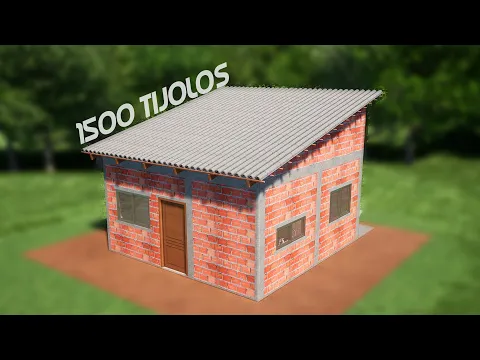
Masonry is the most striking point on the subject, with the mark of about 1,500 bricks. The presented calculation considers the version with slab, without the slope of a visible roof, and already discounts the openings for doors and windows. For the 36 m² compact house, this number reinforces the idea of a lean build, with little wall and rational plan.
The quantity was estimated with bricks approximately 24 cm in length. The explanation itself shows how block choice alters the final count. If the brick is 29 cm, the quantity tends to decrease. If it is 19 cm, consumption may rise to about 1,800 units. This detail is crucial for budgeting, logistics, and installation timeline.
This variation is often underestimated by those who only look at the final number of bricks. In practice, the difference in modulation affects joints, labor yield, and purchase volume. In a compact build, purchase errors may seem small but weigh disproportionately on total cost.
The correct reading, therefore, is not just to repeat the number of 1,500 bricks, but to understand under what conditions it was estimated. In the 36 m² compact house, the result depends on the type of brick adopted, the openings, and the roof covering solution chosen for the upper part.
Columns, Roofing, and the Comparison Between Slab and Visible Roof
In the columns, the project maintains the logic of the nine structural points and presents specific quantities for this phase. The informed estimate is approximately 1 m³ of concrete for filling the columns up to the slab level, plus 14 bars of 12 m rebar and 16 bars for stirrups. It is a lean structure, but with sufficient detailing to move from the realm of idea to budget.
An interesting technical aspect is the comparison between slab and visible roof. The explanation states that, in the end, the load can be close, especially if glazed ceramic tiles are used, which have a relatively high weight. This avoids a common simplification that visible roofs always mean a much lighter structure. The decision between slab and roof needs to consider weight, cost, and future use of the covering.
The proposal also signals two possibilities for upper finishing, one with slab and the other with a visible roof, which enhances the project’s adaptability. In a small lot, this flexibility can be strategic, as it allows the construction to fit the available budget at the moment without changing the main plan.
Moreover, the 36 m² compact house was presented with room for adjustments, such as a porch and window configurations, which shows a light expansion path without changing the essence of the structure. This is relevant for those intending to start with the basic core and improve in phases.
Consolidation of Materials and Realistic Low-Cost Reading

<pIn the overall structural consolidation, excluding the slab to separate the discussion of the covering, the project informs approximately 24 bags of cement, 2.55 m³ of sand, and 3.5 m³ of gravel. There is also a consolidation of steel with about 36 bars. This type of summary is what turns a small plan into a practical construction decision.
The term low cost, however, needs to be read carefully. Low cost does not mean a universal fixed cost. Material prices, shipping, labor, and soil conditions vary by city and region. What the project delivers is a lean consumption base and a simple structure, which tends to facilitate planning and reduce waste compared to larger plans.
Another merit of the proposal is the clarity in separating stages: foundation, beams, columns, masonry, and roofing. In small projects, many budgets fail because everything is treated as a single package, without phase control. When the work is divided by stage, the owner can prioritize, compare, and correct course without losing the entire project.
In the end, the 36 m² compact house stands out by combining an objective plan, functional internal distribution, and a list of materials that allows for a more secure initial estimate. For narrow lots, this combination is often more important than promises of sophisticated finishing.
The 6×6 m proposal shows that a 36 m² compact house can go beyond the idea of minimum space and deliver a more balanced configuration, with a suite, living room, and kitchen, a simple structure with nine columns, and masonry estimated at around 1,500 bricks, plus options between slab and visible roof.
If you had a small lot today, would you build this 36 m² compact house with a slab or a visible roof, and at which stage do you believe that the budget tends to go more out of control: foundation, structure, masonry, or roofing?







-

Uma pessoa reagiu a isso.