Portuguese
  Spanish


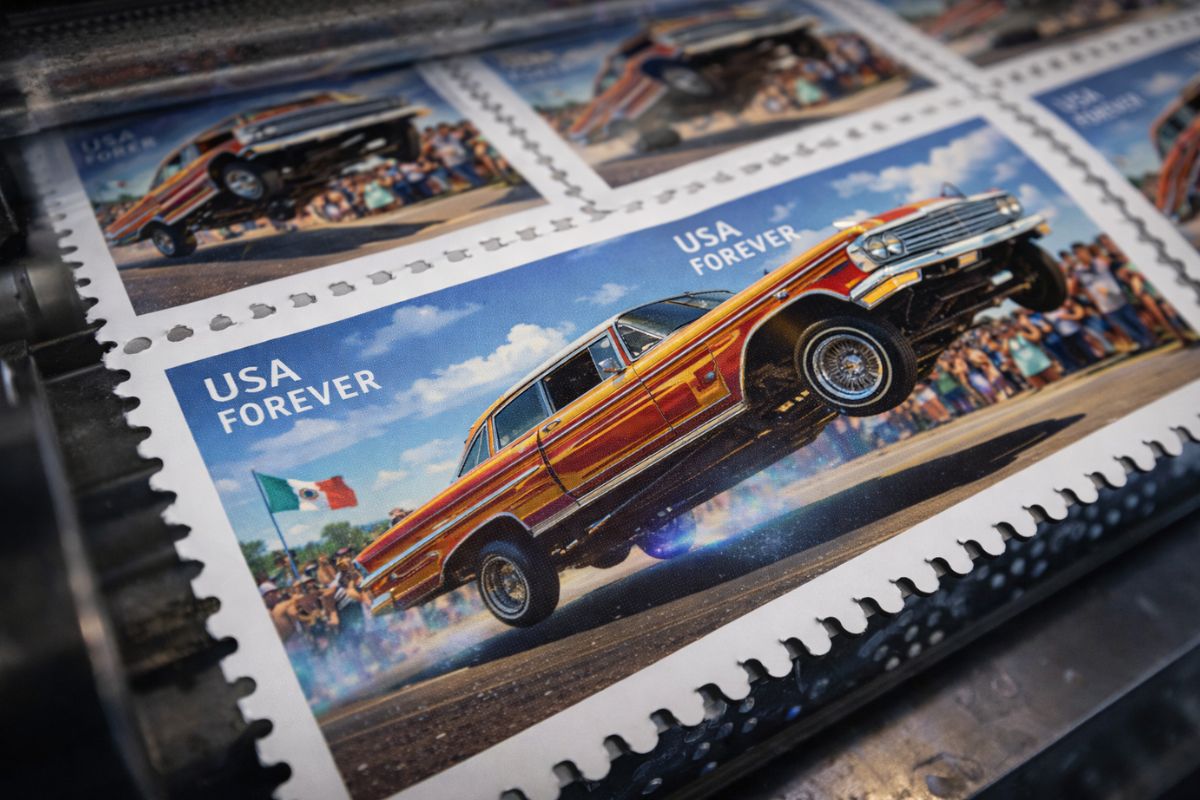

Until 2023, driving a lowrider was illegal in California. In March 2026, the United States Postal Service launched the Lowrider Forever collection and transformed the same cars that the police had seized for decades into officially recognized American art.
Imagine a 1961 Chevrolet Impala bouncing almost a meter in the air in the middle of a street in the United States. The whole car rises, the chrome shines in the sun, and the driver, with five-centimeter pink nails resting on the open window, doesn’t even blink. Pedestrians stop. Someone shouts from the sidewalk: “Nice car!” The sound of Brenton Wood, a 1960s crooner, comes from the speakers as the Impala touches back down on the asphalt and continues gliding along Route 66 in Albuquerque, New Mexico.
This is lowriding. And until recently, it was a crime.
What is a lowrider and why did the United States prohibit it?

A lowrider is a car modified to ride lower than normal. But “lower” is just the beginning. Owners install hydraulic systems that allow them to raise and lower the car at the touch of a button. The result is vehicles that literally bounce on the asphalt, make the chassis dance, and turn any corner into a spectacle.
-
Toyota to Open New Factory in Brazil by November 2026 with $2.2 Billion Investment, Creating 2,000 Jobs, and Ending Corolla Production in Indaiatuba

-
Brazilian Factory Restores Truck Engines and Parts, Reducing Raw Material Use by Up to 85% After 80 Years in Business

-
British Marines Set Record by Changing Ford Escort Engine in 42 Seconds, Unbroken for 40 Years

-
BYD Owners in Brazil Raise Concerns Over Warranty After 87,000 km, Two Repairs in Three Days, and Over $500 in Costs





The tradition began in the 1940s in the garages of Chicano (Mexican-American) working-class communities in California. Cars were modified with whatever was available: military aircraft parts from World War II, adapted hydraulic pumps, handcrafted paint jobs that took weeks. Each lowrider was a work of art on wheels, a statement of identity in a country that treated Mexicans as second-class citizens.
The authorities’ response was not admiration. It was criminalization.
California passed laws prohibiting modified vehicles below a certain height. Driving a lowrider could result in fines, car seizures, and even imprisonment. Cruising slowly through the avenues, the famous “cruising,” was banned in dozens of cities. The official justification was traffic safety. The real justification, according to historians and activists, was to control a form of Latin cultural expression.
For decades, lowriders were treated as a police problem. Car clubs were monitored. Gatherings were dispersed. An entire culture was pushed underground.
What changed?

In 2023, California finally repealed the laws that prohibited lowriders. The state that had criminalized the tradition officially recognized that the ban was discriminatory. But what happened in March 2026 went beyond any expectation.
The United States Postal Service launched the Lowrider Forever collection: a series of official postage stamps celebrating lowrider culture as American art. The launch ceremony took place in San Francisco, featuring an exhibition of dozens of meticulously restored cars.
“This is not just about a stamp. It’s about respect”, said Roberto Hernández, founder and president of the San Francisco Lowrider Council.
Among the cars featured on the stamps is “Pocket Change,” a 1987 green Oldsmobile Cutlass Supreme that became an icon of the community. Each stamp is a statement: what you called a crime, we call art. And now the government agrees.
From Albuquerque to the world
While San Francisco celebrated the stamps, National Geographic published a report on the resurgence of lowriders in Albuquerque, New Mexico. The city, which hosts the longest urban stretch of the legendary Route 66, has become the epicenter of the new generation of lowriders.
Angelica Griego, one of the protagonists of the report, drives a 1960 Chevrolet Impala equipped with a full hydraulic system. With the touch of a button on the dashboard, the car jumps, bounces on the asphalt, and glides again as if nothing happened. In ten minutes of cruising down Central Avenue, three people stop to compliment the car.
The scene would have been unthinkable ten years ago. Twenty years ago, it would have been grounds for seizure.
Why does this story matter?
Because it is one of the greatest cultural reversals in recent years in the United States. A tradition that was born in poverty, was criminalized for decades, and almost disappeared, is now recognized by the government itself as American cultural heritage.
The same cars that the police seized now feature on postage stamps. The same gatherings that were dispersed are now sponsored by museums. The same young Chicanos who were fined for driving too slowly are now invited to official ceremonies in Washington.
From crime to postage stamp. From underground garage to National Geographic. From “traffic problem” to “American art.”
If there is a story that shows how time can completely reverse a society’s judgment, it is the story of lowriders.
With information from National Geographic and the San Francisco Lowrider Council. Lowrider Forever collection launched by the United States Postal Service in March 2026.