





 Portuguese
  English
  Spanish
  6 min of reading
  0 comments


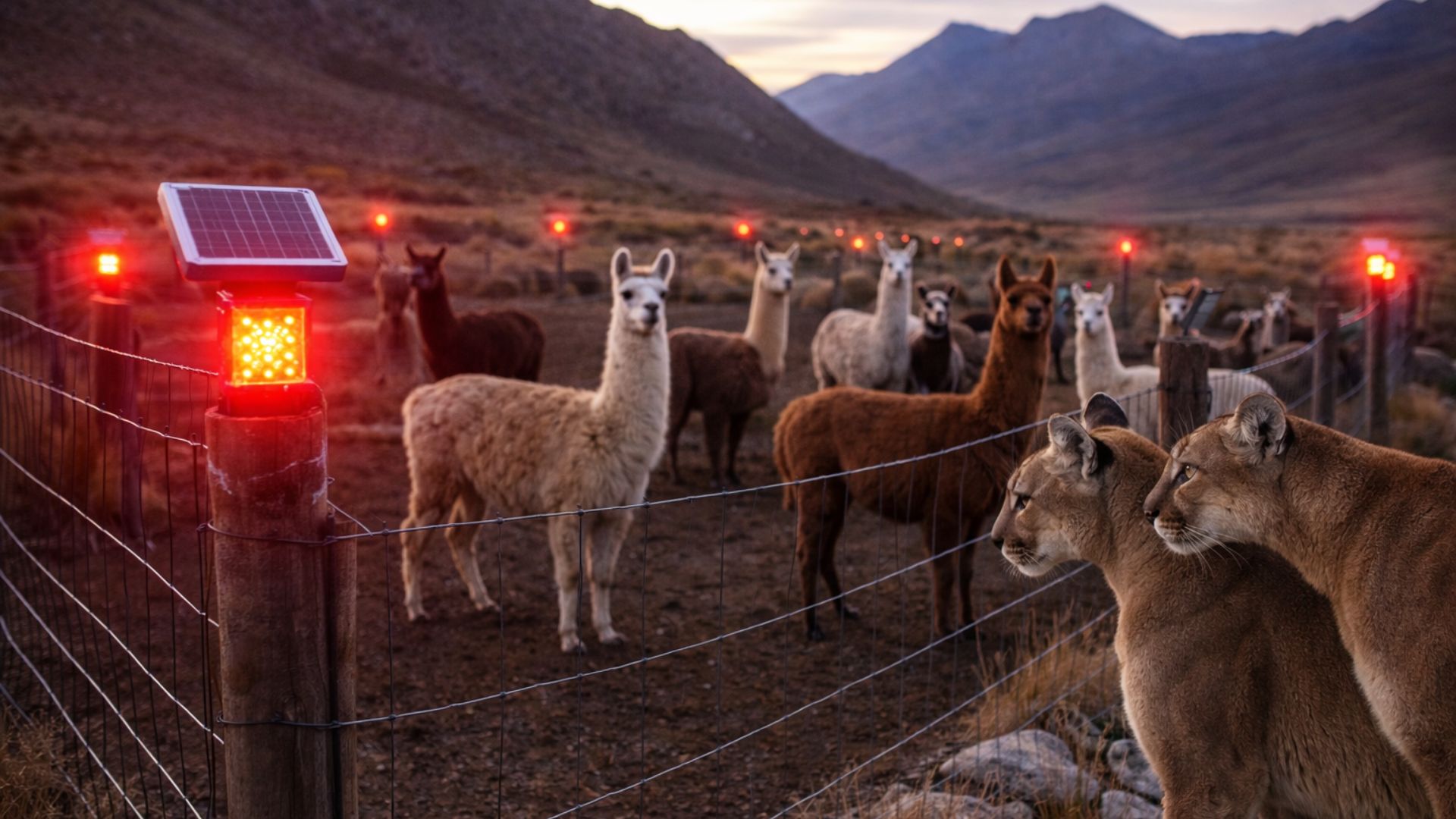
Flashing Lights Activated at Dusk Were Tested in Pens in the Highlands of Chile and Coincided with a Disruption of Puma Attacks on Llamas and Alpacas, in a Controlled Comparison Field Study. Simple Method Dispenses with Poison and Hunting, Reduces Losses and Can Decrease Retaliation Against Predators.
A simple form of nighttime lighting, installed around areas where llamas and alpacas spend the night, was associated with a disruption of puma attacks in a rural region of Chile, in a field test with an experimental design considered to be of high rigor for this type of conflict.
The strategy does not involve poison, traps, or hunting of the predator: they are flashing lights that are automatically activated at dusk and turned off at dawn, used as a visual barrier to discourage the approach of the feline.
Conflict Between Pumas and Herds in the Highlands of Chile
The method was evaluated in the Chilean highlands, in a high-altitude area where Aymara indigenous communities raise domesticated camelids and coexist with pumas and Andean foxes.
-
China retires the J-7 fighter after years of military protection and can now transform military items into drones, following more than 60 years of operation of the J-7, derived from the MiG-21, with thousands of units produced and strategic use in the PLAAF and PLANAF.

-
Volunteers are sought to live in the mountains for a month: a study pays people to stay at 2,500 meters, with 24-hour monitoring of sleep, metabolism, and blood pressure.
-
Goodbye to kitchen cabinets: innovation retires the traditional furniture of Brazilian kitchens by introducing modern pantries with modules of up to 2.40 m, 40% more organization, ergonomic access, adjustable shelves, and smart lighting in 2026.

-
After the union of Brazil and China, BRICS plays a leading role in the merger between two powers: Egypt and India move forward with agreements exceeding US$ 4 billion, expanding industrial capacity in strategic sectors and accelerating the establishment of factories and global production chains.


In this scenario, recurring losses of animals can turn into direct losses and, historically, fuel lethal responses against carnivores.
The research that tested the lights sought to measure, with structured comparison, whether the device truly alters the outcome in the field, where climate, terrain, distance between properties, and animal behavior make it difficult to separate “impression” from evidence.

Field Test with Randomized Design and Crossover
The investigation was presented as a randomized crossover test, a format in which each observed unit alternates between periods with and without the intervention, serving as its own control.
In practice, part of the herds received the lights in the first period and then went without; another part followed the opposite path, starting without and receiving the device in the second period.
This type of design is used to reduce common biases in studies of conflicts with wildlife, such as natural differences between properties, predator routes, and herd characteristics.
In total, 11 participating owners had nighttime resting areas monitored throughout the trial, with herds ranging from just over two dozen to several hundred animals.
The lights were installed in pairs, positioned at the ends of an imaginary ellipse around the overnight location, at varying distances depending on the size of the area, with height adjusted to maintain visibility based on vegetation and topography.
The device used in the study is described as solar equipment designed to emit flashes with random variation and light sensor activation, which avoids reliance on electrical power in the field.
Observed Result: Puma Attacks Concentrated Without the Lights

Records of attacks attributed to pumas appeared concentrated in periods when the lights were not active.
In units that started with the lighting and then moved to the phase without the method, puma attack counts occurred in the phase without the device, while remaining at zero in the phase with the equipment.
In units that followed the opposite path, attacks occurred when the control was in effect and did not recur when the lighting was installed.
The study also kept attention to a second relevant predator in the region: the Andean fox, which, according to the study itself, did not show the same sensitivity to light stimuli, with predation occurrences in both periods.
How Attacks Were Verified in the Field
To reduce the risk that the results were just isolated reports without verification, the study describes a combined checking scheme.
Agents trained by local agencies participated in investigations of predation complaints, and researchers supplemented the assessment with monitoring of carnivore presence through camera traps, searches for traces such as footprints and feces, and field observations.
The text also notes that owners claimed to have prior experience recognizing signs of puma attack, including evidence such as prey dragging, in addition to the loss history reported before the experiment.
Why Flashing Lights Can Deter Pumas
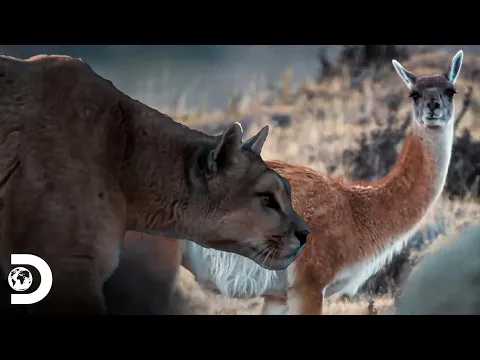
The behavioral logic behind the flashing lights relies on the principle of making the environment less predictable and more “costly” for the predator.
Pumas are hunters that take advantage of cover and low lighting to approach without being detected; by introducing an irregular light stimulus around the target, the method tends to reduce the comfort of the attack and the element of surprise.
The study, however, does not treat this explanation as magic: it describes the observed results for pumas, contrasts them with the absence of effect for Andean foxes, and maintains the interpretation in the context of what was measured in the field.
Cost, Maintenance, and Adoption by Breeders
For those who depend on the herd, cost and maintenance are central points.
The supporting material of the work provides the approximate value per light unit and states that funding, in the observed experience, received support from local government agencies.
In areas where reinforced fences, permanent human surveillance, or monitoring technologies are expensive or unfeasible, a simple intervention can gain acceptance if it does not disrupt the breeder’s routine and does not stress the animals.
The very study describes that, before maintaining the method over time, the breeders monitored the installation to see if the lighting would cause the camelids to abandon their nighttime resting places, and reports that there was no exit of the animals after dark during the observed period.
Local Participation and Limits of the Non-Lethal Method
The research also draws attention to involving participatory workshops and dialogue with owners and public agencies, presenting different non-lethal options and selecting alternatives perceived as viable and cost-effective.
By observing that the lighting did not alter the behavior of the Andean fox in the same way, the study also clearly delineates that an intervention can be specific to one species and fail for another.
This point is relevant because the conflict rarely involves a single predator, and effective measures need to be tested under real conditions, without promising a universal outcome.
The article’s own discussion mentions the challenge of assessing the duration of effectiveness over a longer time and the risk of habituation, a common concern with visual deterrents.
When Protecting the Herd Also Reduces Retaliation
For conservation, the importance of non-lethal tools lies not only in protecting domestic animals.
By reducing the damage that triggers retaliation, methods such as the lights can alleviate human pressure on large carnivores in productive landscapes, where they roam outside strictly protected areas.
In practice, protecting the herd can reduce the incentive to hunt the predator, which changes the balance of conflict without requiring a community to accept losses in the name of a distant goal.
The story behind this type of experiment also interests the public outside the rural context: a simple, visually striking, and easy-to-understand resource, tested with a comparative method and objective results for a target species, reinforces the idea that conservation and production do not need to rely on direct confrontation.
If a flashing light can reorient a predator’s decision at night, what other discreet solutions might exist to reduce long-standing conflicts without resorting to the killing of animals?





-

-

-

6 pessoas reagiram a isso.