





 Portuguese
  English
  Spanish
  6 min of reading
  0 comments


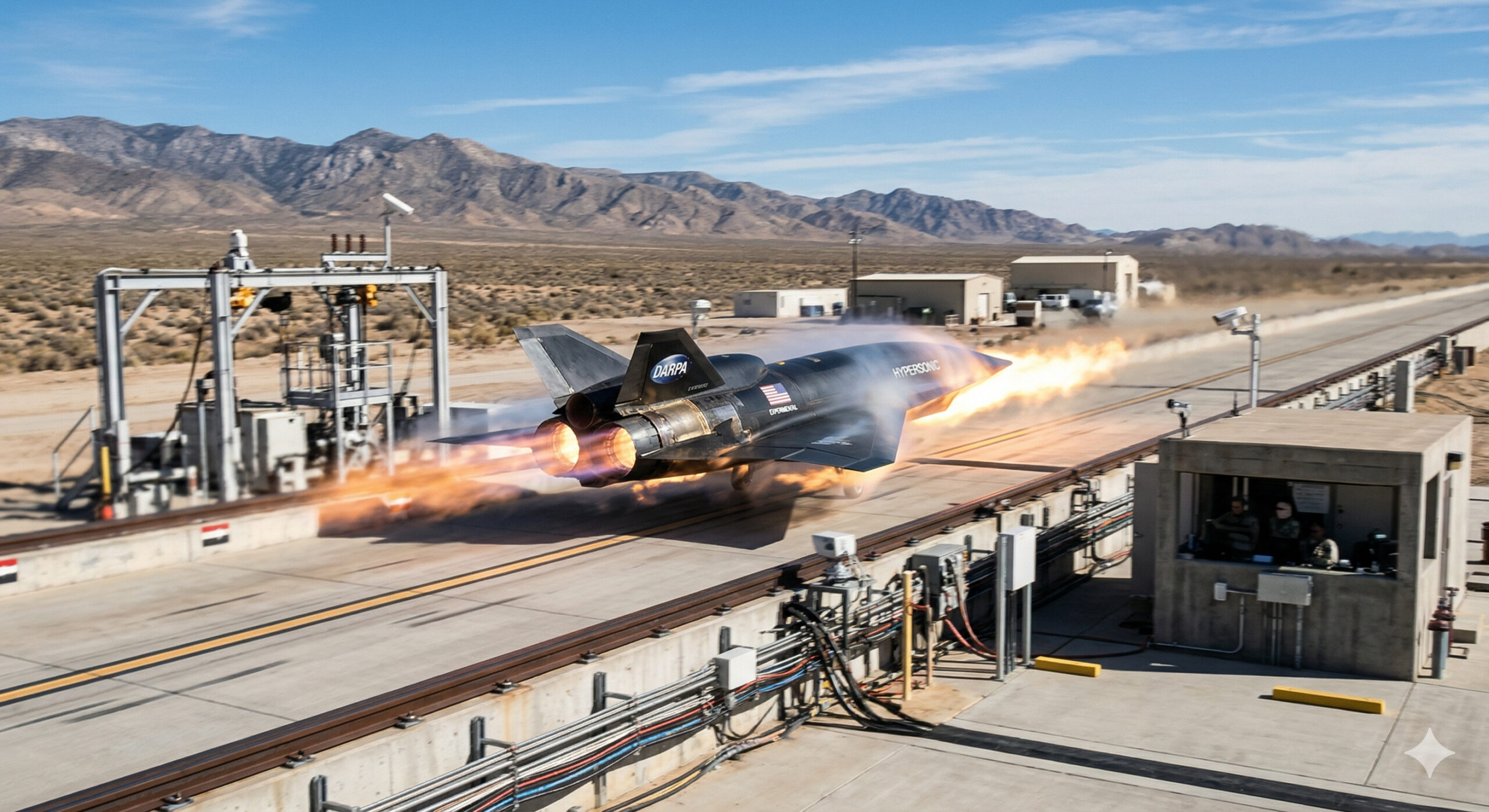
DARPA is working on a hybrid engine that goes from takeoff to over 6,100 km/h and could revolutionize reusable hypersonic flight.
In the official documentation of the DARPA’s Advanced Full Range Engine (AFRE) program, the agency describes an attempt to tackle one of the biggest barriers in aerospace engineering: developing a propulsion system capable of operating from takeoff to hypersonic flight above Mach 5, a range that DARPA associates with about 5,300 km/h. The challenge exists because conventional turbines lose efficiency long before that, while hypersonic engines, like scramjets, do not perform well at lower speeds.
According to the official technical description of the AFRE, the goal is to create a TBCC (turbine-based combined cycle) architecture that combines a turbine engine for low speeds with a dual-mode ramjet for high speeds, allowing a continuous transition between different flight regimes without relying on disposable rockets to take the aircraft to the hypersonic range. The proposal aims to break a historical limitation of air propulsion, which for decades has forced advanced designs to resort to complex hybrid solutions, separate stages, or non-reusable platforms.
The historical challenge of hypersonic aviation that the AFRE seeks to solve
Traditional aircraft engines perform well at certain speed ranges but fail completely outside of them. Conventional turbines, like those used in commercial airplanes, operate efficiently up to about Mach 2 or 3.
-
Scientists identify a unique cell that appears only during pregnancy and plays a role in the connection between the placenta and blood flow, revealing an essential mechanism for fetal development and possible causes of gestational complications.

-
A true “invisible ocean” of fresh water has been found beneath the Atlantic and could sustain a metropolis like New York for centuries while challenging everything that was known about natural water reserves on the planet.
-
Forget land-based data centers: the company wants to install AI modules inside giant turbines at sea and create floating wind-powered computing farms.

-
From ex-PagBank to “talk to me, Jota”: the Brazilian who wants to retire the card reader, create voice payment, turn the cell phone into a card terminal, and target billions in transactions without the customer even opening the bank app.


Above that, engines like the ramjet and scramjet come into play, which rely on the vehicle’s high speed to compress air and generate combustion.
The problem is that these engines do not work at low speeds, which necessitates the use of rockets or other auxiliary systems to reach the required regime. The AFRE seeks to address exactly this limitation.
The idea is to create an engine capable of starting from zero, progressively accelerating, and reaching hypersonic speeds without changing systems, something that, if proven at operational scale, could completely redefine the design of high-speed military and civilian aircraft.
How the turbine + scramjet combined engine concept works
The engine proposed by DARPA uses an architecture known as Turbine-Based Combined Cycle (TBCC), which combines different modes of operation in a single integrated system.
During takeoff and low-speed flight, the engine operates like a conventional turbine, similar to a commercial jet.

As speed increases, the system undergoes an internal transition, gradually shutting down the turbine components and activating the ramjet or scramjet mode.
In the hypersonic regime, air enters the engine at supersonic speed and combustion occurs without complete deceleration of the flow, allowing for extreme speeds to be achieved with greater energy efficiency. This transition is considered the most critical point of the entire engineering design.
Transition between regimes is the biggest technical obstacle of the project
Although the concept of combined engines is not new, its practical execution has always faced severe limitations. The transition between turbine and scramjet involves abrupt changes in temperature, pressure, and flow dynamics.
Errors in this transition can lead to loss of thrust, combustion instability, or even catastrophic structural failures.
DARPA states that the AFRE seeks to address these challenges with new control systems, advanced materials, and integrated architecture.
The ability to smoothly switch between regimes is what differentiates the project from previous attempts, many of which failed precisely at this point.
Extreme temperatures require next-generation materials
Operating at speeds above Mach 5 exposes the engine and aircraft to extremely high temperatures. Friction with the air can raise the surface temperature to over 1,000 °C, while the interior of the engine can reach even higher values during combustion.
These conditions require materials resistant to extreme heat and thermal fatigue, as well as highly efficient cooling systems.
DARPA is working with advanced metal alloys, high-performance ceramics, and thermal management techniques that allow heat to be dissipated without compromising structural integrity.
Speed above 5,100 km/h completely changes the concept of transportation
Flying at over Mach 5 is not just a matter of speed, but of redefining global distances. At this speed, intercontinental journeys could be reduced to just a few hours.
A flight from New York to Tokyo, for example, could be completed in less than 3 hours, depending on the route and altitude.
This potential positions the AFRE not only as a military advancement but also as a possible foundation for ultra-high-speed civil transportation in the future.
Military applications make the project strategic for the United States
In addition to the civil impact, the AFRE has direct implications in the defense area. The ability to launch reusable hypersonic aircraft enables reconnaissance, attack, and rapid response missions on a global scale.
Vehicles equipped with this type of engine could reach any point on the planet in a matter of hours, with enough speed to make interception by traditional defense systems difficult.
This factor makes the project highly strategic in a scenario of technological competition among major powers.
The difference between scramjet and conventional engines explains the technological leap
In traditional engines, air is decelerated before combustion, which limits the maximum speed. In the scramjet, combustion occurs with the airflow still at supersonic speed.
This eliminates one of the main efficiency losses and allows operation in regimes that would be impossible for conventional engines.
However, maintaining flame stability in such a fast flow is one of the biggest engineering challenges.
Previous programs have shown that the technology is possible, but still limited
Projects like the NASA X-43 and the U.S. Air Force X-51 Waverider have already demonstrated the viability of scramjet in flight. However, these vehicles were experimental and did not operate continuously from takeoff.

The AFRE seeks to take the next step: transforming an experimental concept into a complete operational system, capable of being reused and integrated into real aircraft. One of the main barriers to hypersonic technology has always been cost. Many systems rely on disposable rockets, making each mission extremely expensive.
The DARPA proposal is precisely to eliminate this dependency by creating a reusable engine that operates in multiple flights, drastically reducing the cost per operation. This factor is considered essential for enabling commercial applications in the future.
The United States, China, Russia, and Japan are heavily investing in hypersonic technologies. Each country is seeking different solutions to the same problem: achieving high speeds with efficiency and control.
The advantage of a system like the AFRE lies in the versatility and integration of multiple regimes in a single engine, something that has not yet been fully achieved by any other operational technology.
What still prevents the technology from reaching commercial use
Despite the advancements, several challenges still need to be overcome. In addition to technical complexity, there are issues related to cost, safety, and regulation.
Hypersonic flight involves extreme forces and conditions that require new certification standards and infrastructure, both on the ground and in the airspace. The transition from laboratory to commercial use still depends on years of testing and validation.
The proposal for an engine capable of taking off and reaching speeds over 6,100 km/h in a single system represents one of the most ambitious ideas in modern engineering. If successful, the AFRE could completely redefine how humans move across the planet and how military operations are conducted.
In your view, are we close to seeing this type of technology in real operation, or are there still barriers that could delay this revolution for decades?









Seja o primeiro a reagir!