





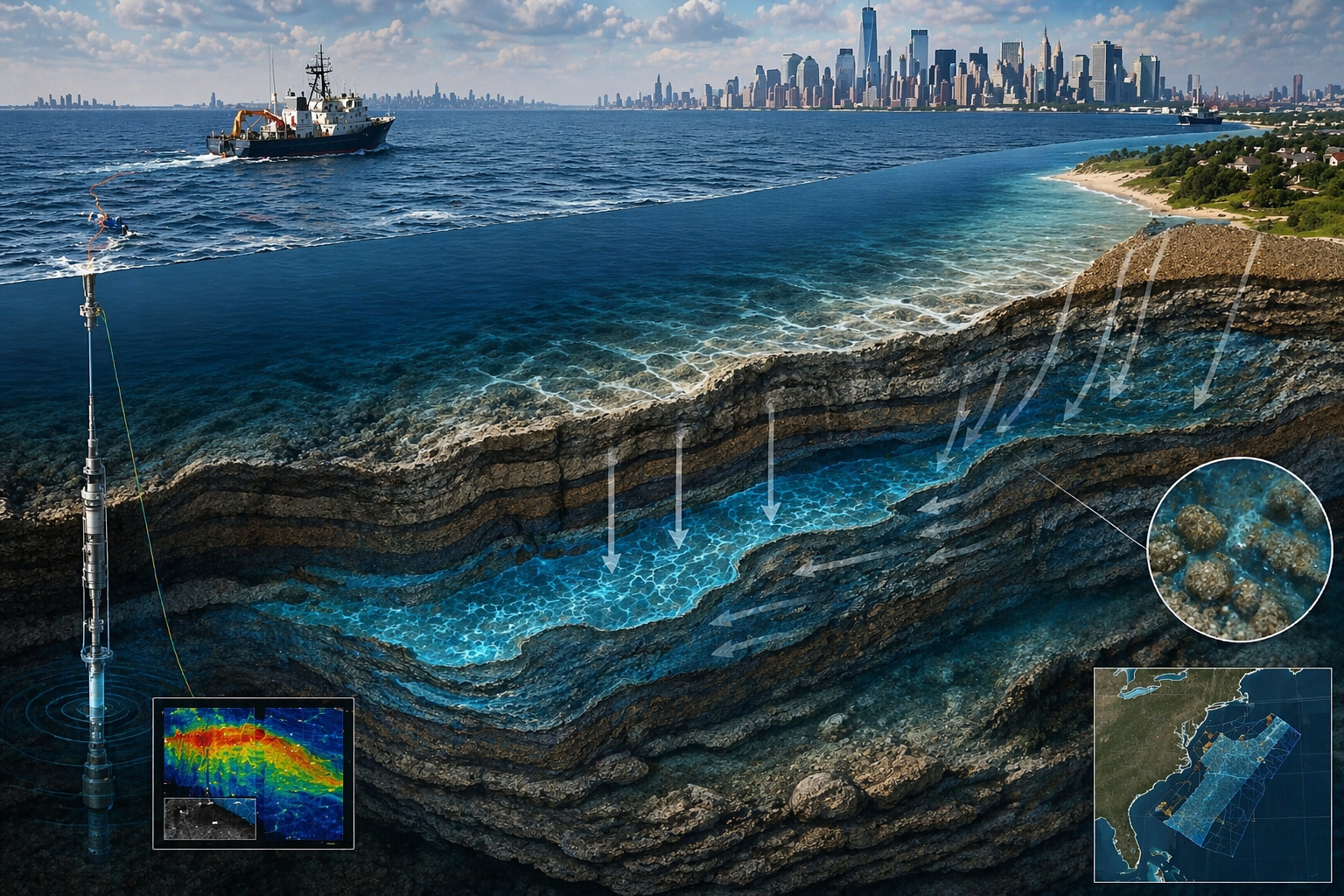

Subterranean reserve discovered under the ocean reveals impressive volume, millenarian geological origin, and technical challenges for sustainable exploration
Scientists have identified a vast reserve of fresh water beneath the bed of the Atlantic Ocean, off the northeastern coast of the United States.
Researchers from the United States Geological Survey and Columbia University conducted studies between 2015 and 2019 and revealed an aquifer of extraordinary proportions.
The stored volume could supply a city like New York for up to eight centuries. This scenario broadens the debate on global water security and reinforces the search for new natural sources of water.
Scientific investigation reveals large-scale subterranean reservoir
Scientific teams confirmed the discovery after analyses with advanced electromagnetic sensors. These devices mapped the seabed and indicated a structure much larger than previous estimates.
-
James Webb Telescope Uncovers Unexpected Clues on Mysterious Moon, Potentially Redefining Planetary Origins

-
$1.5 Billion Sleipnir Vessel Transforms Ocean into Floating Construction Site with 12 Hybrid Engines and Capacity to Lift 20,000 Tons

-
23 Years After Tragedy, Brazil’s Alcântara Space Center to Launch New Suborbital Rocket in 2026 with South Korean SEBIT Project Targeting Near-Space Tests
-
Entrepreneur Turns Neighbor’s Coffee Grounds Waste into Eco-Friendly Pellets, Earning Up to $40,000 Monthly in Brazil


The aquifer extends over more than 90,000 square kilometers and encompasses areas between New Jersey and Massachusetts. This size surpasses that of several known land regions.
Researchers point out that the water volume rivals that of large continental lakes. This factor reinforces the strategic potential of the reservoir for the future.

Geological formation explains the origin of fresh water at the bottom of the sea
The formation of the aquifer began in the last ice age, when large volumes of water became trapped in the soil. The melting of glaciers accumulated in porous sediments before the sea level rose.
The geological layers and oceanic pressure kept the water with low salinity over time. This natural isolation protected the reservoir for thousands of years.
Researchers indicate that the system remains active. Continuous infiltration from the coast helps maintain the aquifer.
In this context, the formation factors stand out:
- Efficient porous sedimentation for water storage
- Geological isolation under high oceanic pressure
- Millenarian accumulation of water from glacial melting

Dimension and capacity place aquifer among the largest natural reserves
Estimates indicate that the reserve could sustain populations for several generations. The scale of storage impresses with its longevity and accumulated volume.
The supply potential surpasses that of many traditional water systems. This scenario broadens the perspectives for global water planning.
Among the main highlights are:
- Territorial extension comparable to large land regions
- Multi-generational supply capacity for large cities
- Water volume equivalent to the largest known lakes
Technical challenges limit immediate exploration of the resource
The exploration of the aquifer faces significant challenges despite the abundance of water. Extraction in deep marine environments requires advanced drilling technologies.
The infrastructure costs for collection and transportation remain high. This factor still limits commercial viability in the short term.
The composition of the water requires additional care. The presence of minerals may necessitate partial desalination.
Experts emphasize the need for rigorous environmental monitoring. Any exploration must consider the impacts on local marine ecosystems.
Discovery paves the way for new global research
The discovery suggests the existence of similar reserves in other regions of the world. Coastal areas may hide strategic resources that are still underexplored.
Geologists have expanded investigations with similar technologies. Research is advancing in regions of Africa and Australia.
This advancement may transform the perception of the availability of drinking water. The new evidence broadens the possibilities for global water management.
The management of these resources will depend on the balance between exploration and preservation.
In light of this, an inevitable question arises: will this gigantic aquifer be a sustainable solution for the future of water on the planet?


