





 Portuguese
  English
  Spanish
  3 min of reading
  0 comments


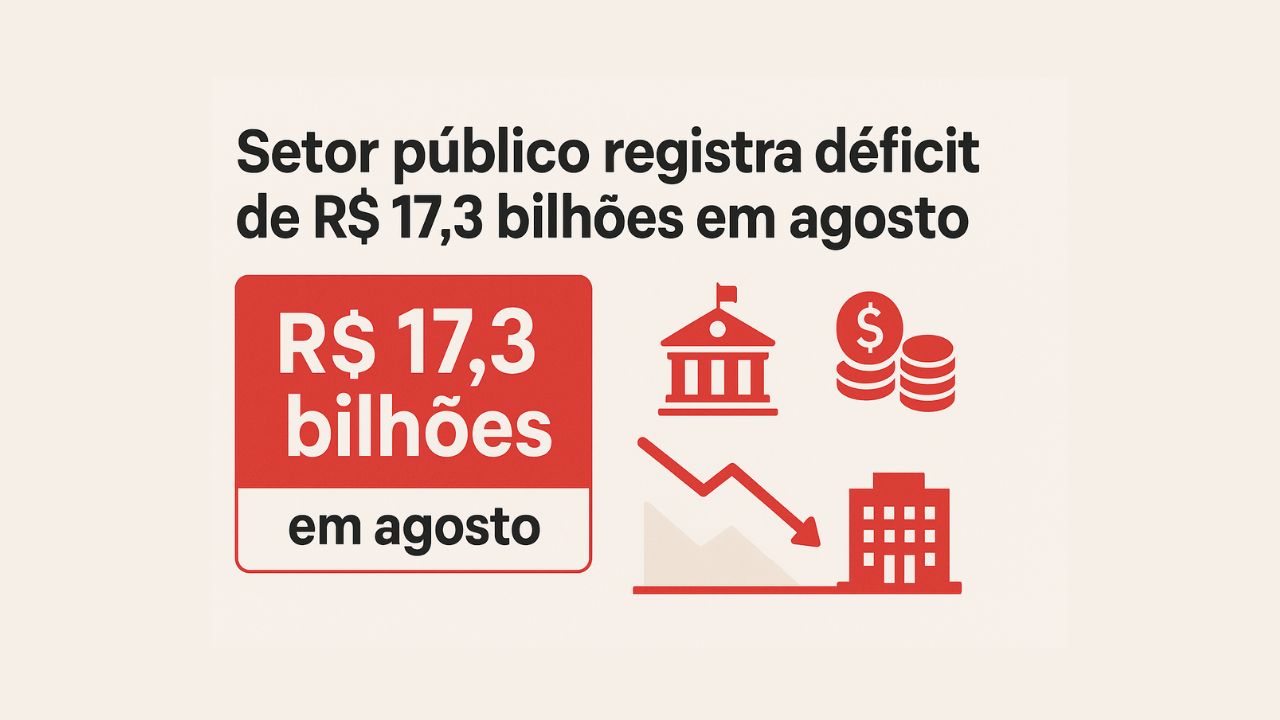
Public Sector Has a Deficit of R$ 17.3 Billion in August, According to the Central Bank. Gross Debt Remains at 77.5% of GDP and Concerns Government and Investors.
Deficit in the Public Sector Raises Concerns for the Brazilian Economy
The consolidated public sector, which includes the Union, States, municipalities, and state-owned companies, closed August 2025 with a primary deficit of R$ 17.3 billion, according to a report released by the Central Bank this Tuesday (30/09/2025).
The result represents one of the largest fiscal imbalances of the year and reinforces the government’s challenges in balancing public accounts.
The negative figure comes after successive deficits recorded in recent years, demonstrating pressure on GDP and public debt.
-
Inflation in March reaches 0.88% according to IBGE and pressures the Brazilian economy, impacting family budgets and requiring more strategic decisions to maintain financial control.
-
In Paraná, distributor Pacto connects 100% of the load in Coronel Vivida to batteries: a BES of 10 MW and 20 MWh costs just over R$ 30 million and lowers the local tariff now.

-
With a dependence of up to 80% on gas imported from the United States, Mexico is responding with a robust energy strategy, betting on shale gas, creating a scientific committee, and preparing to expand natural gas production to reduce vulnerability and strengthen its energy security in the coming years.

-
The United States proposes to Brazil a critical minerals agreement with a minimum price to combat Chinese dumping and priority for investment, but the Planalto is blocking the signing out of fear of upsetting China and due to electoral calculations in a year of competition.

Recent History Shows Negative Trend
Data from the Central Bank reveal that Brazil’s fiscal trajectory has fluctuated between significant deficits and rare moments of surplus.
In August 2021, for example, the public sector had recorded a surplus of R$ 16.7 billion. However, since then, the sequence has been negative results: a deficit of R$ 30.3 billion in 2022, R$ 22.8 billion in 2023, R$ 21.4 billion in 2024, and now R$ 17.3 billion in 2025.
This historical series shows that, despite slight reductions in the annual comparison, the public sector deficit remains a structural concern for the Brazilian economy.
Detailing the Result in August
Upon closer inspection of the numbers, the central government (comprised of the National Treasury, Social Security, and the Central Bank) accounted for the largest portion of the deficit, with R$ 15.9 billion in the month.
The regional governments, which include States and municipalities, reported a deficit of R$ 1.3 billion.
State-owned companies, in turn, had a practically balanced result, but still negative: a deficit of R$ 6 million.
This situation demonstrates that fiscal pressure is not restricted to the federal sphere but also extends to other areas of public administration.
Impact on GDP and Public Accounts
In the accumulated result of the last 12 months, the consolidated public sector reported a primary deficit of R$ 23.1 billion, equivalent to 0.19% of GDP.
Although the percentage may seem small, it indicates that the country continues to spend more than it earns, not considering interest payments.
When analyzing the nominal figures— which include debt interest— the result is even more concerning.
In August, the nominal deficit reached R$ 91.5 billion, a signal that the financial costs of the debt continue to heavily burden the public budget.
Gross Debt Remains High
Another highlighted point in the report is the gross debt of the general government, which includes the Union, INSS, and state and municipal administrations.
In August, the indicator remained at 77.5% of GDP, the same level as July, totaling R$ 9.6 trillion.
According to specialists, the fact that the debt did not grow in the month brings momentary relief, but still reveals a fragile fiscal situation.
The high level limits the government’s ability to invest in strategic areas, such as infrastructure and social programs, in addition to reducing investor confidence.
What These Numbers Reveal About the Economic Future
The persistence of the public sector deficit raises an alert for the coming months. If the government cannot cut spending or increase revenues, the country risks increasing its dependence on borrowing even further.
This could pressure interest rates and compromise GDP growth.
Moreover, the stability of debt in relation to GDP does not mean structural improvement. On the contrary, it reflects a temporary balance amid a scenario of rising mandatory expenses and limitations to broaden revenue collection.
The Central Bank’s report confirms that Brazil still faces a serious fiscal challenge. The public sector deficit, coupled with the weight of the debt, continues to be one of the greatest obstacles to the sustainable advancement of the economy.
To reverse this scenario, the government will need to adopt consistent measures for controlling spending and stimulating economic activity, seeking to improve the relationship between revenue and expenses.
Meanwhile, the population continues to closely monitor the impacts of this reality on public policies, investments, and especially on the growth of the Brazilian GDP.










Seja o primeiro a reagir!