





 Portuguese
  English
  Spanish
  3 min of reading
  0 comments


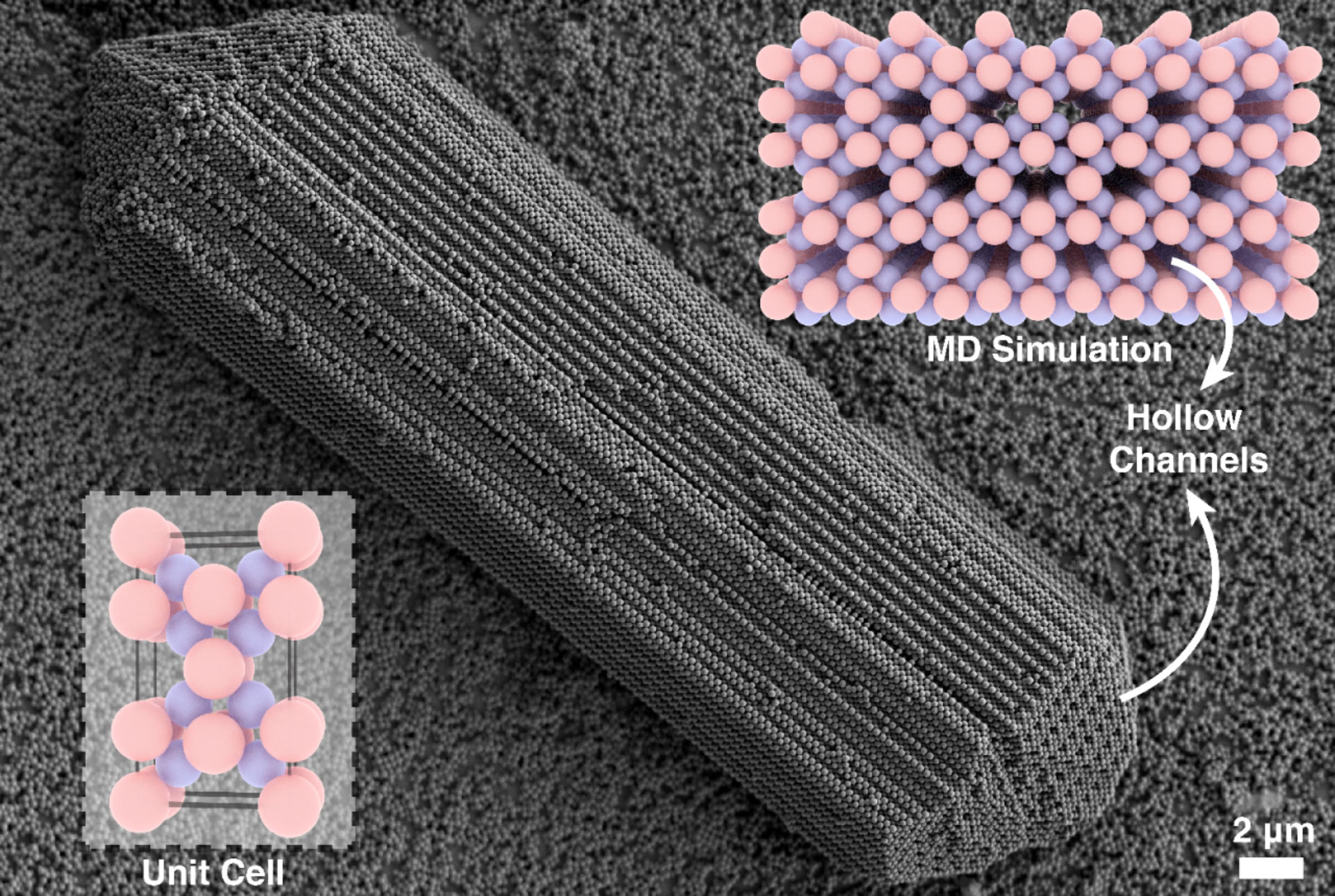
Discovery Made By Scientists At New York University Reveals Unique Crystal With Hollow Channels, Informally Named “Zangenita”, And May Open The Way For New Applications In Advanced Materials.
A team of researchers from New York University made an unexpected discovery during studies on the formation of colloidal crystals. The finding of the crystal, classified as a new crystalline structure never before observed, may open paths for future applications in various fields of science.
Observing Crystals In Detail
Crystals are formed by particles that organize in a repetitive manner. This process, known as self-assembly, was previously seen as a predictable and well documented phenomenon. However, scientists are realizing that reality may be more complex.
By studying colloidal crystals — structures composed of small spheres called colloidal particles — researchers were able to observe the formation of crystals at an unprecedented level of detail.
-
They were brilliant! Scientists discover that our ancestors in China were already making super advanced tools 160,000 years ago, changing everything we knew.

-
Scientists unveil 3 million years of climate secrets hidden in the ice of Antarctica.

-
Ancient farmers created “aggressive plants” that changed nature forever.

-
Astronomers find a “backward” solar system that ignores all the rules of space and leaves scientists scratching their heads!


Unlike atoms, these particles are large enough to be tracked by a microscope in real time.
“With colloids, we can observe the formation of crystals with our microscope”, explained Professor Stefano Sacanna from New York University. This allowed scientists to monitor the behavior of these particles under different conditions, especially in saltwater suspensions.
Formation In Two Steps
During the experiments, scientists noted that colloidal crystals form in two stages. First, amorphous bubbles condense.
Then, these bubbles transform into well-ordered crystalline structures.
The result is the formation of crystals with various shapes.
In addition to laboratory observations, researchers conducted thousands of computer simulations to better understand this process.
These simulations helped explain the experimental data and reinforce the conclusions of the study.
The Emergence Of “Zangenita”
It was amid this work that Shihao Zang, a doctoral student at the university, noticed a different crystal. At first glance, it appeared similar to another already known.
However, upon closer observation, he saw that its composition was distinct and that its tips contained hollow channels.
Finding no match with any of the over a thousand crystals cataloged in nature, the team turned to computational modeling.
The model recreated exactly the same crystal, confirming it to be a previously unrecorded structure.
“This was intriguing because normally crystals are dense, but this one had empty channels running the entire length of the crystal,” said Dr. Glen Hocky, also from New York University.
Informally Named In The Laboratory
The structure was officially named L3S4, in reference to its composition. However, in laboratory meetings, scientists began calling it “Zangenita,” in honor of Zang, who discovered it.
“We study colloidal crystals to mimic the real world of atomic crystals, but we never imagined we would discover a crystal that we couldn’t find in the real world,” said Zang.
Possible Future Applications
The new structure brings interesting possibilities. Due to its internal channels, it resembles other materials used in filtration or the storage of substances.
According to Dr. Hocky, this could open paths for applications in areas such as porous materials or encapsulation technologies.
Professor Sacanna also highlighted that this discovery shows that new structures can still be identified. “Previously, we thought it would be rare to observe a new crystalline structure, but we may discover additional new structures that have yet to be characterized.”
The research was published in the journal Nature Communications.









Seja o primeiro a reagir!