





 Portuguese
  English
  Spanish
  6 min of reading
  0 comments


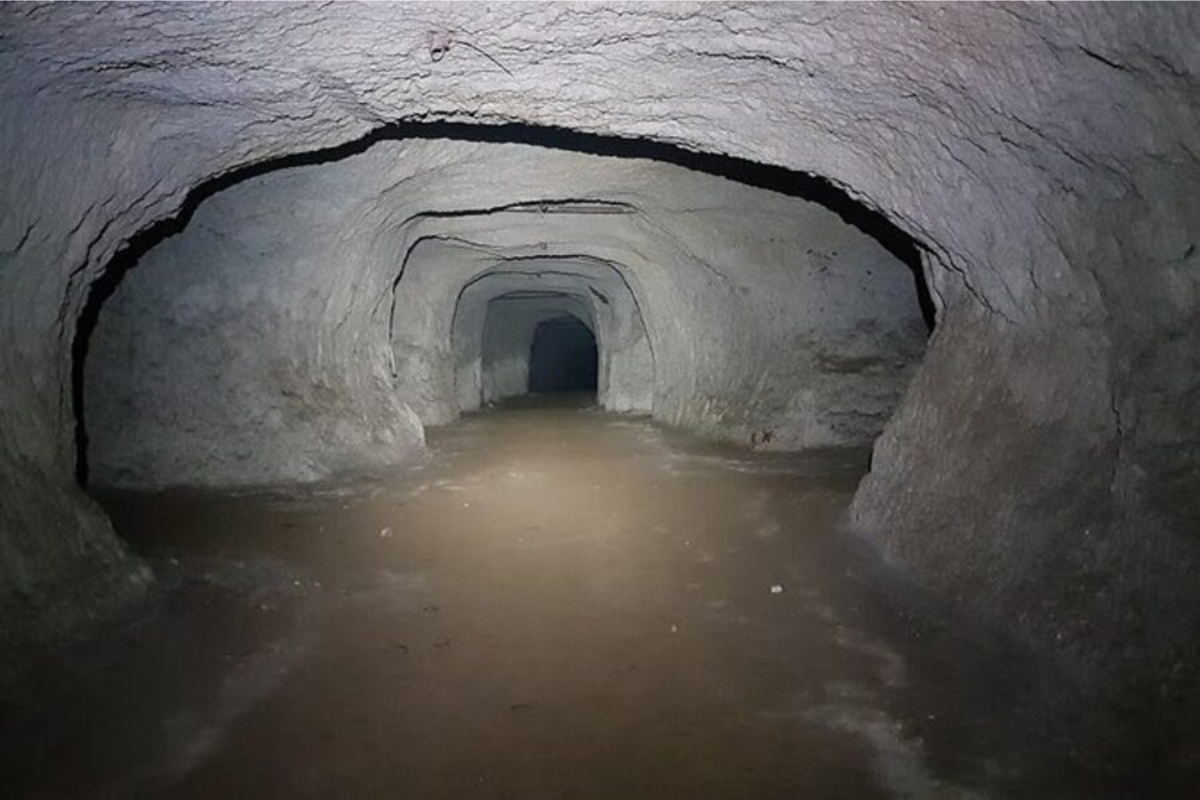
A vast network of tunnels excavated over the centuries has been identified beneath the Italian capital. The underground system, associated with the extraction of pozzolana, is already causing closures, delays in construction, and fears of new sinkholes in urban areas.
Rome has just gained another impressive chapter in its relationship with its own subsoil. Beneath the streets, buildings, and busy roads of the Italian capital, technicians have identified an extensive underground network of about 15 kilometers, considered the largest ever found beneath the city in recent times.
The most recent discovery occurred nine meters deep, below Via degli Angeli, during repair work on a pipeline. What seemed to be just urban maintenance revealed a succession of ancient tunnels excavated to extract pozzolana, a volcanic material widely used in construction since antiquity.
What was found beneath Rome
The find has brought to light a network of underground cavities that, although not entirely unknown to specialists, now appears with even greater dimension and complexity. Technicians from Municipality V, a region already nicknamed the “municipality of cavities,” have been monitoring this type of occurrence for years, but each new revelation increases the level of concern.
-
A rare storm phenomenon in the United States alerts meteorologists worldwide due to four different forms of water falling from the sky, which freeze immediately upon touching the ground, poles, cars, or trees.

-
He has been using a wheelchair for almost 10 years, lives alone, is independent, and decided to become a delivery driver for an app: Samuel makes up to 6 deliveries a day, covering routes of 1 km in his wheelchair and has even managed to do 2.5 km in a single run.

-
An island of 7,500 people received 38,000 bananas by mistake, was left unsure where to store everything, and turned the error into a viral case with donations, hustle, and fruit overflowing everywhere.

-
A promise made to their father led three men to unearth a forgotten house that had been swallowed by time for over 70 years, in a story of memory, abandonment, and reconstruction that seems straight out of a movie.

The underground mesh detected about a year ago had already kept authorities on alert. With at least 15 kilometers in length, it requires constant monitoring as it represents a direct risk to streets, drainage networks, pipelines, and urban structures built on potentially unstable land.

Why these tunnels are so concerning
The problem goes far beyond the historical or geological value of the galleries. In practice, each cavity hidden beneath the city can become a point of collapse, favoring the emergence of sinkholes, cracks, and subsidence capable of compromising the circulation and safety of residents.
This impact is already felt in daily life. Important streets remain closed for long periods, while residents live with the uncertainty of new collapses. Furthermore, repair works often take longer than expected because each excavation can expose new underground voids or exacerbate failures in already weakened infrastructures, such as stormwater systems.
The most affected areas are in the east of the city
The map of occurrences is concentrated mainly in the eastern zone of Rome. Among the most critical points are streets like Via degli Angeli, Via Buie d’Istria, Via Sestio Menas, and Via Tor de’ Schiavi, all associated with recent episodes of underground instability and complex interventions.
On Via degli Angeli, for example, the situation has become emblematic. The street has been closed since February 2025, after anomalies detected in the area led to the discovery of a network of cavities about nine meters deep. The case well summarizes the city’s challenge: managing a modern urban mesh over a historically excavated subsoil.
Slow works, technical reports, and streets closed for years
The works on Via degli Angeli are conducted by Acea under the supervision of the organization Sotterranei di Roma. However, the work has been put on hold while awaiting a definitive report, which makes the postponement of a solution inevitable and prolongs the impacts for those living or circulating in the region.
In other areas, the problem is even older. On Via Buie d’Istria, the street has remained closed for more than ten years after a collapse caused by a sinkhole. The episode shows how an underground occurrence can cease to be a localized emergency and transform into a long-term urban impasse.
Technical studies reveal the severity of the Roman subsoil
On Via Buie d’Istria, excavations identified tunnels in precarious conditions, which required speleological and geophysical studies to map, stabilize, and seal the cavities. This type of analysis is essential because it allows understanding the geometry of the voids, their degree of deterioration, and the risks involved before any reopening of the surface.
The costs are also noteworthy. The works at the site approached 360,000 euros and involved filling tunnels, replacing pipelines, and other containment measures. According to the report, only finishing interventions on the surface are needed for the street to be reopened and receive greenery again.
When the soil gives way: the case in which two cars were swallowed
Another striking episode occurred on Via Sestio Menas, where a ground collapse swallowed two cars and led to the identification of yet another underground network. The case exposed the real risk of these cavities, which often remain invisible until the moment the soil loses support.
After stabilizing the subsoil and executing safety works, the street was reopened a little over a year later, in April 2025. Still, the episode reinforced an uncomfortable conclusion: in certain areas of Rome, the seemingly firm soil can hide ancient structures already degraded by time and the pressure of the modern city.
What is pozzolana and why is it at the center of this story
The origin of these tunnels is directly linked to the geology of the region. The volcanic soil of Rome has an abundance of pozzolana, a volcanic material that has been widely exploited over the centuries for its value in civil construction, especially in ancient techniques that sought strength and durability.
These extractions left behind a network of underground galleries that, over time, became abandoned and forgotten beneath urban growth. The problem is that these ancient structures did not disappear: they remained there, aging, deteriorating, and reacting to the loads imposed by the contemporary city.
Heavy traffic accelerates the deterioration of these cavities
Although the origin of the problem is historical, the current pressure is entirely modern. The vibrations generated by traffic, the constant weight of urban circulation, and the wear of aging underground networks accelerate the weakening of these galleries, making the emergence of new collapses more likely.
It is precisely this combination that transforms the Roman subsoil into a permanent risk area. It is not just an archaeological curiosity, but the delicate intersection between a millennial city and the demands of an intense, dense metropolis continuously pressured by mobility and infrastructure.
The authorities’ response focuses on prevention and technology
In light of the advancing problem, Municipality V has implemented a preventive strategy. An inter-institutional technical committee named “Dolinas and Underground Cavities” has begun coordinating inspections, monitoring, and analysis of the most vulnerable points, aiming to act before new serious incidents occur.
In addition to periodic inspections, the local administration has also been using technology to map critical areas of the subsoil. The focus is on identifying the zones most susceptible to collapse, organizing intervention priorities, and reducing both risks to the population and damage to urban infrastructure.
A risk map is being prepared to avoid new collapses
The authorities are now developing a detailed map of the streets with the highest likelihood of collapse. This survey should guide future works, access restrictions, and preventive actions, allowing the city to act more strategically rather than just reacting after each new episode.
Even though the situation is treated as controlled, recent events show that the emergence of new cavities cannot be ruled out. Each completed work improves urban safety, but also reinforces an inevitable realization: beneath contemporary Rome lies a fascinating, extensive, and unpredictable subsoil, capable of redefining the surface at any moment.
Modern Rome over an unstable past
The discovery of this labyrinth of 15 kilometers underground helps explain why so many works in the Italian capital turn into complex and time-consuming operations. In Rome, the past is not only in the monuments and visible ruins: it also hides beneath the asphalt, directly interfering with the urban life of the present.
Between historical value, technical challenge, and structural risk, the city faces the difficult balance of preserving, monitoring, and protecting. And with each new cavity found, Rome reminds us that its grandeur also rests on delicate ground, where history, geology, and engineering intersect in ways that are as impressive as they are dangerous.








Seja o primeiro a reagir!