





 Portuguese
  English
  Spanish
  3 min of reading
  0 comments


New Electronic Tattoo Monitors Mental Effort in Real Time and Can Help Prevent Burnout in High-Pressure Activities
Accumulating overtime, repetitive tasks, and constant pressure are common in the routine of those who work too much. Now, a new technology may help to better balance the work pace. Researchers from the United States have developed a wireless electronic tattoo capable of assessing mental effort in real time, aiding in the prevention of burnout and other workplace illnesses.
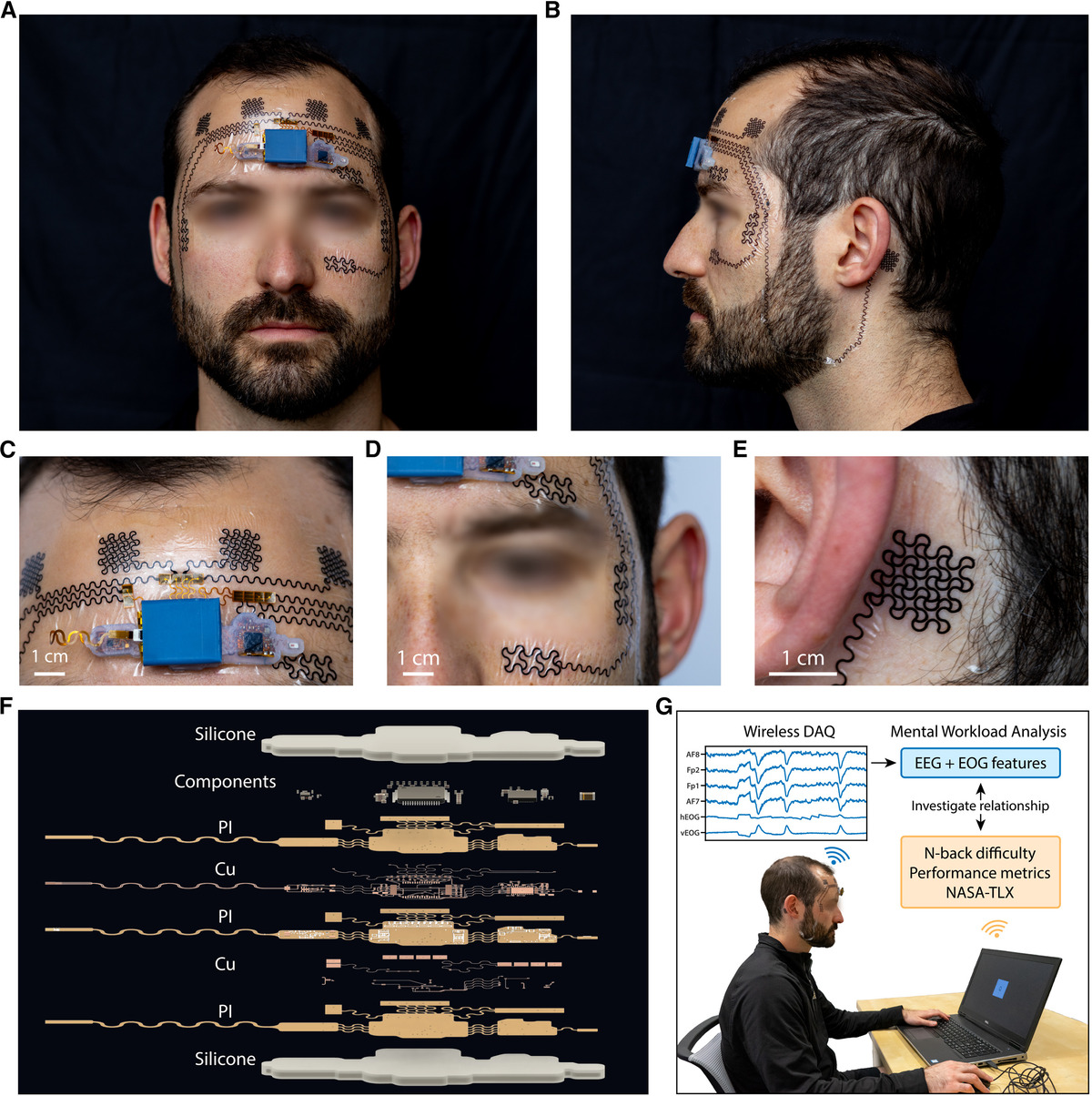
The invention was detailed this Thursday (29) in a study published in the journal Device. The tattoo, temporary and applied on the forehead, encodes brain waves without the need for helmets or bulky equipment.
According to the researchers, it is especially useful in professions with a high risk of errors due to loss of focus, such as air traffic controllers and truck drivers.
-
They were brilliant! Scientists discover that our ancestors in China were already making super advanced tools 160,000 years ago, changing everything we knew.

-
Scientists unveil 3 million years of climate secrets hidden in the ice of Antarctica.

-
Ancient farmers created “aggressive plants” that changed nature forever.

-
Astronomers find a “backward” solar system that ignores all the rules of space and leaves scientists scratching their heads!


“Technology is developing faster than human evolution,” says Nanshu Lu, the lead researcher and a professor at the University of Texas at Austin, in the United States. “There is an ideal mental workload for optimal performance, which varies from person to person.”
First Tests of the Device with Volunteers
In the initial tests, the tattoo—called e-tattoo—was applied to six volunteers. They participated in a memory challenge.
As the test became more difficult, there was an increase in the activity of theta and delta brain waves, indicating greater cognitive demand. When mental fatigue intensified, the activity of alpha and beta waves decreased.
In addition to capturing mental fatigue in real time, the e-tattoo was able to predict brain effort in advance. This was made possible thanks to a computational model trained based on the signals recorded by the sensors. The system also differentiated varying levels of mental load.
Currently, the assessment of workload is usually done using the Task Load Index, developed by NASA.
This index relies on subjective responses in self-assessment surveys. In contrast, the electronic tattoo offers more objective results, directly measuring brain electrical activity and eye movement, similar to electroencephalography (EEG) and electrooculography (EOG) tests.
Lightweight and Comfortable Design
Unlike traditional EEG devices, which have wires, sponge gel, and bulky helmets, the e-tattoo uses only a lightweight battery and sensors as thin as paper, similar to stickers.
The sensors have loops and wavy coils, allowing them to stretch and adapt comfortably to the skin.
“The surprising thing is that these helmets, although they have more sensors for different regions of the brain, never receive a perfect signal because everyone’s head shape is different,” explains Lu. “We measure the facial features of participants to manufacture personalized electronic tattoos, ensuring that the sensors are always in the right place and receiving signals.”
Reduced Cost and Home Application
In addition to comfort, the new technology is much more affordable. Each disposable sensor costs about US$ 20.
The chips and the battery cost US$ 200. In total, the set is priced at US$ 220. Conventional EEG equipment, on the other hand, exceeds US$ 15,000.
“The low cost makes the device accessible,” emphasizes Luis Sentis, co-author of the research and also from the University of Texas at Austin. “One of my wishes is to turn the e-tattoo into a product that we can use at home.”
Now, the researchers are working to improve the equipment. The goal is for the e-tattoo to function not only on skin but also on areas with hair. To achieve this, they are studying the combination of the technology with ink-based sensors that can operate on these surfaces.
With information from Revista Galileu.









Seja o primeiro a reagir!