






 Portuguese
  Spanish


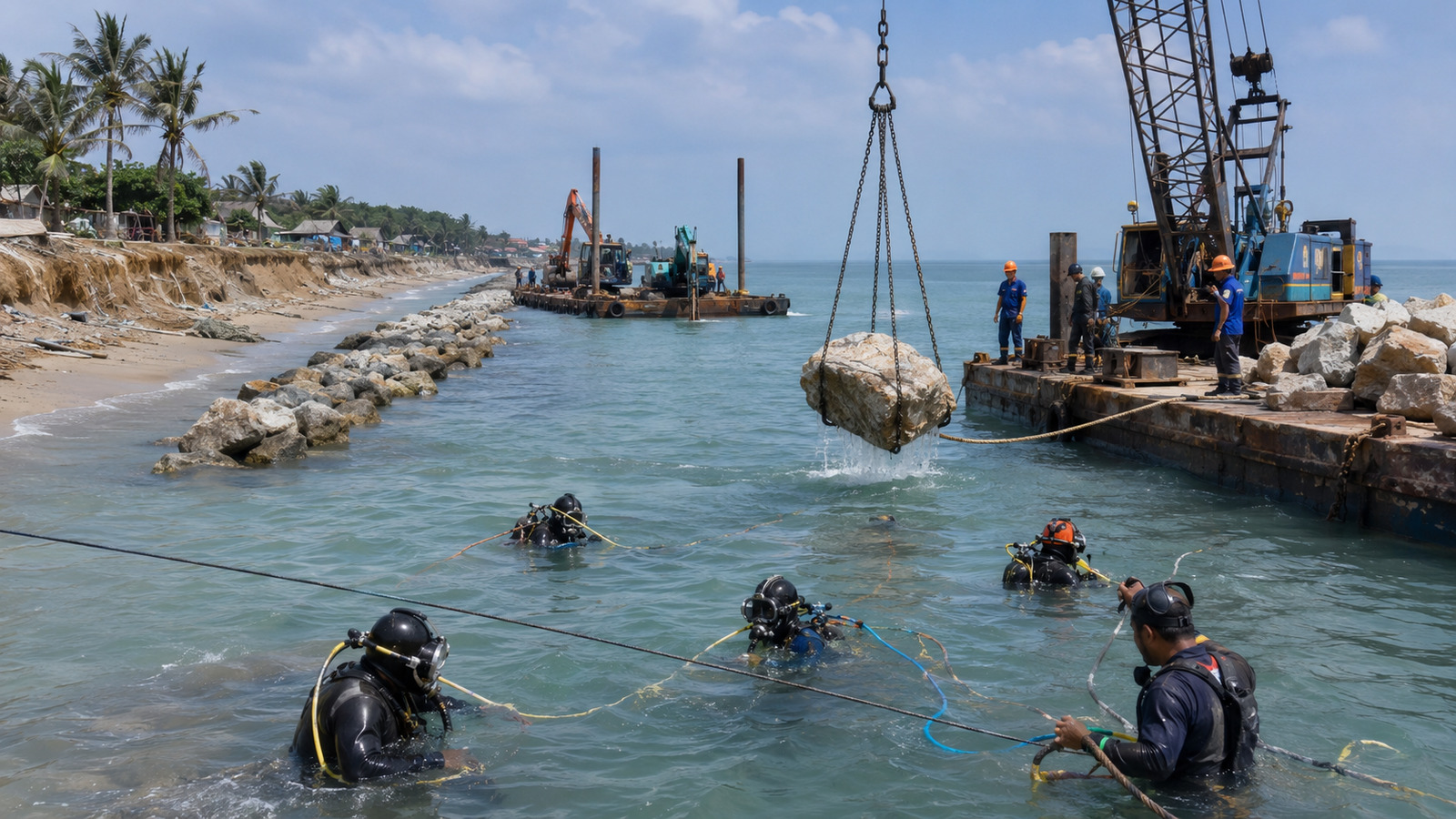

A 982 billion VND project brings together up to 70 divers, five teams, and thousands of tons of stone to restore 3.4 kilometers of Cua Dai beach before the end of August, in Da Nang
About 60 to 70 divers work up to six hours a day on the seabed to build breakwaters against the erosion of Cua Dai beach. Valued at 982 billion VND, the project covers 3.4 kilometers and is expected to be completed before August 31.


Project against the erosion of Cua Dai beach mobilizes five teams
The severe erosion of Cua Dai beach has reduced the sand strip over the years, knocked down rows of coconut trees, and started to directly threaten the livelihood of tens of thousands of people.
To restore the coast, a 982 billion VND project was implemented, funded with a loan and counterpart from the French Development Agency, AFD.
-
A line of over 250 concrete mixer trucks delivers concrete every 2 minutes for 12 hours in Chicago, pouring 470,000 gallons into the foundation of a 72-story skyscraper and leaving beneath the future tower a colossal structure reinforced with steel equivalent to the weight of 155 cars on the shores of Lake Michigan.

-
Instead of demolishing the last industrial vestige of Oerlikon, engineers placed a 6,200-ton building on tracks, pushed the structure 60 meters over 19 hours, and saved the 123-year-old building that was blocking new railway tracks in Zurich, without dismantling anything along the way.
-
Chinese create a bricklaying robot that lays the floor of your house at a speed of 12.5 square meters per hour
-
SP government allocates R$ 2.6 billion to build a colossal R$ 6.8 billion tunnel between Santos and Guarujá; unprecedented structure in Brazil will be 1.5 km long, with 870 meters submerged and a permanent dry connection.


The intervention covers 3.4 kilometers and includes the construction of seven submerged breakwaters and six breakwaters.
On site, five teams work simultaneously, supported by hundreds of workers, machines, barges, and cranes.
More than 250,000 cubic meters of stones have been continuously transported from the regions of Ky Ha and Dung Quat. Contractors mobilize labor and equipment to finish the services before August 31.
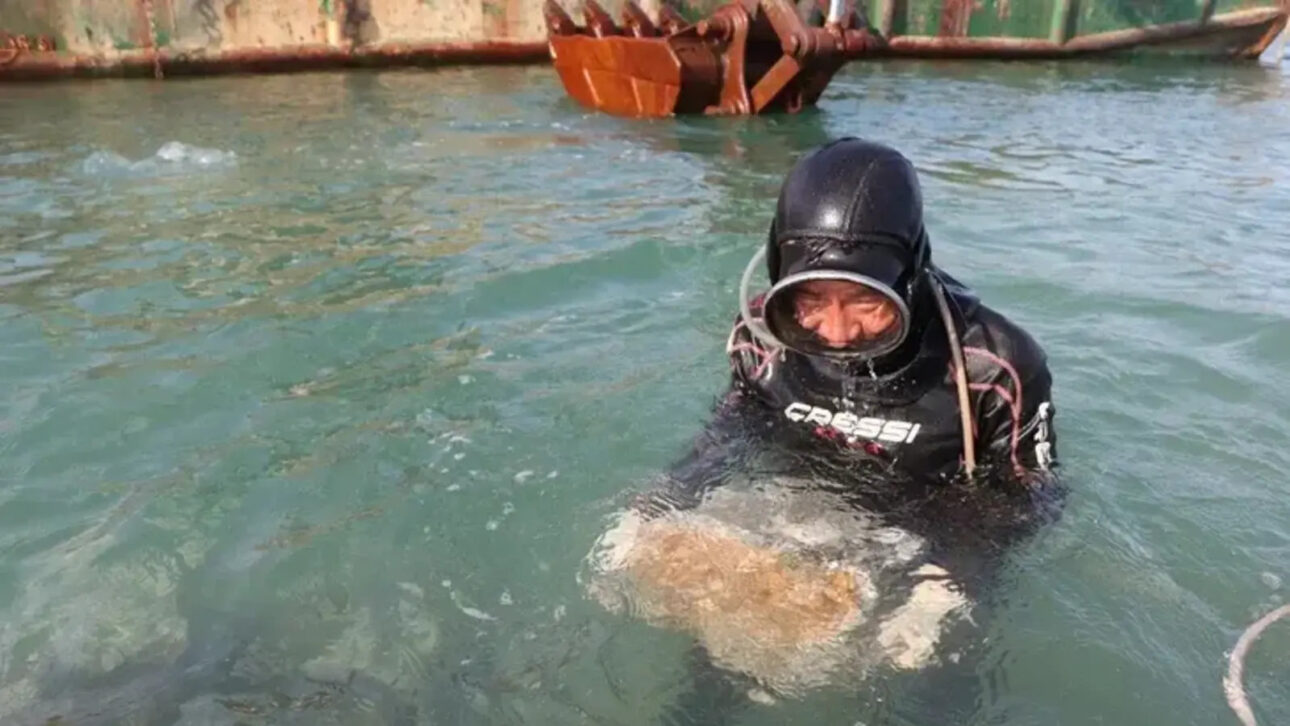
Divers guide stones in water with low visibility
At sea, barges are grouped in front of the coast. Cranes remove rock blocks from the deck and lower them slowly to the bottom, where the divers’ work begins.
The murky water can limit visibility to a few meters. After the stone is launched, the professionals need to approach, secure it with ropes, correct its direction, and guide the team that remains on the surface.
Hand signals and tugs on the ropes indicate whether each block is in the correct position or if it should be removed and placed again.
The divers remain submerged between five and six hours a day. Each carries approximately 10 kilograms of lead to prevent buoyancy from pushing the body towards the surface.
Le Cong Dong, a resident of Nui Thanh commune in Da Nang, has been working as a diver in construction for almost 30 years. According to him, the progress of the service depends on the coordination between the workers above and below.
Heavy rocks make the operation dangerous
The work involves moving stones that can weigh hundreds of kilograms. If they are displaced or compressed improperly, they can cause cuts, scratches, and serious injuries.
Le Xuan Thuy, a resident of Tam Hai commune, has been working as a diver since he was 14 years old. Before construction, he spent over a decade diving to catch shrimp and fish near Ban Than Island and Cu Lao Cham.
According to Thuy, the current job is more difficult because it requires handling heavy rocks, some weighing up to 100 kilograms. He reported that colleagues have suffered cuts on their hands after being hit by stones.
According to Dao Hong Ngoc, responsible for the construction of Dat Phuong Group Joint Stock Company, the landfill has a trapezoidal shape and depends on various stages carried out underwater.
The divers install geotextiles, build foundations, guide the formation of the rocky landfill, and help position concrete components weighing more than six tons, used in protecting slopes and gabions.
Weather limits the months of work in Cua Dai
Construction in the Cua Dai area can only occur between March and September. When the rainy season begins or the sea becomes too rough, the site needs to be temporarily closed for safety.
In addition to the 982 billion VND project, an emergency work of 498.1 billion VND is simultaneously executed on the Thu Bon river dyke and stretches of the Hoi An coast.
According to project manager Le Dinh Son, contractors work in a system of three shifts and four teams, during the day and night. Night services must end before 10 PM.
The organization also needs to reduce impacts on tourism, controlling noise, operation safety, and possible environmental effects during the execution of the works.
This article was prepared based on the information provided about the erosion control projects in Cua Dai, with data, numbers, and statements preserved as per the consulted material.


