





 Portuguese
  English
  Spanish
  4 min of reading
  0 comments



Growing Debt, Government Instability and Economic Contagion Risk in the European Bloc
The France is facing an unprecedented crisis that combines political instability and a continuously escalating public debt. The Prime Minister François Bayrou, lacking a majority in Parliament, may lose the confidence vote scheduled for September 8, 2025. The scenario repeats what occurred in December 2024, when the government of Michel Barnier was toppled after less than 100 days in power.
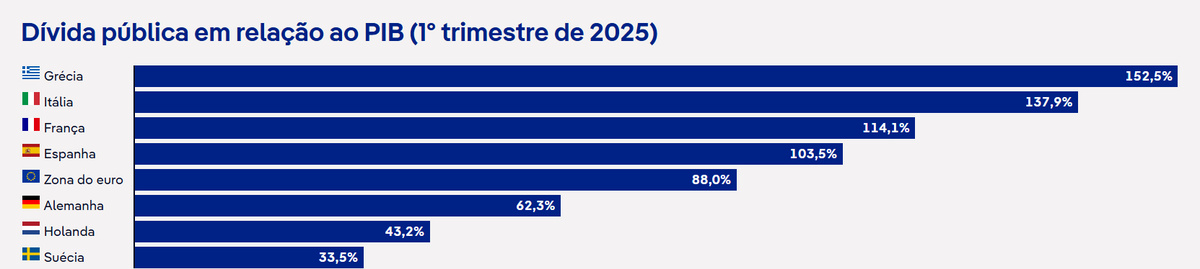
The central question is whether the second-largest economy in the European Union can prevent its public debt, which has already reached €3.35 trillion (114% of GDP), from spiraling out of control. According to projections, the ratio may exceed 125% of GDP by 2030, heightening concerns across the continent.
French Debt Already Exceeds Critical Levels
No other country in the European Union accumulates such high absolute debt as France. Only Greece and Italy have a higher debt-to-GDP ratio. Additionally, France accounts for the largest fiscal deficit in the bloc, estimated between 5.4% and 5.8% of GDP in 2025, well above the 3% limit required by the EU.
-
Iran authorizes the passage of ships with essential goods in the Strait of Hormuz, requires coordination and protocols; UN postpones resolution to reopen the oil route, while China, France, and Russia reject the use of force.

-
The Ukraine war exposes the strength of the M113 armored vehicle amid modern warfare with military drones.

-
Maritime geopolitics: China and the USA compete for strategic ports in Peru.

-
Iran shoots down two US aircraft: F-15 fighter crashes in mountainous area, one crew member is rescued and another is still missing; second crash in the Persian Gulf exposes still active air defense, says US intelligence.


To reduce this deficit, severe budget cuts would be necessary, a measure considered politically unfeasible. This difficulty provokes reactions from the financial markets, which impose risk surcharges on French debt securities. Economist Friedrich Heinemann from the Leibniz Centre for European Economic Research (ZEW) stated that “the eurozone is not stable at this moment” and that French fragility threatens the economic balance of the bloc.
Protests and Strikes Revive the Memory of the Yellow Vests
As the economic crisis presses on, social tension is also rising. The unions have called for a general strike on September 10, 2025, two days after the parliamentary vote.
This movement recalls the wave of protests from the “yellow vests” in 2018, triggered by a rise in fuel taxes. At that time, the demonstrations paralyzed the country and left deep marks on the politics of President Emmanuel Macron, who is once again trying to maintain governability.
European Commission and ECB Face a Strategic Dilemma
The stance of the European Commission is criticized by experts, who claim that Brussels “turned a blind eye to France for years” to avoid strengthening populist movements.
Currently, just to pay €67 billion annually in interest, the French government is forced to cut investments in strategic sectors. Furthermore, there is an expectation that the European Central Bank (ECB) may intervene by purchasing French bonds. However, economists warn that this measure could compromise the credibility of the institution across the bloc.
Lack of Reforms Aggravates the Fiscal Scenario
Like Germany, France needs structural reforms that reduce public spending and make the economy more sustainable. However, the alternative of raising taxes is unfeasible, as the country has one of the highest tax burdens in Europe.
The rise of left and right-wing populists makes a political consensus impossible. “The center is disappearing, and I see no solution in sight,” Heinemann said when evaluating the situation in the French Parliament.
Economist Andrew Kenningham from Capital Economics assesses that the risks are currently under control. However, he warns that the crisis could escalate into a greater threat to the entire European project if there are no quick and sustainable solutions.
Trade Tensions with the U.S. Increase Pressure
The crisis occurs alongside delicate trade negotiations between the EU and the United States, which include disputes over taxing tech giants.
According to Heinemann, the protectionist tradition of French policy, present on both the left and right, increases the risk of a trade escalation with Washington. If the European Commission adopts retaliatory tariffs against American measures, the possibility of a transatlantic trade war cannot be ruled out.
Recent Timeline
- December 2024 – Michel Barnier’s government falls after less than 100 days.
- August 2025 – French public debt reaches €3.35 trillion (114% of GDP).
- September 8, 2025 – Confidence vote scheduled in the French Parliament.
- September 10, 2025 – General strike called by national unions.
France at the Center of the European Future
The French challenge is no longer just a national issue but represents a direct risk to the European Union. If indebtedness reaches the projected levels by 2030, the pressure on the euro will be intense and will require immediate responses from the ECB and the European Commission.
The inevitable question remains: Will France be able to reverse its trajectory of fiscal and political instability, or will it jeopardize the future of the entire European Union?










-

Uma pessoa reagiu a isso.