





 Portuguese
  English
  Spanish
  4 min of reading
  0 comments


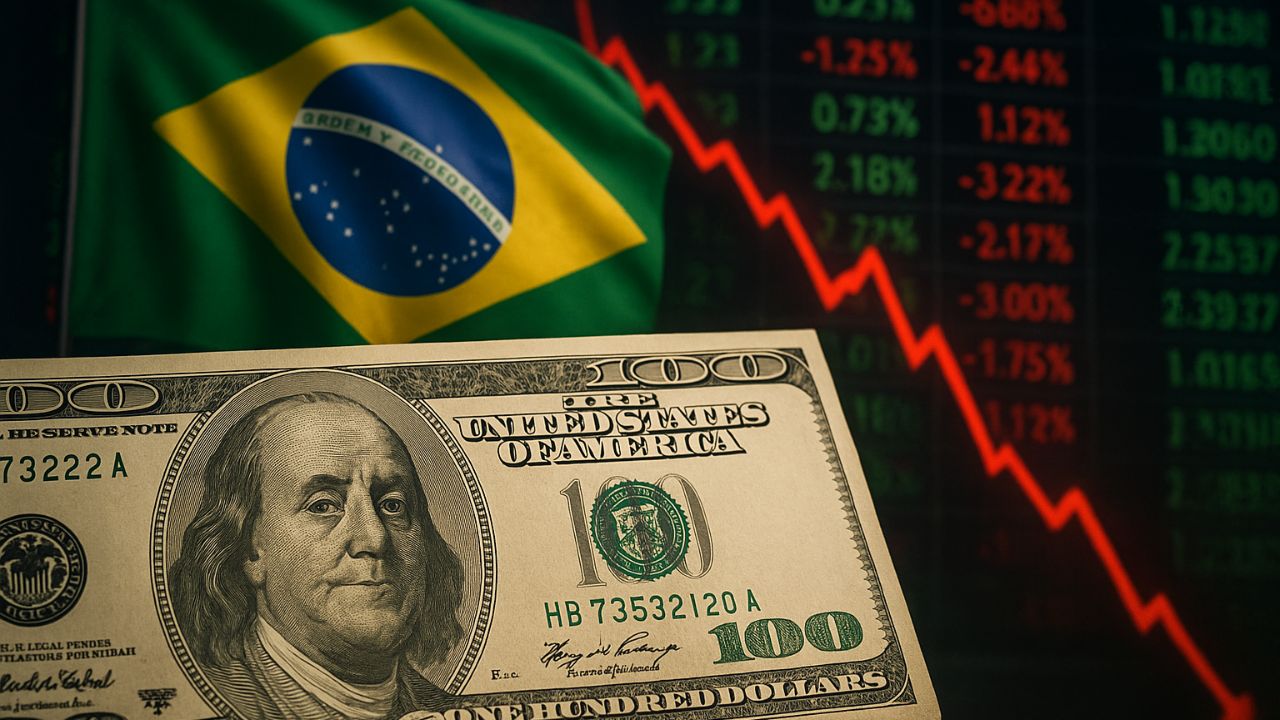
U.S. Currency Registers 11% Drop in 2025; Use of Dollar as Geopolitical Weapon by Trump Accelerates Search for Alternatives and Raises Debate on Dedollarization.
Based on an in-depth analysis by BBC News Brasil, the global financial landscape is facing a rare moment of instability, with the U.S. dollar recording its worst semiannual performance in over half a century. In the first half of 2025, the currency suffered a devaluation of 11% against a basket of other strong currencies, a movement that sparked intense debate among investors and governments about the sustainability of its long dominance.
This decline is not an isolated event but rather a reflection of a confluence of geopolitical and economic factors. The aggressive use of economic sanctions by the Trump administration and the record increase in U.S. federal debt have led nations, especially the BRICS bloc, to openly question their dependence on the American financial system and actively seek viable alternatives for trade and international reserves.
What Explains the Historic Fall of the Dollar?
The current fragility of the dollar is supported by concrete data that concerns the market. A report from investment bank J.P. Morgan, widely circulated, was one of the first to sound the alarm about the process of “dedollarization”. The document highlights that the share of the dollar in global central banks’ international reserves dropped from 71% in the early 2000s to the current 57%, the lowest level in three decades. These reserves are crucial for a country’s economic stability, serving as a safety cushion during crises.
-
Inflation in March reaches 0.88% according to IBGE and pressures the Brazilian economy, impacting family budgets and requiring more strategic decisions to maintain financial control.
-
In Paraná, distributor Pacto connects 100% of the load in Coronel Vivida to batteries: a BES of 10 MW and 20 MWh costs just over R$ 30 million and lowers the local tariff now.

-
With a dependence of up to 80% on gas imported from the United States, Mexico is responding with a robust energy strategy, betting on shale gas, creating a scientific committee, and preparing to expand natural gas production to reduce vulnerability and strengthen its energy security in the coming years.
-
The United States proposes to Brazil a critical minerals agreement with a minimum price to combat Chinese dumping and priority for investment, but the Planalto is blocking the signing out of fear of upsetting China and due to electoral calculations in a year of competition.
In addition to the drop in reserves, other indicators confirm this trend. Gold has become a preferred substitute, especially for developing countries seeking assets less subject to political sanctions. As reported by BBC News Brasil, an increasing number of trade transactions, particularly in the energy sector, are being settled in other currencies. Russia, for instance, is already trading diesel with Brazil using Chinese yuan and Emirati dirham, completely circumventing the American system.
Sanctions and American Debt: The Risk Factors
The foreign policy of the White House under Donald Trump is cited as one of the main catalysts for the search for alternatives to the dollar. The imposition of a “tariff shock” unprecedented in scale and the expansion of sanctions against political adversaries have transformed the currency into a tool of coercion. This approach has generated a strong backlash, causing countries to fear that their dollar assets could be frozen or confiscated, undermining the trust that has sustained the currency as a safe haven for decades.
At the same time, the fiscal health of the United States itself is under scrutiny. With a federal debt now reaching a record of 37 trillion dollars, investors fear that, in the future, the U.S. government may be pressured to devalue its own currency to lessen the burden of the deficit. This uncertainty is exacerbated by Trump’s pressure on the Federal Reserve (the U.S. central bank) to lower interest rates, a move that, if implemented, could further diminish the attractiveness of investments in dollars.
The Rise of the BRICS and the Search for Alternatives
In this context, the BRICS bloc, originally formed by Brazil, Russia, India, China, and South Africa, and recently expanded with members like Iran and Saudi Arabia, has emerged as the main forum for discussions on dedollarization. The group’s meetings, as reported by BBC News Brasil, have focused on developing alternatives to both the dollar and the internationally controlled SWIFT payment system that is largely dominated by the U.S.
Practical actions are already underway. The bloc has intensified the use of local currencies in trade among its members, particularly the Chinese yuan. Russia, for its part, is testing its own digital payment platform to mitigate the impact of sanctions. While the Brazilian government, through President Lula and Minister Fernando Haddad, supports diversification, it adopts a cautious stance, stating that transactions in dollars will continue, but advocating for greater use of local currencies in trade with strategic partners such as China.
Is the End of the Dollar Premature?
Despite the evident signs of weakening, most economists and analysts interviewed by BBC News Brasil consider the idea of the “end of the dollar” to be quite premature. The main obstacle to a transition is the lack of a substitute currency with the same liquidity, stability, and global acceptance. No other currency, not even the euro or the yuan, currently possesses the necessary infrastructure and trust to process the volume of transactions that the dollar handles daily.
Interestingly, some actions by the Trump administration may, paradoxically, strengthen the position of the American currency. The approval of a law to regulate stablecoins, cryptocurrencies designed to maintain parity with the value of the dollar, may further increase the currency’s presence in the growing digital financial ecosystem. Thus, even as the world moves towards a multipolar system, the complete decoupling from the dollar still seems a distant horizon.
In light of this complex scenario, what is your perspective? Do you believe that the search for alternative currencies directly impacts the Brazilian market and its investments? Share your opinion in the comments, we want to hear from those living it in practice.







Seja o primeiro a reagir!