





 Portuguese
  English
  Spanish
  4 min of reading
  6 comments


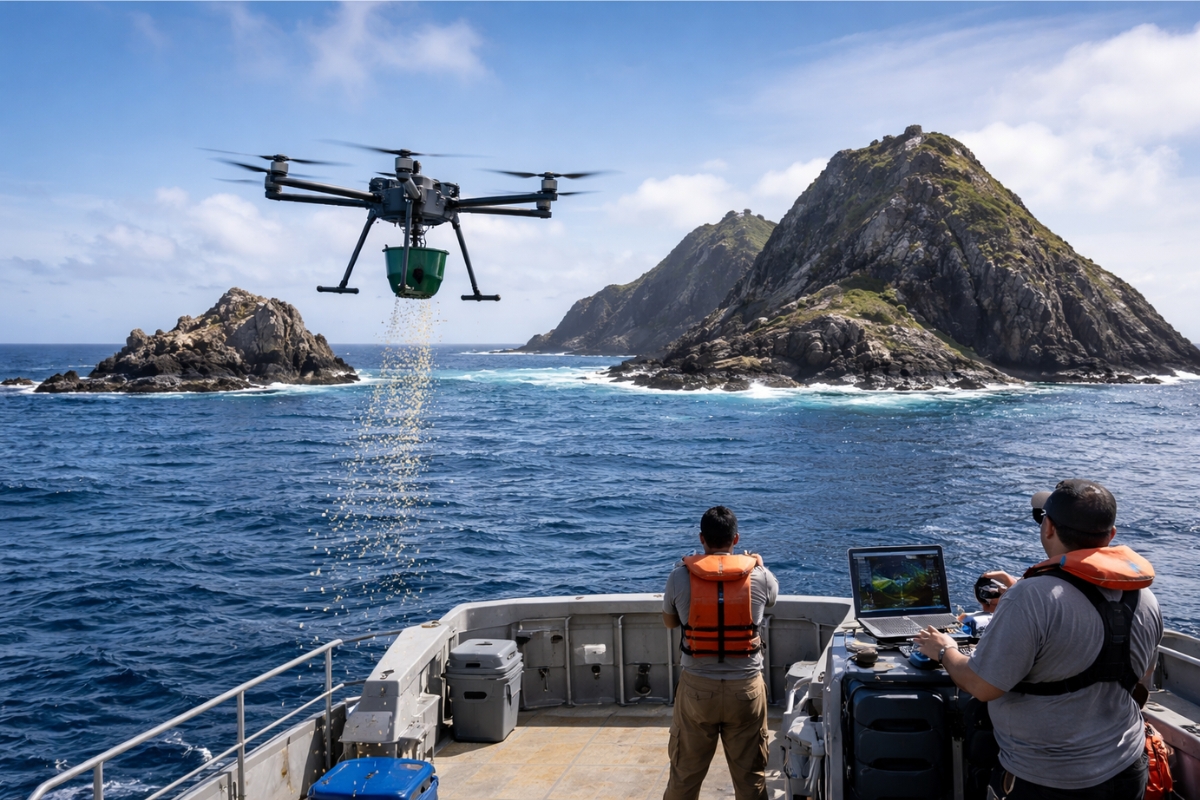


Drone Technique Delivers Bait Precisely to Inaccessible Areas and Can Speed Up Actions to Protect Seabirds on Remote Islands
Conservation on islands has entered a more technological and controversial phase. In Ua Pou, in the Marquesas Islands, an operation placed drones at the center of a delicate task: spreading bait to control invasive rodents.
The most striking aspect was the method of work. Drones operated from a boat made scheduled flights and distributed bait on islets where human access is difficult and dangerous.
The proposal draws attention for promising more precision and less operational risk. At the same time, it reignites the debate about harsh interventions in nature and their potential side effects.
-
Scientists create a “molecular sponge” that transforms dirty water and even water from the Dead Sea into potable water using only sunlight and without consuming any electrical energy.

-
Chinese company creates solar cell that breaks the physical limit of silicon with 34.85% efficiency and promises to revolutionize electricity bills with panels that generate 20% more energy starting in 2026.
-
For the first time in over half a century, humans have seen the Moon up close and returned to tell the tale, and the technology that brought them back makes Apollo look like a toy.

-
From 1969 to 1972, only 12 human beings set foot on the Moon, and then the world simply stopped going, until this week when NASA showed that the journey back has finally begun.
What Happened and Why It Garnered Attention
The operation in Ua Pou marked a rare step in conservation logistics. Instead of sending teams on foot or relying on traditional aircraft, distribution was done using drones that took off from a boat.
The method was designed to reach isolated and steep points. Such areas often become a bottleneck because they limit coverage and increase the cost of any action.
The use of drones in this scenario also creates a new standard. Technology serves as a practical solution for places where nature imposes real barriers.
Why Invasive Rodents Have Become a Significant Threat on Islands

Islands often concentrate unique species, many of which have a fragile ecological balance. When rats and mice arrive, the impact can be swift and profound.
The pressure primarily increases on seabirds and other species that depend on ground nests. The attack on eggs and chicks can derail reproduction and accelerate local extinction.
This type of crisis tends to evolve silently. When the decline becomes evident, the window of time to act is already small.
How Aerial Distribution with Drones from a Boat Works
The central point of the process lies in the combination of mobility and control. The boat serves as an operational base, allowing the team to approach the islets without needing to disembark.
The drones make planned flights and release the bait at chosen locations. The idea is to cover difficult areas with a higher level of precision.
In addition to reaching places that people cannot safely access, the solution reduces human exposure to unstable terrain and rough seas.

What Changes in Practice for Those Working in Island Conservation
The most direct gain is operational. The ability to use drones extends the reach of projects in remote places, without relying on the same level of infrastructure required by larger aircraft.
There is also an effect on costs and risks. Less ground travel and reduced need for complex operations tend to make such actions more viable.
In practice, this can shorten the path between identifying a problem and executing a response in the field.
Points of Attention and Common Questions
Even with technology, the topic remains sensitive. The distribution of bait for the control of invasive rodents raises questions about impacts on non-target species.
The debate also involves the limits of interventions. The more advanced the tool, the greater the pressure to act quickly, even when the decision is difficult.
Attention is directed toward planning, monitoring, and technical choices. A mistake in fragile environments can produce effects that are difficult to reverse.
What Could Happen from Now On
The experience in Ua Pou is likely to influence other operations on islands. When a technique proves capable of reaching inaccessible areas, it becomes a reference for locations facing similar problems.
Interest is growing because many islands face the same challenge. Invasive rodents continue to be one of the main causes of breeding collapse of birds in isolated environments.
The trend is toward increased use of technology in conservation. Drones, sensors, and monitoring systems are gaining traction as crises become more urgent.
The operation in Ua Pou established drones as a tangible tool in an extreme scenario, with difficult access and complex decisions.
At the same time, the initiative reinforces that modern conservation needs to balance efficiency, safety, and environmental impact, as each intervention on islands can reshape the future of local species.









Muito legal e prático!!!👏👏
Texto repetitivo e desnecessariamente extenso, não entendi,essas iscas seriam envenenadas para exterminar os roedores?e se outras espécies também vulneráveis consumir estás iscas?
Acho que a melhor isca para roedores é feijão semi cozido pois fermenta no intestino dos roedores é não fazem mal aos pássaros.
Boa tarde eu trabalhei na Ilha Guaíba lá a nutricionista quando chegou éla estalou uma Câmara fria pra conservar o lixo úmido até a remoção atravessa pra fazer a coleta lá é um pátio de minério da Vale a ilha éla fica distante da área.
CESTÃO DE BRINCADEIRA?
O BRASIL É NADA DIANTE DOS EUA.
A reportagem fala de preservar espécies e extinguir os roedores predadores .