Learn how to install an outlet with less mess using a modern technique. Check out electrician tips for a safe and break-free electrical installation.
Creating new power points in a house is often associated with a lot of debris, dust, and days of renovation. However, a technique presented by an electrician shows that it is possible to install an outlet with much less impact on the wall structure. The method uses modern materials and careful planning to reduce breakage, preserve the finish, and speed up the execution of the service.
According to an article published by Super Rádio Tupi on July 23, 2026, the proposal has attracted attention mainly from those who want to modernize environments without facing extensive work. Although the technique requires knowledge of electrical installation and compliance with safety standards, it can reduce finishing costs and make a break-free renovation much more practical.
Installing an outlet starts with good electrical network planning
Before installing an outlet, it is essential to assess the current state of the home’s electrical network. This precaution prevents overloads and ensures that the new power point operates safely over time.
-
Moving 7.5 billion dollars per year and employing around 93,000 people, the cleaning products sector in Brazil experienced a consumer shift towards popular brands in 2025, which grew twice as much as premium brands.

-
Bringing together more than 1 million transporters and moving around 1.4 billion tons, Brazil’s road freight transport closed 2025 as a fragmented sector, where the independent truck driver is the absolute majority among operators.
-
Instead of demolishing the 1,451-ton hotel that was blocking a new development, engineers placed the brick building on 36 pneumatic dollies, crossed a reinforced bridge, and moved everything about five blocks in six days.

-
A colossal tunnel in Brazil goes through a mountain range and transforms a 30-minute passage into just 1, changing the connection between the locations.


It is also important to identify where the electrical supply will come from. Correctly defining the cable route reduces material waste and facilitates the entire execution of the work, especially when the goal is to carry out an outlet without breaking large areas of the wall.
According to the reference content, three factors should be considered before starting the service:
- Detailed planning of the electrical conductors’ route in the wall.
- Use of modern technologies to avoid excessive breaking in masonry.
- Compliance with technical standards to ensure protection against short circuits.
These precautions make a difference in both the safety and the finish of the installation.


How the electro tape allows an outlet without breaking the wall
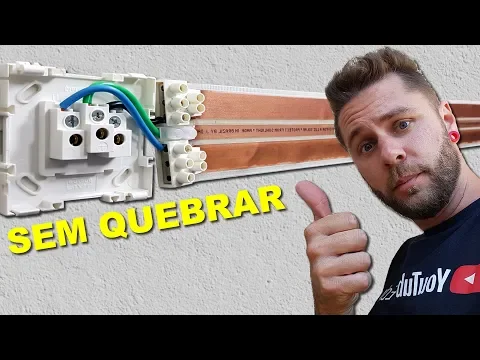
One of the highlights of this technique is the use of the electro-tape, an adhesive conductive tape that replaces part of the conventional conduits in specific applications.
Instead of making large cuts in the masonry, the material is applied directly to the wall surface. After the installation of the appropriate conductors, it receives a thin layer of putty, allowing the original appearance of the environment to be practically restored.
This solution is gaining ground precisely because it facilitates a socket without breaking, reducing the amount of debris and decreasing the time needed to complete the work.
Besides practicality, the technology also helps those who intend to reorganize the rooms of the house without compromising the existing decoration.

Electrician tips help avoid mistakes during installation
Even with modern technologies, some precautions remain indispensable. The main electrician tips involve planning, correct choice of materials, and compliance with electrical installation standards.
Among the most important recommendations are:
- turn off the power before starting any intervention;
- use appropriate tools for electrical services;
- check the capacity of the existing circuit;
- use connectors compatible with the installation;
- avoid improvisations in cable splices.
Another essential point is to follow the guidelines of ABNT NBR 5410, a standard that establishes criteria for low voltage electrical installations in Brazil. Compliance with these rules significantly reduces the risks of short circuits and overloads.
Essential materials for an electrical installation with professional finishing
Gathering all the components before starting the work avoids unnecessary interruptions and contributes to a more efficient result.
According to the reference content, the main materials are:
- adhesive conductive tape suitable for electrical current;
- specific connectors for secure splices;
- plastic spatula;
- putty for surface leveling.
These items play important roles during the execution of the electrical installation, ensuring better fixation of components and greater durability of the new power point.
Moreover, using quality materials directly influences the finish and safety of the installation.
Installing an outlet with invisible finish requires attention to detail
After fixing the conductive tape, one of the most important stages of the process begins: the finish.
The recommendation is to apply thin layers of putty over the entire length of the conductive tape. After complete drying, the surface should be gently sanded until the wall texture is restored.
Next, simply apply paint using the same shade already existing in the environment.
When all these steps are executed correctly, the new power point practically disappears on the wall, maintaining the original look of the room.
This care also enhances the property and demonstrates why so many electrician tips highlight the importance of not rushing the final phase of the work.
Renovation without breaking reduces costs and improves the experience during the work
The possibility of carrying out a renovation without breaking is one of the main attractions of this technique.
Since there is no need to open large channels in the masonry, the amount of dust and debris decreases considerably. This also reduces the time spent on cleaning and subsequent repairs.
Another benefit is related to the comfort of the residents. The intervention usually causes less disruption to the household routine and allows for the creation of new power points exactly where they are needed.
Additionally, savings can appear at different stages of the work:
- lower consumption of materials for wall reconstruction;
- reduction in execution time;
- less spending on finishing;
- less waste generation.
These factors make the renovation without breaking an interesting alternative for small residential modernizations.
Technology Expands the Possibilities of Residential Modernization
The reference content shows that solutions like the electrostrip represent an important evolution for residential renovations. The combination of planning, modern materials, and adherence to standards allows for installing outlets more practically, preserving the aesthetics of spaces and reducing much of the common disruptions in conventional construction.
The channel itself, Concretizando, mentioned in the original material, presents a video delving into the technique and demonstrating its practical application. Even so, any intervention must follow technical criteria and be carried out by a qualified professional whenever there are doubts or a need for changes in the electrical network.
With proper planning, good electrician tips, and attention to electrical installation, it becomes possible to create new power points safely, functionally, and with a finish that practically does not reveal where the wall received the intervention.