





 Portuguese
  English
  Spanish
  4 min of reading
  0 comments


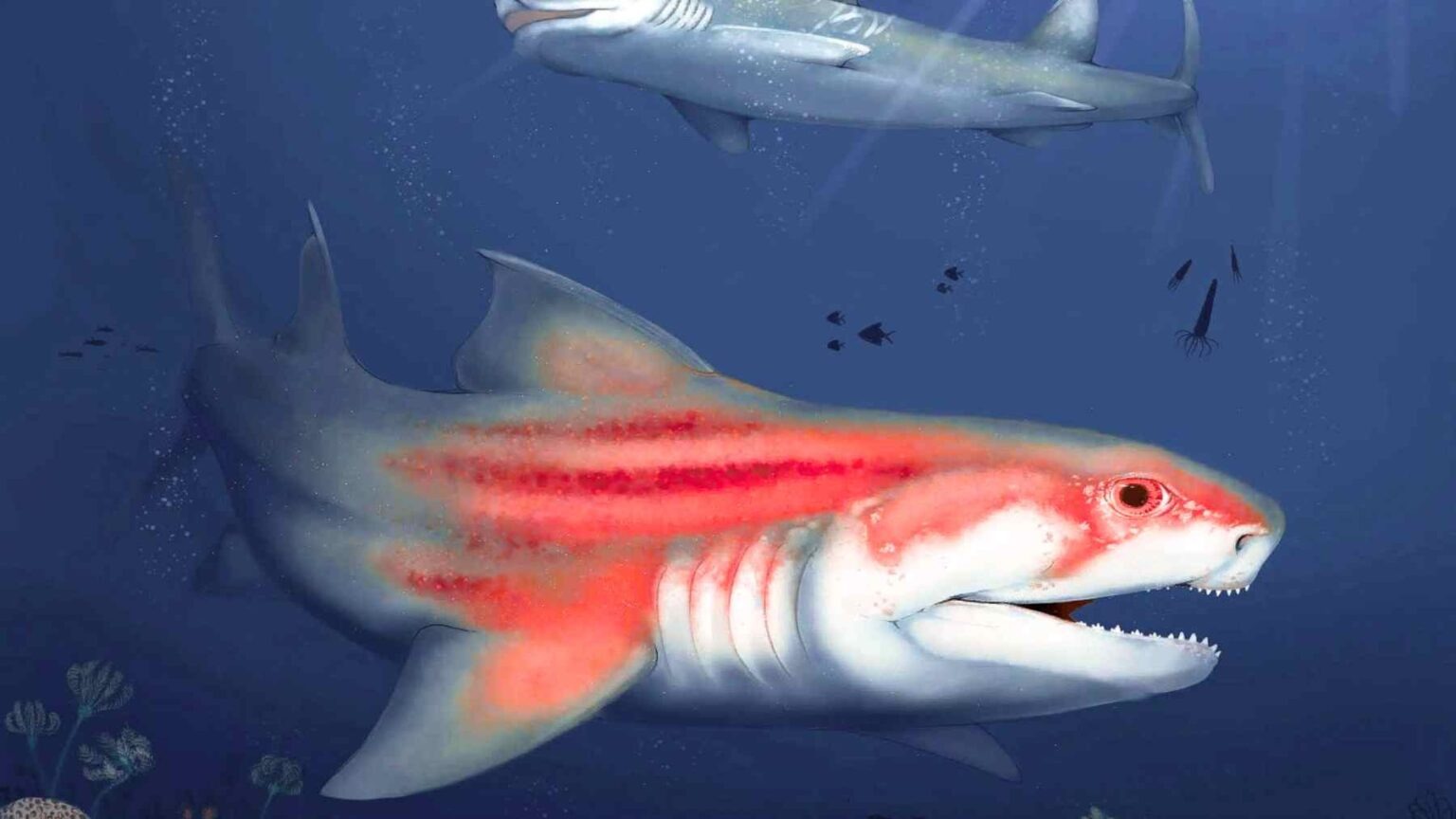
The Detailed Paleontological Investigation in the Depths of the Kentucky Cave System Led to the Identification of Two New Species of Marine Predators from the Mississippian Period, Whose Exceptionally Preserved Fossils Offer a Unique Insight into the Anatomy and Evolution of Large Ancestral Sharks
Researchers identified two new species of sharks from 325 million years ago in Mammoth Cave National Park, Kentucky. The fossils from the Mississippian Period reveal predators up to 4 meters long preserved in a stable environment, significantly expanding paleontological knowledge.
Context and Identification of the Species
The discovery took place in Mammoth Cave National Park, part of the world’s largest known cave system, where two sharks from 325 million years ago were found.
Their fossils were recovered from rock layers deposited during the Mississippian Period, when the region was near the equator and teeming with intense marine life.
-
They were brilliant! Scientists discover that our ancestors in China were already making super advanced tools 160,000 years ago, changing everything we knew.

-
Scientists unveil 3 million years of climate secrets hidden in the ice of Antarctica.

-
Ancient farmers created “aggressive plants” that changed nature forever.

-
Astronomers find a “backward” solar system that ignores all the rules of space and leaves scientists scratching their heads!


The discovery adds two new species to the shark family tree and highlights the fact that caves preserve extremely delicate and rare fossil details.
Open surfaces typically destroy these remnants, but the newly described sharks, Troglocladodus trimblei and Glikmanius careforum, were kept intact in the cave’s protected environment.
Both are members of an extinct group called ctenacanth sharks and were identified from fossilized teeth and fin spines collected in the subterranean passages.
Researchers analyzed gill structures collected in cave passages, a material that had been overlooked for decades in museum drawers.
A peer-reviewed article formally presented the species and reframed the park as an extremely important biodiversity hotspot and paleontological archive.
Exceptional Preservation in a Subterranean Environment
Shark fossils tell a story through their teeth, as cartilage decomposes and rarely survives over the vast geological time on earth.
Mammoth Cave is valuable because, inside the caves, fossils are protected from rain, sun, and the repeated cycles of freezing and thawing.
These cycles can crack and scatter the fragile remains, but the stable environment keeps things looking as if they just came out of the shark’s mouth yesterday.
Paleontologist John Paul Hodnett stated that, in such a stable environment, these remnants appear to have come out of the shark’s mouth very recently.
Paleontologists from the park and their partners found not only teeth, but also partial jaws, gill traces, and very well-preserved fin spines.
Elements found can be crucial to understanding how ancient sharks lived and how different lineages evolved over time.
This stability helped reveal a remarkable detail about Glikmanius careforum, including a partial set of jaws and gill structures considered rare.
Anatomical Details and Ancestral Habitat
Troglocladodus trimblei was nicknamed “cave branched tooth” due to the peculiar shape of its teeth found at the paleontological research site.
It was probably a predator 3 to 4 meters long in the shallow sea that once covered the region analyzed by local scientists.
The species name honors Barclay Trimble, superintendent of Mammoth Cave, who advocated for fossil research in the national park during his tenure.
Glikmanius careforum was named in honor of the Cave Research Foundation, a long-time partner in exploring and conducting scientific research on the cave and its resources.
It apparently had a similar size, with jaw proportions suggesting a short head and a powerful bite to capture its marine prey.
The discovery pushes back the origin of Glikmanius by over 50 million years compared to what paleontologists previously anticipated in their studies.
Animals hunted in coastal habitats and fed on smaller sharks, bony fish, and squid-like orthocones in the warm, tropical waters of the sea.
At that time, much of what is now Kentucky was submerged, and an ancient oceanic connection linked the eastern North America to Europe.
Institutional Collaboration and Scientific Relevance
As continents moved toward the supercontinent Pangea, seas shrank and disappeared, leaving the marine ecosystem buried in limestone.
Fossils were discovered through the Paleontological Resources Inventory, a collaboration between the Mammoth Cave team and university and park researchers.
The project began in 2019 with the goal of documenting and protecting the fossils found throughout the region’s cave system.
The aim is also to reexamine historical collections that may contain species not yet recognized by the scientific community and paleontological researchers.
Barclay Trimble stated that each new discovery in Mammoth Cave is possible thanks to collaborations and partnerships established over many years.
Specimens from Alabama played an important role, as the comparative material helped researchers accurately interpret the Mammoth Cave fossils with precision and technical detail.
This underscores the importance of national parks in protecting much more than landscapes and wildlife visible to visitors and tourists.
The Mammoth Cave team has already documented dozens of species of ancient fish in deposits within the cave, suggesting a valuable and unique underground record.
New fossil sites are not always new places, but rather familiar landscapes where the right experience allows a hidden archive to finally reveal itself.










-

-

-

-

-

-

68 pessoas reagiram a isso.