





 Portuguese
  English
  Spanish
  5 min of reading
  0 comments


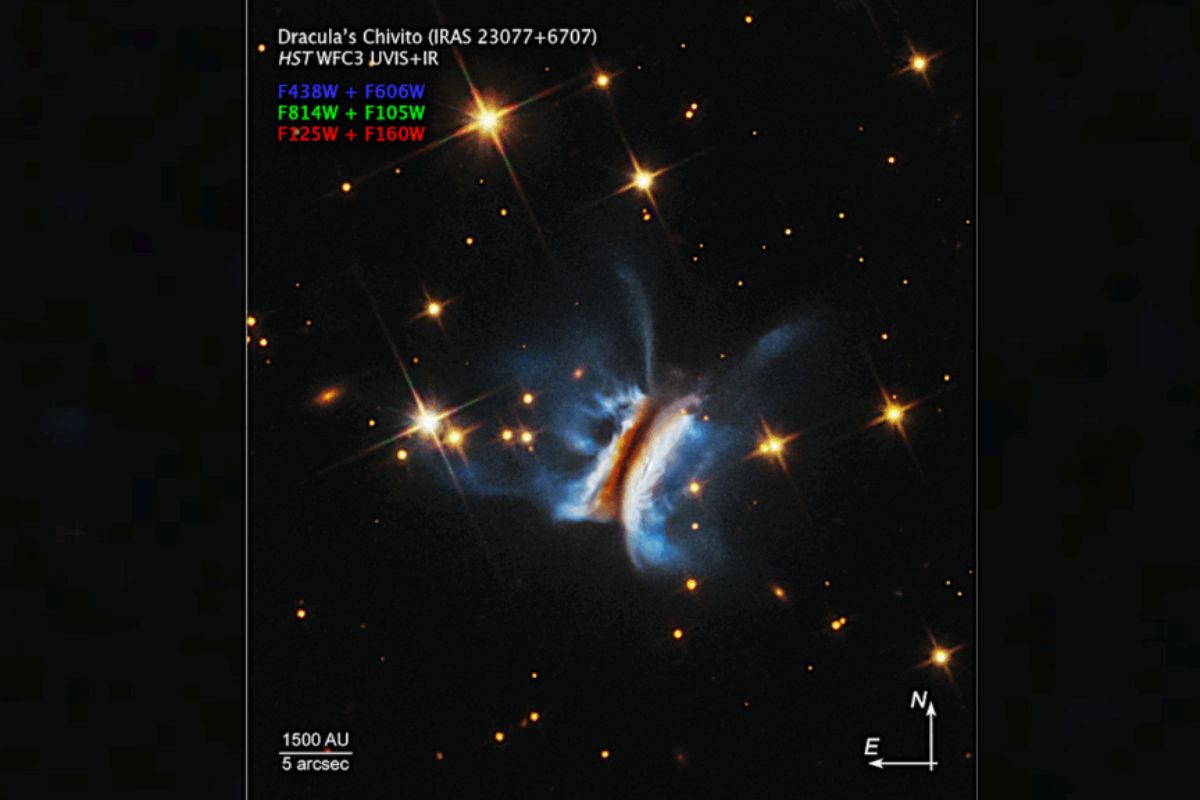
Where Planets Are Born Is a Matter of Scale When NASA Points Hubble at the Protoplanetary Disk IRAS 23077+6707, Nicknamed Dracula’s Chivito, and Finds Turbulent Filaments and Reprocessed Brightness by Dense Gas, Suggesting Planetary Formation Off Script at 1,000 Light-Years, 40x Above the Solar System
Amid the images that NASA releases from deep space, a specific cut has turned into a scientific alert, the very place where planets are born and where the dust has not yet settled. When pointing Hubble at the protoplanetary disk IRAS 23077+6707, the team found a brightness that does not behave as expected.
The protoplanetary disk IRAS 23077+6707, described as 40 times larger than the diameter of the Solar System, is about 1,000 light-years away and still hides its central star under gas and dust. In this condition, NASA states that Hubble does not see the star directly but rather the light reprocessed by the surrounding material, and that’s where the pattern breaks.
What Hubble Sees When the Star Is Hidden

In a young protoplanetary disk, the central star may be hidden beneath a dense layer of gas and dust, which changes the reading of what appears in the image.
-
An engineer designs a solar plane to fly on Mars at an altitude of 1,000 meters and a speed of 300 km/h, covering 16,000 kilometers in a Martian year, 900 times the distance traveled by the Ingenuity helicopter in three years on the planet before experiencing a rotor failure, and NASA is already funding the feasibility study.

-
A new phenomenon of contactless magnetic friction intrigues scientists and questions a theory that has been valid since the 17th century.

-
An impressive phenomenon in Northern Brazil causes rivers of different colors to flow side by side, revealing secrets about sediments, currents, and biodiversity.

-
While many schools are still struggling with the basics, a teacher in China went viral for having elementary school students build a two-stage rocket using plastic bottles, water, and pressurized air in a science class that caught the attention of the entire world.


Hubble primarily records the radiation that has been absorbed and re-emitted, an indirect path that can amplify contrasts and create regions of apparent brightness.
This type of reading depends on geometry, material thickness, and the angle of observation. Practically speaking, what reaches the telescope can be a combination of light scattered on disk surfaces, light reprocessed in outer layers, and shadows cast by internal structures that are still rearranging.
This detail is central to understanding where planets are born because formation does not occur in a clean vacuum, but rather within an opaque and dynamic medium.
When working with IRAS 23077+6707, NASA emphasizes that part of what is seen is the effect of the environment, not a simple “beacon” in the center of the protoplanetary disk.
IRAS 23077+6707 and the Scale That Changes the Conversation
The nickname Dracula’s Chivito arose to summarize an impression of size and strangeness, but the technical data is more direct. IRAS 23077+6707 has an estimated span of about 40 times the diameter of the Solar System, which places this protoplanetary disk outside the more common scale patterns.
Scale, here, is not just aesthetic. A much larger protoplanetary disk tends to concentrate large volumes of gas and dust in wide regions, which increases the number of possible trajectories for matter to circulate, collide, and migrate.
The growth of a system begins before the planet exists, and this can happen in different ways in each disk.
In observational astronomy, scale also determines how much small irregularities become visible.
If the protoplanetary disk is large, filaments and height variations may stand out more, and what seems “exaggerated” may be the sum of an extensive structure with a very active medium. This helps explain why where planets are born can sometimes appear as a turbulent laboratory.
Filaments, Turbulence, and What NASA Calls Chaotic
According to NASA, IRAS 23077+6707 appears “unexpectedly chaotic and turbulent,” with filaments of material extending well above and below the disk.
This geometry deviates from the flattened shape usually associated with a more “disciplined” protoplanetary disk, where matter tends to align in a plane.
In practice, filaments and turbulence mean internal transport of material, mixing of regions, and local density changes.
These variations are relevant because they alter where planets are born within the disk, shifting accumulation zones and creating pockets where particles can collide and grow unevenly.
When filaments appear above and below the plane, researchers often consider the possibility of a protoplanetary disk still connected to a larger gas envelope or crossed by instabilities that throw material out of the main plane.
Even without closing a diagnosis, the technical point is that the architecture observed in IRAS 23077+6707 broadens the repertoire of what is expected from young systems.
The Off-Pattern Brightness and the Reprocessing Hypothesis
The point that “shines where it shouldn’t” is described as strange precisely because it doesn’t appear to be direct light.
The suggested reading is that the brightness observed by Hubble is radiation that passed through, was absorbed, and returned to space after interacting with dense gas, a signature of material being illuminated, heated, or rearranged.
In a protoplanetary disk like IRAS 23077+6707, this is compatible with the idea of layers with different opacities, where light emerges through windows, cracks, or surfaces tilted by the flows themselves.
When light is reprocessed, it can “light up” peripheral regions, and NASA treats this effect as a clue to an internal architecture still evolving.
The consequence is methodological. A reprocessed brightness may mean that the observer is seeing “the skin” of the disk, not necessarily its denser interior, where some of the material tends to concentrate.
To reconstruct what is happening in where planets are born, the work now becomes to combine imagery, physical interpretation of light, and models explaining why certain regions appear and others disappear.
Why This Case Matters in the Debate About Where Planets Are Born
The scientific interest is not just in the visual spectacle but in what it suggests about the diversity of planetary systems.
If IRAS 23077+6707 grows and organizes differently, the hypothesis is that the final result may also diverge, and this broadens the discussion about how many pathways there are to form planets.
There is also a message about time. In initial phases, protoplanetary disks may be highly dynamic, with dust and gas shifting position, opening channels, and creating regions of shadow and light that vary as the material moves.
Not every system is born with symmetry, and what NASA describes in IRAS 23077+6707 may be a more honest portrait of the youth of where planets are born.
Moreover, the case reinforces a practical limitation. As long as gas and dust remain thick, Hubble and NASA rely on indirect signals to reconstruct the environment, and certainties are conditioned to new observations and models.
What seems “disturbing” today may become a reference tomorrow, precisely for exposing a more disordered phase of where planets are born.
The question that remains is less about fear and more about method, how to interpret an image when light is filtered and reshaped by the very object being observed.
In IRAS 23077+6707, the protoplanetary disk forces NASA and Hubble to treat brightness, filaments, and scale as pieces of the same puzzle of where planets are born.
In your view, what stands out the most in where planets are born, the extreme scale of IRAS 23077+6707, the brightness captured by Hubble, or the description of chaos made by NASA, and why?








-

-

-

7 pessoas reagiram a isso.