





 Portuguese
  English
  Spanish
  3 min of reading
  0 comments


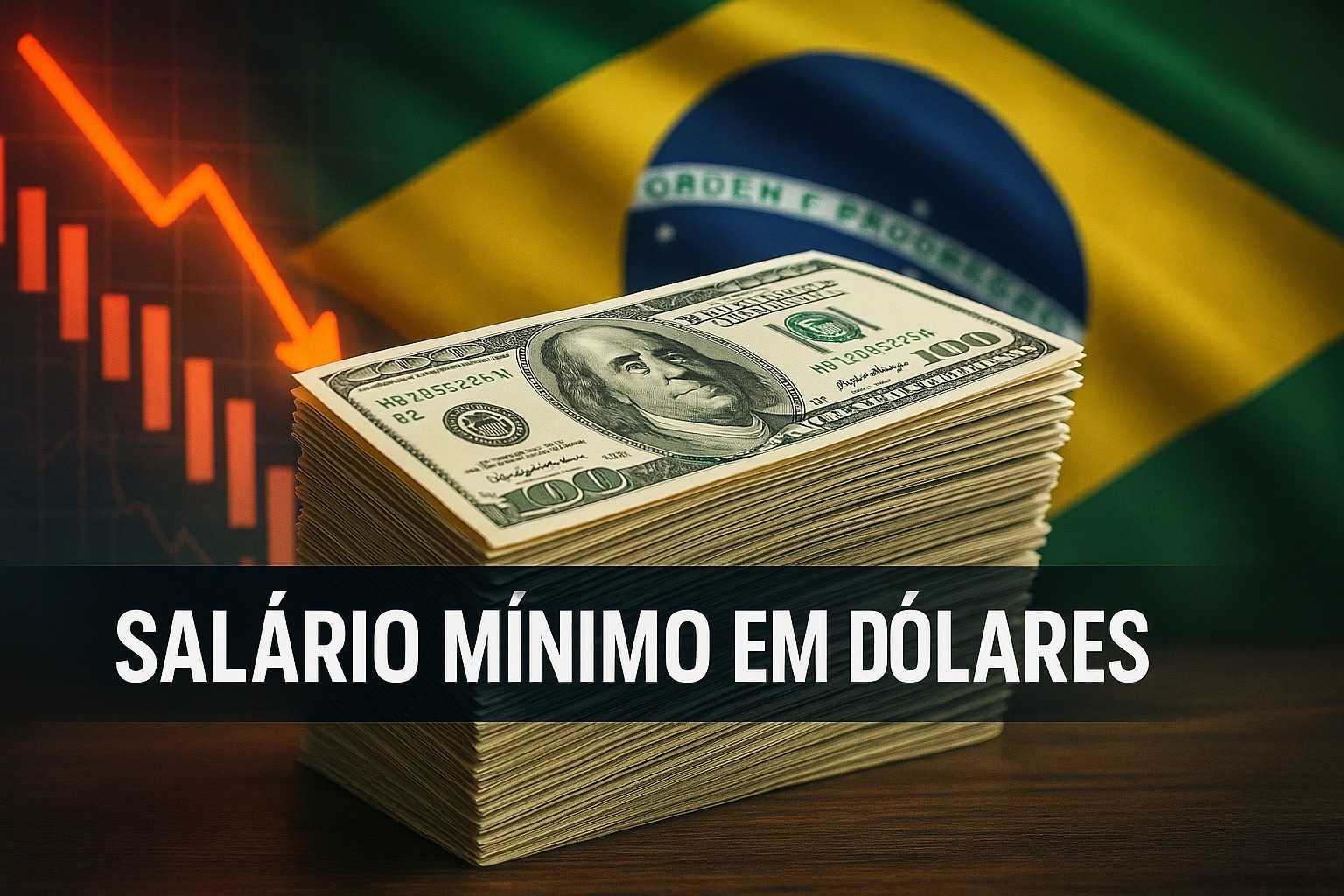
In 2017, The Minimum Wage Reached US$ 294, But Fell to US$ 199 During the Pandemic and Is Now Still Stagnant at US$ 262
The minimum wage is one of the main social and economic indicators in Brazil.
It directly impacts millions of workers, retirees, and beneficiaries of social programs. However, the analysis in reais often hides the international reality of purchasing power.
When converted to dollars, the Brazilian minimum reveals intense fluctuations that are not only linked to internal adjustment policies but also to exchange rate volatility.
-
São Paulo hides beneath the asphalt a project worth R$ 1.1 billion with 44.6 km of underground cables, energy from Itaipu, and a silent mission: to reinforce the ABC region of São Paulo.

-
Refrigeration technicians become a rare commodity in Brazil: the lack of qualified labor is already affecting air conditioning, supermarkets, hospitals, industries, and data centers, while salaries exceed R$ 4,400 in CLT positions, and the billion-dollar sector rushes to train new professionals.

-
After spending more than $4 million on a plot of land that remained vacant for over a decade, Dallas approved a village with 50 micro-homes for homeless veterans, rent-free housing, a community center, and support next to a veterans’ hospital.
-
Brazilian Army had R$ 1.5 billion planned for operations, but a Defense budget freeze halted actions at the borders against drugs, illegal mining, and factions.



In the last ten years, the trajectory shows nominal advances in reais, but significant losses in foreign currency, especially during periods of crisis. The table below summarizes the evolution between 2015 and 2025:
Table – Minimum Wage in Brazil in Reais and Dollars (2015–2025)
| Year | Minimum Wage (R$) | Average Exchange Rate (R$/US$) | Equivalent in US$ |
|---|---|---|---|
| 2015 | 788 | 3.33 | 236 |
| 2016 | 880 | 3.49 | 252 |
| 2017 | 937 | 3.19 | 294 |
| 2018 | 954 | 3.65 | 262 |
| 2019 | 998 | 3.93 | 254 |
| 2020 | 1,045 | 5.24 | 199 |
| 2021 | 1,100 | 5.40 | 204 |
| 2022 | 1,212 | 5.21 | 233 |
| 2023 | 1,320 | 4.99 | 262 |
| 2024 | 1,412 | 5.39 | 262 |
| 2025 | 1,518 | 5.80 | 262 |
From Appreciation to Collapse in Dollars
In 2015, the minimum wage was equivalent to US$ 236, reflecting a real weakened by the economic and political crisis. Despite this, it still represented a reasonable level against Brazil’s historical backdrop.
The peak in dollars occurred in 2017, when the minimum reached US$ 294, driven by a more favorable exchange rate.
But this improvement was temporary. Political instability, fiscal tensions, and currency devaluation once again pressured purchasing power in dollars.
In 2018, the minimum fell to US$ 262, and in 2019 it dropped to US$ 254, even with nominal increases in reais.
The Pandemic Shock and the Lowest Value in 10 Years
The year 2020 was the toughest in the series. With the Covid-19 pandemic, capital flight, and fiscal distrust, the real became one of the most devalued currencies in the world.
The minimum of R$ 1,045 was worth only US$ 199, the lowest level in the entire decade. For experts, this figure demonstrates how both external and internal crises can quickly erode income in international terms.
2021 to 2023: Slow Exchange Rate Recovery
In 2021 and 2022, the Brazilian minimum wage grew again in reais, but in dollars it remained at modest levels — US$ 204 and US$ 233, respectively.
Only in 2023, with a more favorable exchange rate, did the minimum wage return to US$ 262, approaching the values of 2018. Still, Brazilian workers have not recovered the peak of 2017.
2024 and 2025: Apparent Stability
In the last two years, the minimum wage advanced in reais to R$ 1,412 and R$ 1,518, but in dollars it remained stable around US$ 262.
This means that gains in national currency were virtually neutralized by exchange rate fluctuations.
The policy of adjustments limited to inflation ensured the maintenance of domestic purchasing power but did not increase its value in international terms.
What The Average Reveals
When calculating the average minimum wage in dollars over the decade, it amounts to US$ 243 per month. This figure is lower than what Latin American countries like Chile and Uruguay offer their workers.
This data exposes Brazil’s difficulty in translating nominal gains in reais into real gains in the international scenario.
Purchasing Power and Future Challenges
The comparison in dollars is relevant not only to measure the standard of living in relation to other countries but also because many inputs, technologies, and consumer goods are dollarized.
When the minimum wage falls in foreign currency, the impact is reflected in the prices of fuels, electronics, medications, and even imported foods.
Therefore, the Brazilian challenge goes beyond adjusting the minimum wage annually: it is necessary to ensure exchange rate stability and sustainable economic growth.
Only then will workers achieve consistent gains not only in reais but also in terms of global living standards.
The trajectory of the Brazilian minimum wage in dollars over the last ten years shows a harsh reality.
Despite annual adjustments, the international purchasing power of workers fluctuated intensely, even dropping to less than US$ 200 in 2020. Today, stabilized around US$ 260, the minimum is still far from the peak of 2017.
The most important figure is that, on average, Brazilian workers received US$ 243 per month over the last decade.
This reveals that, even with nominal advances in reais, international purchasing power has changed little.
The lesson is clear: without economic and exchange stability, the minimum wage will continue to be a fragile achievement.




-

1 person reacted to this.